

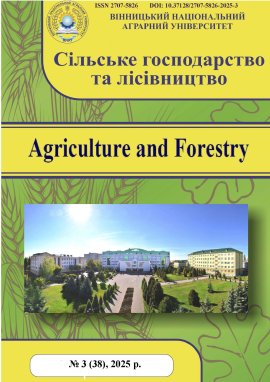
Issue №: 3 (38)
Publications contains the results of researches on optimization of technological methods of cultivation of crops, preservation of soil fertility, greening of agricultural production, modern directions of selection, reproduction of forest resources.
USEFUL ENTOMOPHAUNA PEA FIELD
Kryvenko Anna Ivanivna – Doctor of Agricultural Sciences, Professor, Head of the Department of Plant Protection, Genetics and Breeding of Odessa State Agrarian University (65039, Odessa, Kanatna St., 99, e-mail: kryvenko35@ukr.net).
Trandafir Iryna Vasylivna – postgraduate student at the Department of Plant Protection, Genetics and Breeding of Odessa State Agrarian University (65039, Odessa, Kanatna St., 99, e-mail: irinatra27@gmail.com).
Shushkivska Natalia Ivanivna – Associate Professor of the Department of Plant Production and Digital Technologies in Agronomy, Bila Tserkva Agrarian National University, (09117, Bila Tserkva, Soborna Square, 8/1, e-mail: shushkivska57@gmail.com).
Orekhivskyi Volodymyr Danylovych – Doctor of Historical Sciences, Senior Researcher, Department of Economic Research and Innovation Providing (85307, Donetsk region, Pokrovsk city, Zahisnykyv Ukrainy street, e-mail: orekhovskiy@gmail.com).
The article presents the results of a field study conducted by VIP-AGRO LLC in the Odessa region, investigating the taxonomic structure and abundance of beneficial entomofauna in the pea agrocenosis. The purpose of the study is to establish the complex of entomophages in the pea field agrocenosis in the Southern Steppe of Ukraine, determine the species composition and taxonomic structure of beneficial insects and the feasibility of using some species as biological agents in controlling the number of pests. The methodological basis of this study is: empirical (field experiments and observations), theoretical (formation of conclusions based on research results), statistical, mathematical. Analysis of the taxonomic structure and biocenotic relationships of arthropods in the pea field agrocenosis allowed us to identify the dominant species of phytophages and assess the effectiveness of entomophages in regulating their number in the conditions of the Southern Steppe of Ukraine. In pea crops in the Odessa region, 30 species of entomophages belonging to 8 families from 4 orders of the class Insecta were found. The most numerous in the agrocenosis of the pea field were predatory beetles from the family Coccinellidae, the share of which Carabidae was 24 and 32.2% of the total number of entomophages, respectively. Parasitic Hymenoptera hymenoptera made up 28.7% They are representatives of the families ichneumonids, braconids, aphidiids. Biocenotic ratios "entomophage: phytophage" in the phase of bean formation indicate the asynchrony of the dynamics of the development of beneficial and harmful fauna, which reduces the effectiveness of natural biological control. The most optimal ratio was recorded for turuns, however, it did not guarantee stable biological containment. The results of the research confirm the feasibility of implementing elements of integrated plant protection, focused on biological pest control and selective use of pesticides to maintain ecological balance in agrocenoses. It has been established that predatory and parasitic insects play an important role in the biological regulation of the number of phytophages. However, it has been determined that with the existing number of entomophages, the ratio "predator:prey" is insufficient to effectively restrain the reproduction of phytophages to a level below the economic threshold of harm (ETD).
1. Bilyk M.O. (2022). Biolohichnyi zakhyst roslyn vid shkidlyvykh orhanizmiv: pidruchnyk [Biological protection of plants against harmful organisms: a textbook]. [in Ukrainian].
2. Dolia M.M., Moroz S.Yu., Kostrych D.V., Mamchur R.M., Bobonych Ye.F. (2023). Populiatsiina adaptyvnist dominuiuchykh komakh-fitofahiv i entomofahiv za prohresyvnykh tekhnolohii zakhystu roslyn v Ukraini [Population adaptability of dominant phytophagous and entomophagous insects under progressive plant protection technologies in Ukraine]. Zroshuvane zemlerobstvo. Zbirnyk naukovykh prats. – Irrigated agriculture. Collection of scientific papers. № 79. 33–38. [in Ukrainian].
3. Berezovska-Bryhas V.V. (2016). Korysna entomofauna soievoho polia [Beneficial entomofauna of soybean fields]. Zakhyst i karantyn roslyn : mizhvid. temat. zb. − Plant protection and quarantine: interdisciplinary thematic collection. Issue 62. 48–57. [in Ukrainian].
4. Fedorenko V.P., Pokozii Y.T., Krut M.V. (2013). Entomolohiia [Entomology].
5. Lytvynova B.M., Yevtushenka M.D. (2005). Silskohospodarska entomolohiia: Pidruchnyk [Agricultural Entomology: Textbook]. [in Ukrainian].
6. Ruban M.B., Hadzalo Ya.M. (2008). Silskohospodarska entomolohiia: Pidruchnyk [Agricultural entomology: Textbook]. [in Ukrainian].
7. Tkachova S.V. (2012). Zakhyst posiviv soi vid shkidnykiv. [Protection of soybean crops from pests]. Ahronomiia sohodni – Agronomy today. July 7. https://agro-business.com.ua/agro/ahronomiia-sohodni/item/245-zakhyst-posiviv-soi-vid-shkidnykiv.html. [in Ukrainian].
8. Pryshchepa M.M., Serhieiev L.A., Konashchuk O.P. (2020). Vyroshchuvannia nasinnievoho horokhu na Pivdni Ukrainy [Growing seed peas in the South of Ukraine]. Ahronom – Agronomist. 16.01.2020 https://www.agronom. com.ua/vyroshhuvannya-nasinnyevogo-gorohu-na-pivdni-ukrayiny/ [in Ukrainian].
9. Omeliuta V.P., Hryhorovych I.V., Chaban V.S. (1986). Oblik shkidnykiv i khorob silskohospodarskykh kultur [Accounting for pests and diseases of agricultural crops]. [in Ukrainian].
10. Stankevych S.V., Hornovska S.V. (2022). Metody vyiavlennia, zboru ta zberihannia komakh: navch. posib. [Methods of detecting, collecting and storing insects: a teaching aid]. [in Ukrainian].
About the journal
Cluster Agricultural and veterinary sciences (H1 Agronomy, H4 Forestry)
Name of the publication «AGRICULTURE AND FORESTRY»
The aim of the journal "Agriculture and Forestry" is to highlight the results of fundamental and applied research in the fields of agriculture and forestry, aimed at improving the efficiency of agricultural production and introducing modern technologies into farming practice.
This goal defines the main objectives:
– to ensure the creation of open information access regarding the dissemination of relevant scientific research results to: lecturers of agricultural higher education institutions, postgraduate students, doctoral candidates, research staff, and agricultural production specialists;
– to promote the development of young scientists in agricultural sciences;
– to enhance communication between experienced researchers and young scientists in agronomy and forestry;
– to facilitate the expansion of ties between Vinnytsia National Agrarian University and domestic and foreign educational institutions, scientific establishments, and their academic communities.
The scientific, production, and educational journal "Agriculture and Forestry" is a peer-reviewed open-access publication that publishes original experimental research, theoretical and practice-oriented articles within the cluster of "Agricultural and Veterinary Sciences".
The journal's subject matter covers such areas as agronomy and forestry. Publications of scientific and practical significance address the experimental foundations of agricultural and forestry sector development, innovative production technologies, and the results of fundamental and applied research aimed at increasing productivity, product quality, and the sustainable development of natural and production systems.
Publisher: Vinnytsia National Agrarian University
EDRPOU code: 00497236
Publisher's ROR:05m3ysc06
Prefix DOI: 10.37128/
Frequency is quarterly
Publication languages: (Ukrainian, English)
Media ID R30-05174.
Editor in Chief Ihor Didur
According to the order of the Ministry of Education and Science of Ukraine dated 17.03.2020 № 409. The journal Agriculture and Forestry is included in the List of scientific professional publications of Ukraine Category "B" in agricultural sciences (specialties) - 101, 201, 202, 203, 205, 206.
State registration: Decision of the National Council of Ukraine on Television and Radio Broadcasting No. 1337 and No. 1181. Media identifier – R30-05174.
Scientific journal "AGRICULTURE AND FORESTRY" was founded in 1995; it was entitled as Bulletin of Vinnytsya State Agricultural Institute.
In 2010-2014 was enritled as Collection of scientific works of Vinnytsia National Agrarian University.
It has been named as Agriculture and Forestry since 2015.
Listed in the updated list of scientific professional editions of Ukraine on agricultural sciences under the name Agriculture and Forestry (Order of the Ministry of Education and Science of Ukraine of May 16, 2016; No. 515).
Since 2015, "Agriculture and Forestry". (archive of previous issues for 2015-2019) at http://forestry.vsau.edu.ua/.
The journal “Agriculture and Forestry (ISSN: 2707-5826)” passed the evaluation process of Index Copernicus positively and is indexed in the database of ICI Journals Master List ICV for 2018, 2019, 2020, 2021, 2022, 2023, 2024 is presented in the full list of indexed journals in the Master List International List
ICI Journals Master List Value
