

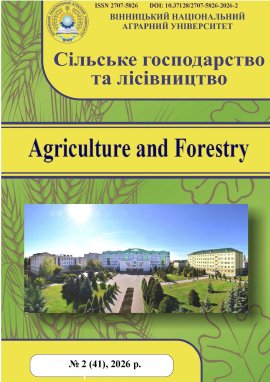
Issue №: 2 (41)
This issue of the journal is dedicated to current issues in improving technological methods for crop cultivation. Significant attention is given to the specifics of growing vegetable, grain and leguminous crops, which play a vital role in ensuring the state's food security. The scientific publications present the results of experimental research on the production of organic leguminous products, the importance of adaptive breeding to increase the resilience of agrocenoses, plant protection against harmful objects and the application of fertilizers to increase crop yields. Certain papers are devoted to the implementation of innovative methods for stimulating the seed productivity of forest seed plantations.
THE ROLE OF ORGANIC SOYBEAN IN ENSURING EUROPE'S FOOD SECURITY
Jolanta Puczel, dr inż. International Academy of Applied Sciences in Łomża, Poland, jolanta.puczel@wp.pl, ORCID: https://orcid.org/0009-0009-1713-7058.
Bronisław Puczel, dr inż. International Academy of Applied Sciences in Łomża, Poland, bronekpuczel@gmail.com, ORCID: https://orcid.org/0009-0008- 5097-9639.
This article examines the issue of ensuring food security through the use of soybeans, the most widely grown legume crop. This question is increasingly being raised by EU farmers and policymakers: can organic soybeans realistically reduce the European Union’s dependence on imported protein? The article presents production trends for this crop from 2017 to 2022, specifically the expansion of organic soybean acreage from 60,000 to 155,000 hectares, a 94% increase in production, yet the EU’s self-sufficiency rate did not rise; on the contrary, it fell from 64% to 61%, while the demand grew more rapidly. Key agronomic constraints have been identified – lower yields under rainfed conditions (3.1 vs. 3.5 t/ha compared to North America), a shortage of specialized varieties, and vulnerability to droughts. In conclusion: organic soybeans are of strategic importance for Europe’s food security, but realizing this potential without targeted breeding, the development of supply chains, and effective support within the CAP is not possible. The EU regulatory framework is one of the most supportive in the world for the development of organic production. The “Farm to Fork” Strategy, the Organic Action Plan, the CAP 2023–2027, and the EUDR together form a powerful set of incentives and commitments. The question is whether farmers and processors will be able to translate these incentives into concrete production results by 2030. Agronomic challenges are real and will not disappear on their own. Lower yields under rain-fed conditions, the difficulty of weed control, climate instability, and a lack of the specialized varieties – all these problems require targeted scientific and practical solutions. Public funding for breeding programs focused on organic farming is of special attention. Market conditions remain attractive for those willing to invest in quality and supply chain transparency. The premium for organic and non-GM soybeans, coupled with the growth in the food market segment and the EUDR, collectively create a long-term demand capable of offsetting higher production costs.
1. Petrychenko V., Kobak S., Kolisnyk S., Chorna V., Korniychuk O., Pantsyrev O. (2024). Agroecological Assessment of Soybean Varieties under the Conditions of the Right Bank Forest Steppe of Ukraine. Journal of Ecological Engineering. Vol. 25, Issue 9, P. 60–69. DOI: https://doi.org/10.12911/ 22998993/190492. [in English].
2. Katsoulas N., Stanghellini C. (2019). Modelling Crop Transpiration in Greenhouses: Different Models for Different Applications. Agronomy. Vol. 9, Issue 7. 392 р. DOI: 10.3390/agronomy9070392 [in English].
3. Pantsyreva H.V. (2025). Rozrobka bioorganicnoi tekhnolohii vyroshchuvannia silskohospodarskykh kultur za vykorystannia biodobryv, pozakorenievykh pidzhyven i fizyolohichno-aktyvnykh rechovyn [Development of bio-organic cultivation technology of agricultural crops using biofertilizers, foliar feeding and physiologically active substances]. Agrarni innovatsii − Agrarian innovations. 29. DOI: https://doi.org/10.32848/agrar.innov.2025.29.17 [in Ukrainian].
4. Mazur V., Didur І., Tkachuk О., Pantsyreva Н., Ovcharuk V. (2021). Agroecological stability of cultivars of sparsely distributed legumes in the context of climate change. Scientific Horizons. Vol. 24, № 1. Р. 54-60. DOI: https://doi.org/10.48077/scihor.24(1).2021.54-60 [in English].
5. Mazur O., Mazur O., Tymoshchuk T., Didur I., Tsyhanskyi V. (2024). Study of legume-rhizobia symbiosis in soybean for agroecosystem resilience. Scientific Horizons. Vol. 27, № 11. Р. 68-89. DOI: 10.48077/scihor11.2024.68 [in English].
6. Petrychenko V., Lykhochvor V., Didur I., Pantsyreva H. Scientific aspects of organic soy productionin Ukraine. Chemistry-Didactics-Ecology-Metrology. 2024. Vol. 29, Issue 1-2. P. 111-121. DOI: 10.2478/cdem-2024-0008 [in English].
7. Didur I., Bakhmat M., Сhynchyk O., Pantsyreva H., Telekalo N., Tkachuk O. (2020). Substantiation of agroecological factors on soybean agrophytocenoses by analysis of variance of the Right-Bank Forest-Steppe in Ukraine. Ukrainian Journal of Ecology. Vol. 10, № 5. Р. 54-61. DOI: 10.15421/2020_206. [in English].
8. Mazur V.A., Tkachuk O.P., Didur I.M., Pantsyreva H.V. (2021). Osoblyvosti tekhnolohii vyroshchuvannia maloposhyrenykh zernobobovykh kultur, monohrafiia. [Peculiarities of the technology of growing rare legume crops, monograph]. Vinnytsia: VNAU. [in Ukrainian].
9. Mazur V.A., Didur I.M., Tsyhanskyi V.I., Malamura S.V. (2020). Formuvannia produktyvnosti hibrydiv soniashnyka zalezhno vid rivnia udobrennia ta umov zvolozhennia. [Formation of productivity of sunflower hybrids depending on the level of fertilization and moisture conditions]. Silske hospodarstvo ta lisivnytstvo – Agriculture and Forestry. (4) 19. DOI: https://doi.org/10.37128/2707-5826-2020-4-19 [in Ukrainian].
10. Tkachuk O.P., Mazur O.V. (2025). Ekolohichnyi analiz osnovnykh polozhen novoho poriadku provedennia monitorynhu zemel i gruntiv v Ukraini. [Ecological analysis of the main provisions of the new procedure for monitoring lands and soils in Ukraine]. Ekolohichni nauky – Ecological Sciences. 1 (58). DOI: https://doi.org/10.32846/2306-9716/2025.eco.1-58.28 [in Ukrainian].
About the journal
Cluster Agricultural and veterinary sciences (H1 Agronomy, H4 Forestry)
Name of the publication «AGRICULTURE AND FORESTRY»
The aim of the journal "Agriculture and Forestry" is to highlight the results of fundamental and applied research in the fields of agriculture and forestry, aimed at improving the efficiency of agricultural production and introducing modern technologies into farming practice.
This goal defines the main objectives:
– to ensure the creation of open information access regarding the dissemination of relevant scientific research results to: lecturers of agricultural higher education institutions, postgraduate students, doctoral candidates, research staff, and agricultural production specialists;
– to promote the development of young scientists in agricultural sciences;
– to enhance communication between experienced researchers and young scientists in agronomy and forestry;
– to facilitate the expansion of ties between Vinnytsia National Agrarian University and domestic and foreign educational institutions, scientific establishments, and their academic communities.
The scientific, production, and educational journal "Agriculture and Forestry" is a peer-reviewed open-access publication that publishes original experimental research, theoretical and practice-oriented articles within the cluster of "Agricultural and Veterinary Sciences".
The journal's subject matter covers such areas as agronomy and forestry. Publications of scientific and practical significance address the experimental foundations of agricultural and forestry sector development, innovative production technologies, and the results of fundamental and applied research aimed at increasing productivity, product quality, and the sustainable development of natural and production systems.
Publisher: Vinnytsia National Agrarian University
EDRPOU code: 00497236
Publisher's ROR:05m3ysc06
Prefix DOI: 10.37128/
Frequency is quarterly
Publication languages: (Ukrainian, English)
Media ID R30-05174.
Editor in Chief Ihor Didur
According to the order of the Ministry of Education and Science of Ukraine dated 17.03.2020 № 409. The journal Agriculture and Forestry is included in the List of scientific professional publications of Ukraine Category "B" in agricultural sciences (specialties) - 101, 201, 202, 203, 205, 206.
State registration: Decision of the National Council of Ukraine on Television and Radio Broadcasting No. 1337 and No. 1181. Media identifier – R30-05174.
Scientific journal "AGRICULTURE AND FORESTRY" was founded in 1995; it was entitled as Bulletin of Vinnytsya State Agricultural Institute.
In 2010-2014 was enritled as Collection of scientific works of Vinnytsia National Agrarian University.
It has been named as Agriculture and Forestry since 2015.
Listed in the updated list of scientific professional editions of Ukraine on agricultural sciences under the name Agriculture and Forestry (Order of the Ministry of Education and Science of Ukraine of May 16, 2016; No. 515).
Since 2015, "Agriculture and Forestry". (archive of previous issues for 2015-2019) at http://forestry.vsau.edu.ua/.
The journal “Agriculture and Forestry (ISSN: 2707-5826)” passed the evaluation process of Index Copernicus positively and is indexed in the database of ICI Journals Master List ICV for 2018, 2019, 2020, 2021, 2022, 2023, 2024 is presented in the full list of indexed journals in the Master List International List
ICI Journals Master List Value
