

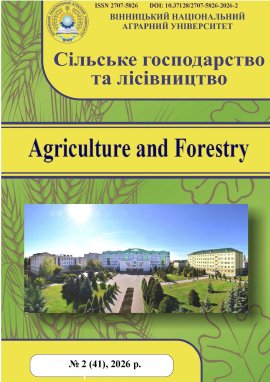
Issue №: 2 (41)
This issue of the journal is dedicated to current issues in improving technological methods for crop cultivation. Significant attention is given to the specifics of growing vegetable, grain and leguminous crops, which play a vital role in ensuring the state's food security. The scientific publications present the results of experimental research on the production of organic leguminous products, the importance of adaptive breeding to increase the resilience of agrocenoses, plant protection against harmful objects and the application of fertilizers to increase crop yields. Certain papers are devoted to the implementation of innovative methods for stimulating the seed productivity of forest seed plantations.
THE EFFECT OF SOIL HERBICIDES AND PRE-SOWING SEED TREATMENT ON THE CHICKPEA (CICER ARIETINUM) GROWTH AND YIELD
Shcatula Yurii, Candidate of Agricultural Sciences, Associate of Professor of the department of agriculture, soil science and agrochemistry of Vinnytsia National Agrarian University (21008, Vinnytsia, Sonaychna St. 3, e-mail: shkatula@vsau.vin.ua, ORCID: https://orcid.org/0000-0002-4275-309X).
Tatiana Zabarna, Candidate of Agricultural Sciences (PhD), Senior Lecturer of the Department of Soil Management, Soil Science and Agrochemistry, Vinnytsia National Agrarian University (21008, Vinnytsia, Soniachna Str.3, е-mail: zabarna-tanja@ukr.net, ORCID: https://orcid.org/0000-0002-6796-7625).
Chickpeas are one of the oldest leguminous crops and are currently widely used both for human consumption and as animal feed. Their biological characteristics, in particular their high resistance to drought, high temperatures and even brief cold spells, make it possible to achieve stable yields in regions with unfavourable climatic conditions. In terms of nutritional value, chickpea seeds occupy an important place among other crops, as they contain significant amounts of protein, lipids and carbohydrates, and are rich in minerals and bioactive compounds. This makes them a promising source of plant protein and an important component in addressing food security issues. The low yield of this crop is often due to failure to adhere to the basic principles of cultivation technology. A key role is played by the plant protection system, which involves the timely control of harmful organisms, including weeds. Weed infestation is a common problem for all agricultural ecosystems, and chickpea crops are no exception. In the early stages of development, plants grow slowly, which significantly reduces their ability to compete with weeds. At this time, weeds grow rapidly, utilising available resources more efficiently than the crop plants. The composition and prevalence of weeds in chickpea crops can vary significantly depending on specific growing conditions. This is influenced by climatic factors, soil type, previous crops and the specific agronomic practices employed on the farm. Soil herbicides play a critical role in weed management in chickpea cultivation. When used judiciously, they can enhance weed control and contribute to increased chickpea yield. The purpose of this study was to investigate the growth, development and productivity of chickpea depending on the treatment with biological preparations and chemical protection against weeds in the conditions of the Vinnytsia region, Ukraine. The highest chickpea seeds yield was noted in 2025 in the variant where chickpea seeds were treated with both inoculant and biofungicide substance before sowing and the soil herbicide Frontier® Optima 72 EC was applied, and the yield was 2.54 (t ha-1). The lowest level of the yield 0.55 (t ha-1) was noted in the control I on average years of experiments. Treatment of chickpea seeds with Rhizobophyte inoculant and biofungicide Biopolycide with the further application of the soil herbicide Frontier® Optima 72 EC provided to obtain the yield of chickpea seeds at the level of 2.28 (t ha-1), which was more than in the control sites at 1.73 (t ha-1). The average yield of chickpeas during the years of experiments was 2.23 (t ha-1), and it did not differ significantly on similar options, but with the use of the soil herbicide Harness® 90 EC.
1. Khan I., Khan M.I., Hashim S., Fawad M., Jamal A., Seleiman M.F., Khan H., Gul B., Hussain Z., Saeed M.F., Scavo A. (2023). Managing Weed-Crop Interactions Enhances Chickpea (Cicer arietinum L.) Chemical Components. Plants (Basel). Vol. 12, Issue 17. 3073. DOI: https://doi.org/10.3390/plants12173073. [in English].
2. Machado R.G., E.L.S. de Sá L. Hahn S. Oldra J.F.M. dos Passos B.D.O. Filho M.R.D. Stroschein and W.R. da Silva. (2016). Rhizobia Symbionts of Legume Forages Native to South Brazil as Promoters of Cultivated Grass Growing. International Journal of Agriculture and Biology. Vol. 18(5), P. 1011-1016. DOI: 10.17957/IJAB/15.0201. [in English].
3. Shkatula Yu.M., Votyk V.O., Kuzemskyi V.M. (2024). Osnovni tekhnolohichni zakhody pry vyroshchuvanni nutu v umovakh Lisostepu Pravoberezhnoho. [Key cultivation practices for growing chickpeas in the Right-Bank Forest-Steppe region]. Silske hospodarstvo ta lisivnytstvo– Agriculture and forestry. 3 (34). DOI: https://doi.org/10.37128/2707-5826-2024-3-10 [in Ukrainian].
4. Shkatula Yu.M, Votyk V.O. (2024). Ekonomichnyi ta enerhetychnyi analiz efektyvnosti vyroshchuvannia nutu za dii biolohichnykh preparativ i herbitsydiv. [Economic and energy analysis of the efficiency of chickpea cultivation under the influence of biological preparations and herbicides]. Silske hospodarstvo ta lisivnytstvo – Agriculture and forestry. 1 (32). DOI: https://doi.org/10.37128/2707-5826-2024-1-11[in Ukrainian].
5. Mahajan G., Chauhan B.S. (2022). The first report of chickpea (cicer arietinum L.) tolerance to paraquat in australia. Frontiers in agronomy. Vol. 4. DOI: https://doi.org/10.3389/fagro.2022.969960 [in English].
6. Boydston R.A., Nelson H., Chaves-Cordoba B. (2017). Tolerance of chickpeas to postemergence broadleaf herbicides. Weed technology. Vol. 32, Issue 2. P. 190–194. DOI: https:// doi.org/10.1017/wet.2017.99. [in English].
7. Koloianidi N.O., Hyrlia L.M., Ruryk V.V. (2024). Vplyv herbitsydiv na urozhainist sortiv nutu v umovakh pivdnia Ukrainy [The effect of herbicides on the yield of chickpea varieties in southern Ukraine]. Ahrarni innovatsii – Agricultural innovations. 28. DOI: https://doi.org/10.32848/agrar.innov.2024.28.29 [in Ukrainian].
8. Shkatula Yu.M., Votyk V.O. (2023). Fenolohichni sposterezhennia za fazamy rostu i rozvytku sortiv nutu [Phenological observations of the growth and development stages of chickpea varieties]. Naukovi dopovidi NUBIP Ukrainy – Scientific Reports of the National University of Life and Environmental Sciences of Ukraine. 1 (101). DOI: https://doi.org/10.31548/dopovidi1(101).2023.007. [in Ukrainian].
9. Pantsyreva H.V. (2024). Osoblyvosti formuvannia urozhainosti ta yakosti nasinnievoi produktsii nutu v umovakh Pravoberezhnoho Lisostepu Ukrainy. [Features of yield formation and seed quality of chickpeas in the conditions of the Right-Bank Forest-Steppe of Ukraine.]. Zbalansovane pryrodokorystuvannia – Balanced Nature Management. 1. 90-94. DOI: 10.33730/2310-4678.1.2024.302630 [in Ukrainian].
10. Mazur V.A., Didur I.M., Pantsyreva H.V., Mordvaniuk M.O. (2022). Enerhetychna efektyvnist tekhnolohichnykh pryiomiv vyroshchuvannia nutu v umovakh zminy klimatu [Energy efficiency of chickpea cultivation techniques under climate change conditions]. Silske hospodarstvo ta lisivnytstvo – Agriculture and forestry. 2 (25) DOI: 10.37128/2707-5826-2022-2-1 [in Ukrainian].
11. Shkatula Yu.M., Votyk V.O. (2020). Kontroliuvannia burianiv v ahrotsenozakh nutu [Weed control in chickpea agrocenoses]. Silske hospodarstvo ta lisivnytstvo – Agriculture and forestry. 4 (19). DOI: https://doi.org/10.37128/2707-5826-2020-4-12 [in Ukrainian].
12. Didur I.M., Tkachuk O.P., Pantsyreva H.V., Volynets Ye.O. (2025). Naukove obhruntuvannia shliakhiv pidvyshchennia produktyvnosti nutu zvychainoho (Cicer Arietinum L.) v umovakh pravoberezhnoho Lisostepu Ukrainy. [Scientific justification of methods for increasing the productivity of common chickpea (Cicer Arietinum L.) in the conditions of the Right-Bank Forest-Steppe of Ukraine.]. Vinnytsia. TVORY, 200 s. [in Ukrainian].
About the journal
Cluster Agricultural and veterinary sciences (H1 Agronomy, H4 Forestry)
Name of the publication «AGRICULTURE AND FORESTRY»
The aim of the journal "Agriculture and Forestry" is to highlight the results of fundamental and applied research in the fields of agriculture and forestry, aimed at improving the efficiency of agricultural production and introducing modern technologies into farming practice.
This goal defines the main objectives:
– to ensure the creation of open information access regarding the dissemination of relevant scientific research results to: lecturers of agricultural higher education institutions, postgraduate students, doctoral candidates, research staff, and agricultural production specialists;
– to promote the development of young scientists in agricultural sciences;
– to enhance communication between experienced researchers and young scientists in agronomy and forestry;
– to facilitate the expansion of ties between Vinnytsia National Agrarian University and domestic and foreign educational institutions, scientific establishments, and their academic communities.
The scientific, production, and educational journal "Agriculture and Forestry" is a peer-reviewed open-access publication that publishes original experimental research, theoretical and practice-oriented articles within the cluster of "Agricultural and Veterinary Sciences".
The journal's subject matter covers such areas as agronomy and forestry. Publications of scientific and practical significance address the experimental foundations of agricultural and forestry sector development, innovative production technologies, and the results of fundamental and applied research aimed at increasing productivity, product quality, and the sustainable development of natural and production systems.
Publisher: Vinnytsia National Agrarian University
EDRPOU code: 00497236
Publisher's ROR:05m3ysc06
Prefix DOI: 10.37128/
Frequency is quarterly
Publication languages: (Ukrainian, English)
Media ID R30-05174.
Editor in Chief Ihor Didur
According to the order of the Ministry of Education and Science of Ukraine dated 17.03.2020 № 409. The journal Agriculture and Forestry is included in the List of scientific professional publications of Ukraine Category "B" in agricultural sciences (specialties) - 101, 201, 202, 203, 205, 206.
State registration: Decision of the National Council of Ukraine on Television and Radio Broadcasting No. 1337 and No. 1181. Media identifier – R30-05174.
Scientific journal "AGRICULTURE AND FORESTRY" was founded in 1995; it was entitled as Bulletin of Vinnytsya State Agricultural Institute.
In 2010-2014 was enritled as Collection of scientific works of Vinnytsia National Agrarian University.
It has been named as Agriculture and Forestry since 2015.
Listed in the updated list of scientific professional editions of Ukraine on agricultural sciences under the name Agriculture and Forestry (Order of the Ministry of Education and Science of Ukraine of May 16, 2016; No. 515).
Since 2015, "Agriculture and Forestry". (archive of previous issues for 2015-2019) at http://forestry.vsau.edu.ua/.
The journal “Agriculture and Forestry (ISSN: 2707-5826)” passed the evaluation process of Index Copernicus positively and is indexed in the database of ICI Journals Master List ICV for 2018, 2019, 2020, 2021, 2022, 2023, 2024 is presented in the full list of indexed journals in the Master List International List
ICI Journals Master List Value
