

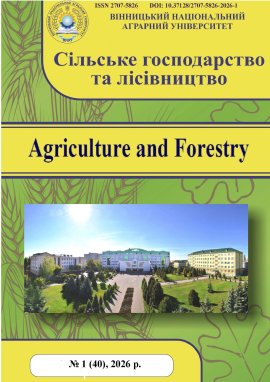
Issue №: 1 (40)
This issue of the journal is devoted to current issues related to the optimization of technological elements in the cultivation of agricultural crops. Considerable attention is paid to the specific features of growing vegetable and cereal crops, which play an important role in ensuring the state’s food security. The scientific publications present research results on the role of leguminous crops in improving soil fertility, the development of domestic and international adaptive breeding, as well as the application of mineral and foliar fertilization to increase the productivity of agroecosystems. Separate studies are devoted to improving the efficiency of forest management and to issues related to landscape greening.
SUBSTITUTION OF THE TECHNOLOGY OF TOMATO GROWING USING VARIOUS METHODS OF OBTAINING SEEDLINGS
Ihor Didur, Doctor of Agricultural Sciences, Professor, Acting the director of the Institute of Agricultural Technologies and Nature Management of the Vinnytsia National Agrarian University (21008, Soniachna Str. 3, Vinnytsia, email: e-mail: ascience@ukr.net; ORCID: https://orcid.org/0000-0002-6612-6592).
Tetiana Aralova, PhD in Agricultural Sciences, Senior Lecturer Department of Botany, Genetics and Plant Protection, Faculty of Agronomy, Horticulture and Plant Protection, Educational and Scientific Institute of Agrotechnology and Environmental Management, Vinnytsia National Agrarian University (21008, 1 Soniachna Str., Vinnytsia, Ukraine; e-mail: aralova.t@ukr.net; ORCID: https://orcid.org/0000-0002-9013-3979).
The article presents the results of research on the effectiveness of tomato growing technologies using different methods of obtaining seedlings in the greenhouse conditions of the Vinnytsia National Agrarian University. The aim of the work was to carry out a comprehensive analysis of the feasibility of tomato growing technologies, taking into account plant productivity and their marketability. The research was conducted during 2024–2025 on the basis of the greenhouse of the Educational and Scientific Institute of Agrotechnology and Environmental Management. The experimental design involved comparing two options: non-transshipment and transshipment. The experiment was conducted with three repetitions, and the placement of options was randomized. For growing seedlings, a peat substrate «Jifi» with optimized physicochemical indicators, including an adjustable pH level and nutrient content, was used. Seed sowing was carried out semi-automatically, observing the recommended density. During the growing period, optimal conditions of temperature, air humidity and substrate were maintained in accordance with the biological needs of the crop. Watering and fertilizing were carried out according to standard recommendations for greenhouse vegetable growing. During the research, biometric indicators of plants were recorded, tomato yield was determined and their marketability was assessed. The obtained experimental data were processed using mathematical statistics methods with the determination of average values and variation indicators. The research results showed a significant impact of the method of growing seedlings on the formation of yield. Plants without transshipment yielded 80.08 t/ha in 2024 and 85.41 t/ha in 2025 (average 84.25 t/ha). With the transshipment method, the corresponding indicators were 89.09 t/ha and 95.65 t/ha (average 92.37 t/ha). This indicates that transshipment contributes to increasing plant productivity and forms a larger gross harvest. Analysis of the commercial characteristics of fruits showed that the transshipment method improves product quality: the share of marketable fruits increases to 87% compared to 78% in the non-transshipment method, and substandard fruits decrease from 22% to 13%. The average fruit weight increases from 84g to 96g, the dry matter content reaches 5.7 Bx, and the share of fruits with a cuboid-round shape is 92% compared to 85% in the control. For cherry tomatoes, the weight of fruits from one plant with the transshipment method increases to 580 g compared to 480 g in the non-transshipment method, the average fruit weight increases from 20 g to 25 g, and the number of fruits on the plant practically does not change – 24-25 fruits. This indicates the preservation of plant productivity with an increase in fruit weight and improvement in crop marketability. The results obtained confirm that the transshipment method of growing tomato seedlings F1 1015 increases both quantitative and qualitative yield indicators, contributes to increasing the marketability of products and the economic efficiency of cultivation in greenhouse conditions.
1. Al-Dairi M., Pathare P.B., Al-Yahyai R. (2021). Effect of postharvest transport and storage on color and firmness quality of tomato. Horticulturae. Vol. 7. (7). P. 163. DOI: https:// doi.org/10.3390/horticulturae7070163 [in English].
2. Rempelos L., Barański M., Sufar E. K., Gilroy J., Shotton P., Leifert H., Leifert C. (2023). Effect of climatic conditions, and agronomic practices used in organic and conventional crop production on yield and nutritional composition parameters in potato, cabbage, lettuce and onion; results from the long-term NFSCtrials. Agronomy, 13 (5), P. 1225. DOI: https://doi.org/10.3390/agronomy 13051225. [in English].
3. Liu Y., Sun Y., Ye M., Zhu L., Zhang L., Zhu S. (2021). Improvement in storage quality of postharvest tomato fruits by nitroxyl liposomes treatment. Food chemistry. 359. P. 129933. DOI: https://doi.org/10.1016/j.foodchem.2021.129933 [in English].
4. Amons S. E. (2021). Stan ta perspektyvy rozvytku vyrobnytstva orhanichnoi produktsii v Ukraini [The state and prospects for the development of organic production in Ukraine]. Silske hospodarstvo ta lisivnytstvo − Agriculture and forestry. 3 (22). DOI: https://doi.org/10.37128/2707-5826-2021-3-18 [in Ukrainian].
5. Mourão I., Teixeira J., Brito L.M., Ferreira M.E., Moura M.L. (2014). Pruning system effect on greenhouse grafted tomato yield and quality. Rahmann G. & Aksoy U. (Eds.) Proceedings of the 4th ISOFAR Scientific Conference. ‘Building Organic Bridges’, at the Organic World Congress, 13-15 Oct., Istanbul, Turkey (eprint ID 24059), P. 941-944. DOI: 10. 3220/REP_20_1_2014 [in English].
6. Semenchenko O., Melnyk O., Zavertaliuk V., Pastukhov V. (2021). Vrozhainist ta yakist plodiv tomata zalezhno vid ushchilnennia posiviv za kraplynnoho zroshennia u Pivnichnomu Stepu Ukrainy [Yield and quality of tomato fruits depending on crop density under drip irrigation in the Northern Steppe of Ukraine]. Ahrarni innovatsii − Agrarian Innovations, 6. DOI: https://doi.org/ 10.32848/agrar.innov.2021.6.7 [in Ukrainian].
7. Venglinsky M.O., Glushchenko M.K., Hodynchuk N.V., Khmara T.I. (2014). Rol mikroelementiv v zhyvlenni ros-lyn i polipshenni rodiuchosti gruntu. [The role of trace elements in plant nutrition and improved soil fertility]. Visnyk Natsionalnoho universytetu vodnoho hospodarstva ta pryrodo-korystuvannia. Ser.: Silskohospodarski nauky − Bulletin of the National University of Water Management and Nature Management. Ser.: Agricultural Sciences. DOI: 10.32412/ 2306-5478- (1)2014.026 [in Ukrainian].
8. Didur I., Vdovenko S., Tkachuk O., Palamarchuk I., Pantsyreva H., Chabaniuk Ya., Shkatula Yu., Zabarna T., Gucol, G. (2024). Cultivation of tomatoes using mycorrhizal biological preparations. Modern Phytomorphology, 18, P. 133–138. DOI:10.5281/zenodo.200121 [in English].
9. Metodyka doslidnoi spravy v ovochivnytstvi i bashtannytstvi (2001). [Research methodology in vegetable and melon growing]. za red. H.L. Bondarenka, K.I. Yakovenka. Kharkiv: Osnova, 369 [in Ukrainian]
10. Katsoulas N., Stanghellini C. (2019). Modelling Crop Transpiration in Greenhouses: Different Models for Different Applications. Agronomy. Vol. 9. 392 р. DOI: 10.3390/ agronomy 9070392 [in English].
About the journal
Cluster Agricultural and veterinary sciences (H1 Agronomy, H4 Forestry)
Name of the publication «AGRICULTURE AND FORESTRY»
The aim of the journal "Agriculture and Forestry" is to highlight the results of fundamental and applied research in the fields of agriculture and forestry, aimed at improving the efficiency of agricultural production and introducing modern technologies into farming practice.
This goal defines the main objectives:
– to ensure the creation of open information access regarding the dissemination of relevant scientific research results to: lecturers of agricultural higher education institutions, postgraduate students, doctoral candidates, research staff, and agricultural production specialists;
– to promote the development of young scientists in agricultural sciences;
– to enhance communication between experienced researchers and young scientists in agronomy and forestry;
– to facilitate the expansion of ties between Vinnytsia National Agrarian University and domestic and foreign educational institutions, scientific establishments, and their academic communities.
The scientific, production, and educational journal "Agriculture and Forestry" is a peer-reviewed open-access publication that publishes original experimental research, theoretical and practice-oriented articles within the cluster of "Agricultural and Veterinary Sciences".
The journal's subject matter covers such areas as agronomy and forestry. Publications of scientific and practical significance address the experimental foundations of agricultural and forestry sector development, innovative production technologies, and the results of fundamental and applied research aimed at increasing productivity, product quality, and the sustainable development of natural and production systems.
Publisher: Vinnytsia National Agrarian University
EDRPOU code: 00497236
Publisher's ROR:05m3ysc06
Prefix DOI: 10.37128/
Frequency is quarterly
Publication languages: (Ukrainian, English)
Media ID R30-05174.
Editor in Chief Ihor Didur
According to the order of the Ministry of Education and Science of Ukraine dated 17.03.2020 № 409. The journal Agriculture and Forestry is included in the List of scientific professional publications of Ukraine Category "B" in agricultural sciences (specialties) - 101, 201, 202, 203, 205, 206.
State registration: Decision of the National Council of Ukraine on Television and Radio Broadcasting No. 1337 and No. 1181. Media identifier – R30-05174.
Scientific journal "AGRICULTURE AND FORESTRY" was founded in 1995; it was entitled as Bulletin of Vinnytsya State Agricultural Institute.
In 2010-2014 was enritled as Collection of scientific works of Vinnytsia National Agrarian University.
It has been named as Agriculture and Forestry since 2015.
Listed in the updated list of scientific professional editions of Ukraine on agricultural sciences under the name Agriculture and Forestry (Order of the Ministry of Education and Science of Ukraine of May 16, 2016; No. 515).
Since 2015, "Agriculture and Forestry". (archive of previous issues for 2015-2019) at http://forestry.vsau.edu.ua/.
The journal “Agriculture and Forestry (ISSN: 2707-5826)” passed the evaluation process of Index Copernicus positively and is indexed in the database of ICI Journals Master List ICV for 2018, 2019, 2020, 2021, 2022, 2023, 2024 is presented in the full list of indexed journals in the Master List International List
ICI Journals Master List Value
