

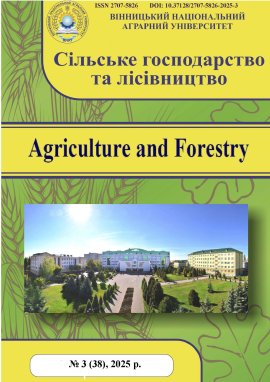
Issue №: 3 (38)
Publications contains the results of researches on optimization of technological methods of cultivation of crops, preservation of soil fertility, greening of agricultural production, modern directions of selection, reproduction of forest resources.
SUBSTANTIATION OF THE INFLUENCE OF SEED SOWING TIMES ON THE PRODUCTIVITY AND QUALITY OF BEAN GRAIN IN OPEN GROUND
Hetman Nadiia Yakivna − Doctor of Agricultural Sciences, Senior Lecturer of the Department of Crop Production and Horticulture, Vinnytsia National Agrarian University, 3 Sonyachna St., Vinnytsia, Ukraine, 21008).
Yevgeny Vasilievish Gyk - graduate student of the Department of Plant Production and Horticulture, Vinnytsia National Agrarian University (21008, Vinnytsia, Sonyachna St., 3. е-mail: zjenya.guk@ukr.net).
The article evaluates different sowing dates of bean seeds on their productivity and crop quality in the conditions of the Forest-Steppe of Right-Bank Ukraine. The research was conducted during 2023-2024 using the following varieties of common beans of medium ripening period, namely: Slaviya, Ros, Fayny Yas. Plants of the Slaviya variety were selected as the control. Seeds of bean varieties were sown in three terms: 1st, 2nd and 3rd decade of May, the sowing method is wide-row. The assessment of the effectiveness of the sowing dates of seeds was carried out according to a number of parameters, including the duration of interphase periods, the duration of the growing season, determining the number of tubers and their mass on the plant, determining the total yield and quality indicators of the crop. The best conditions for the growth of bean plants are created when sowing seeds in the 2nd and 3rd decade of May. When sowing seeds in the first decade of May, the duration of the interphase period "sowing-emergence" is 5.4 days - for the Ros variety and 5.7 days - for the Slaviya variety, while when sowing seeds in the second decade of May, germination is observed somewhat earlier, namely by 5.0-5.1 days. As a result of sowing beans in the third decade of May, the duration of the interphase period is the longest. Due to the increase in the average daily temperature and the existence of a sufficient amount of moisture in the soil, the sowing time of beans in the second-third decade of May contributes to a decrease in the interphase period "full germination-flowering" by 0.3-1.0 days, the shortest interphase period is characterized by the Ros and Faynyi Yas bean varieties (43.7-44.1 days) when sowing in the second-third decade of May. The duration of the growing season of bean varieties varies within 87-94 days, where the longest growing season was observed for the Faynyi Yas variety when sowing seeds in the 1st, 2nd and 3rd decade of May. The largest total number of tubers 30.2 pcs/plant was obtained for the Slaviya variety, the seeds of which were sown in the 3rd decade of May, and the smallest - 26.6 pcs/plant for the Faynyi Yas bean variety when sowing in the 1st decade of May. The largest total mass of tubers is accumulated by the Ros bean variety when sowing seeds in the 1st-2nd decade of May before the flowering phase, and by the "seed formation" phase it decreases by almost 2.9-3.5 times. The highest grain yield can be obtained when growing the Faynyi Yas variety when sowing in the 1st, 2nd or 3rd decade of May, its value can be 3.8 t/ha, 3.3 t/ha and 3.4 t/ha, respectively. A decrease in bean yield by 7% or 11% is possible when sowing seeds in the 2nd and 3rd decade of May for the Slaviya variety. The timing of sowing seeds affects the formation of the main quality indicators (the highest value of protein in the grain is obtained when sowing seeds in the 2nd and 3rd decade of May for the Slaviya and Ros varieties, and the Faynyi Yas variety has an increased content of dry matter, crude fat, nitrogen and phosphorus).
1. Vyshnivskyy P.S., Kaminskyy V.F. (2013). Zernobobovi kultury v umovakh zminy klimatu. [Legumes in the conditions of climate change]. Kormy i kormovyrobnytstvo: mizhvid. temat. nauk. zb. NAAN Ukrayiny − Feed and feed production: interdisciplinary thematic scientific collection of NAAS of Ukraine. Issue 77. 110-117. [In Ukrainian].
2. Babych A.O., Babych-Poberezhna A.A. (2008). Svitovi resursy roslynnoho bilka [World resources of vegetable protein]. Selektsiya i nasinnytstvo − Breeding and seed production. Issue. 96. 215-222. [In Ukrainian].
3. Hryshchenko O.M., Zhemoyda V.L., Poltoretska N.M. (2009). Stiykist sortiv kvasoli zvychaynoyi do khvorob v umovakh Pivnichnoho Lisostepu Ukrayiny [Resistance of common bean varieties to diseases in the conditions of the Northern Forest-Steppe of Ukraine]. Zbirnyk naukovykh prats Umanskoho derzhavnoho ahrarnoho universytetu − Collection of scientific works of Uman State Agrarian University. CH. 1, Issue 72. 135–142. [In Ukrainian].
4. Mykhaylov V.H., Romanyuk L.S., Shcherbyna O.Z. (2016). Uspadkuvannya kilʹkisnykh oznak u hibrydiv kvasoli F 1 [Inheritance of quantitative traits in F 1 bean hybrids]. Selektsiya i nasinnytstvo − Breeding and seed production. № 3–4. 197–205. [In Ukrainian].
5. Shvydenko M. V. (2006). Minlyvistʹ posivnykh ta vrozhaynykh yakostey nasinnya kvasoli zvychaynoyi zalezhno vid abiotychnykh i tekhnolohichnykh faktoriv [Variability of sowing and yield qualities of common bean seeds depending on abiotic and technological factors]. avtoref. dys. na zdobuttya nauk. stup. kand. s.-h nauk: za spets. 06.01.05. Selektsiya i nasinnytstvo. Kharkiv. 22 s. [In Ukrainian].
6. Markov L. (2004). Suchasni tekhnolohiyi vyroshchuvannya kvasoli [Modern technologies of bean cultivation]. Ahronom − Agronom. №3. 86-88. [In Ukrainian].
7. Ovcharuk V.I., Ovcharuk O.V., Akulenko V.V. (2016). Urozhaynist ta yakist zerna kvasoli v umovakh Lisostepu zakhidnoho [Yield and quality of bean grain in the conditions of the Western Forest-Steppe]. Zbirnyk naukovykh pratsʹ NNTS «Instytut zemlerobstva NAAN» − Collection of scientific works of the NSC Institute of Agriculture of the NAAS. Issue 1. 58–65. [In Ukrainian].
8. Olifirovych S.Y. (2015). Vyvchennya sortozrazkiv kvasoli zvychaynoyi na prydatnistʹ do mekhanizovanoho zbyrannya v umovakh pivdennoyi chastyny Zakhidnoho Lisostepu [Study of common bean variety samples for suitability for mechanized harvesting in the conditions of the southern part of the Western ForestSteppe]. Zbirnyk naukovykh pratsʹ Selektsiyno-henetychnoho instytutu - Natsionalʹnoho tsentru nasinnyeznavstva ta sortovyvchennya − Collection of scientific works of the Selection and Genetic Institute - National Center for Seed Science and Variety Research. Issue. 26 (66). 148–153. [In Ukrainian].
9. Ovcharuk O.V. (2014). Sortovi osoblyvosti kvasoli zvychaynoyi v umovakh Lisostepu Ukrayiny [Varietal features of common bean in the conditions of the Forest-Steppe of Ukraine]. Tavriyskyy naukovyy visnyk. Seriya: Silskohospodarski nauky − Tavria Scientific Bulletin. Series: Agricultural Sciences. Issue 88. 152-158. [In Ukrainian].
10. Sokolov V.M., Sichkar V.I. (2010). Stan naukovo-doslidnykh robit z selektsiyi zernobobovykh kulʹtur [The state of scientific research on the selection of legume crops]. Zbirnyk naukovykh prats Selektsiyno-henetychnoho instytutu - Natsionalʹnoho tsentru nasinnyeznavstva ta sortovyvchennya − Collection of scientific works of the Selection and Genetic Institute - National Center for Seed Science and Variety Research. Issue15 (55). 6–13. [In Ukrainian].
11. Petrychenko V.F., Kaminskyy V.F., Patyka V.P. (2003). Bobovi kulʹtury i stalyy rozvytok ahroekosystem [Legume crops and sustainable development of agroecosystems]. Kormy i kormovyrobnytstvo: mizhvid. temat. nauk. zb. Int kormiv UAAN − Feed and feed production: interdisciplinary thematic scientific collection. Issue 51. 3-6. [In Ukrainian].
12. Kobyzyeva L.N., Bezuhla O.M., Tertyshnyy O.V. (2012). Potentsial zernobobovykh kulʹtur dlya stvorennya sortiv prydatnykh dlya mekhanizovanoho zbyrannya [The potential of leguminous crops for the creation of varieties suitable for mechanized harvesting]. Selektsiya i nasinnytstvo − Breeding and seed production. Issue. 102. 10–15. [In Ukrainian].
13. Sayko V.F. Kaminskyy V.F., Svydynyuk I.M. (2008). Tekhnolohiya vyroshchuvannya zernovykh kolosovykh, zernobobovykh, krupʺyanykh, oliynykh kulʹtur i kukurudzy [Technology of growing grain crops, legumes, cereals, oilseeds and corn]. K.: EKMO. [In Ukrainian].
14. Ovcharuk O.V. (2013). Otsinka produktyvnosti sortiv kvasoli zvychaynoyi v umovakh Lisostepu zakhidnoho [Assessment of productivity of common bean varieties in the conditions of the Western Forest-Steppe]. Zbirnyk naukovykh pratsʹ Podilʹsʹkoho derzhavnoho ahrarno-tekhnichnoho universytetu − Collection of scientific works of the Podolsk State Agrarian and Technical University. № 21. 17-20. [In Ukrainian].
15. Sych Z.D., Kutovenko V.B. (2009). Pidbir sortiv kvasoli vytkoyi dlya umov Pravoberezhnoho Lisostepu Ukrayiny [Selection of varieties of string beans for the conditions of the Right-Bank Forest-Steppe of Ukraine]. Naukovyy visnyk NUBiP Ukrayiny − Scientific Bulletin of the NUBiP of Ukraine. Issue. 13. 333-355. [In Ukrainian].
16. Mazur O.V. (2016). Selektsiya kvasoli zvychaynoyi na adaptyvnistʹ i produktyvnistʹ [Breeding of common beans for adaptability and productivity]. Vseukrayinsʹka naukova konferentsiya aspirantiv, mahistriv ta studentiv «Napryamy doslidzhenʹ v ahrarniy nautsi: stan ta perspektyvy». Vinnytsya. 154-155.
17. Rozhkov A.O., Puzik V.K., Kalensʹka S.M. (2016). Doslidna sprava v ahronomiyi: navch. posibnyk [Research work in agronomy: a textbook: in 2 books]: u 2 kn. Statystychna obrobka rezulʹtativ ahronomichnykh doslidzhenʹ. Kharkiv: Maydan.
About the journal
Cluster Agricultural and veterinary sciences (H1 Agronomy, H4 Forestry)
Name of the publication «AGRICULTURE AND FORESTRY»
The aim of the journal "Agriculture and Forestry" is to highlight the results of fundamental and applied research in the fields of agriculture and forestry, aimed at improving the efficiency of agricultural production and introducing modern technologies into farming practice.
This goal defines the main objectives:
– to ensure the creation of open information access regarding the dissemination of relevant scientific research results to: lecturers of agricultural higher education institutions, postgraduate students, doctoral candidates, research staff, and agricultural production specialists;
– to promote the development of young scientists in agricultural sciences;
– to enhance communication between experienced researchers and young scientists in agronomy and forestry;
– to facilitate the expansion of ties between Vinnytsia National Agrarian University and domestic and foreign educational institutions, scientific establishments, and their academic communities.
The scientific, production, and educational journal "Agriculture and Forestry" is a peer-reviewed open-access publication that publishes original experimental research, theoretical and practice-oriented articles within the cluster of "Agricultural and Veterinary Sciences".
The journal's subject matter covers such areas as agronomy and forestry. Publications of scientific and practical significance address the experimental foundations of agricultural and forestry sector development, innovative production technologies, and the results of fundamental and applied research aimed at increasing productivity, product quality, and the sustainable development of natural and production systems.
Publisher: Vinnytsia National Agrarian University
EDRPOU code: 00497236
Publisher's ROR:05m3ysc06
Prefix DOI: 10.37128/
Frequency is quarterly
Publication languages: (Ukrainian, English)
Media ID R30-05174.
Editor in Chief Ihor Didur
According to the order of the Ministry of Education and Science of Ukraine dated 17.03.2020 № 409. The journal Agriculture and Forestry is included in the List of scientific professional publications of Ukraine Category "B" in agricultural sciences (specialties) - 101, 201, 202, 203, 205, 206.
State registration: Decision of the National Council of Ukraine on Television and Radio Broadcasting No. 1337 and No. 1181. Media identifier – R30-05174.
Scientific journal "AGRICULTURE AND FORESTRY" was founded in 1995; it was entitled as Bulletin of Vinnytsya State Agricultural Institute.
In 2010-2014 was enritled as Collection of scientific works of Vinnytsia National Agrarian University.
It has been named as Agriculture and Forestry since 2015.
Listed in the updated list of scientific professional editions of Ukraine on agricultural sciences under the name Agriculture and Forestry (Order of the Ministry of Education and Science of Ukraine of May 16, 2016; No. 515).
Since 2015, "Agriculture and Forestry". (archive of previous issues for 2015-2019) at http://forestry.vsau.edu.ua/.
The journal “Agriculture and Forestry (ISSN: 2707-5826)” passed the evaluation process of Index Copernicus positively and is indexed in the database of ICI Journals Master List ICV for 2018, 2019, 2020, 2021, 2022, 2023, 2024 is presented in the full list of indexed journals in the Master List International List
ICI Journals Master List Value
