

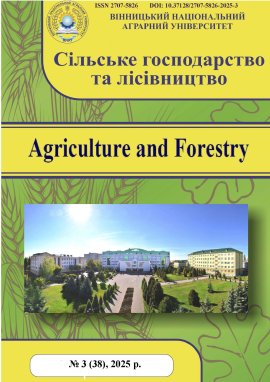
Issue №: 3 (38)
Publications contains the results of researches on optimization of technological methods of cultivation of crops, preservation of soil fertility, greening of agricultural production, modern directions of selection, reproduction of forest resources.
SPECIFIC FEATURES OF MAIZE PRODUCTIVITY FORMATION DEPENDING ON SEED FRACTION COMPOSITION
Palamarchuk Vitalii Dmytrovych – Doctor of agricultural sciences, associate professor of the department of plant production and horticulture, faculty of agronomy, horticulture and plant protection, educational and research institute of agricultural technologies and nature management, Vinnytsia national agrarian university (21008, Vinnytsia, Sonyachna st., 3 email: vd-palamarchuk@ukr.net).
Krychkovskyi Vadym – PhD in agronomy, senior lecturer at the department of plant growing and horticulture, faculty of agronomy, horticulture and plant protection, educational and research institute of agricultural technologies and nature management, Vinnytsia national agrarian university (21008, Vinnytsia, Sonyachna st., 3 email: 2112kv@gmail.com).
Maize is one of the leading energy, grain-forage, and feed crops in Ukraine and worldwide. The aim of the research was to highlight the impact of maize hybrid seed fraction size on productivity formation and a complex of economically valuable traits. The article presents the results of a two-year field study dedicated to examining the effect of seed size on morphological characteristics, growth, development, and productivity of maize hybrids of different maturity groups: Takt (FAO 200), Marsel (FAO 280), and Tiador (FAO 360). The study considered three seed fractions-small, medium, and large-classified according to the weight of 1000 kernels. The objective was to determine how seed fraction size influences germination energy, laboratory and field germination, plant morphometric parameters, ear height, and ultimately, grain yield. The obtained results indicate that seed size has a stable effect throughout the entire growing season. Plants grown from large seed fractions demonstrated higher growth parameters; in the milk stage, their height exceeded that of plants from small seeds by 6.8 cm and from medium seeds by 5.4 cm. Ear placement was also higher in variants with large seeds: by 3.0 cm compared to the medium fraction and by 6.5 cm compared to the small fraction. The highest values of plant height and ear placement were recorded in the hybrids Takt, Marsel, and Tiador when sown with large seed fractions, which correlated with better biometric and productivity indicators. In the yield structure, a positive effect of large seeds was noted on the weight of 1000 kernels, the number of rows and kernels per row, as well as overall grain yield. On average, over two years, the use of large seed fractions ensured the highest yield level. The yield increase amounted to 0.13 t/ha (1.8%) compared to the medium fraction and 0.44 t/ha (6.01%) compared to the small fraction. Thus, the results of the study confirm the feasibility of using large seeds in maize hybrid cultivation, as this allows for higher production efficiency and better realization of the genetic potential of hybrids under favorable growing conditions.
1. Palamarchuk V., Krychkovskyi V., Honcharuk I., Telekalo N. (2021). The Modeling of the Production Process of High-Starch Corn Hybrids of Different Maturity Groups. European journal of sustainable development. Vol. 1. № 10. P. 584-598. DOI: https://doi.org/10.14207/ejsd.2021.v10n1p584. [in English].
2. Dovbash N.I., Klymenko I.I., Davydiuk H.V., Shkarivska L.I., Kushchuk M.A. (2021). Urozhainist ta ekonomichna otsinka vyroshchuvannia kukurudzy na zerno za riznoho rivnia zabrudnennia ahroekotopiv poliutantamy [Yield and economic evaluation of maize grain production under various levels of agro-ecotope pollution by pollutants]. Zernovi kultury − Grain crops. Vol. 5. № 1. 132-137. DOI: https://doi.org/ 10.31867/ 2523-4544/0169 [in Ukrainian].
3. Hryhoriv Ya.Ia., Turak Yu.O. (2024). Osoblyvosti vyroshchuvannia kukurudzy v suchasnykh umovakh [Features of maize cultivation under modern conditions]. Tavriiskyi naukovyi visnyk. Seriia: Silskohospodarski nauky − Tavria Scientific Bulletin. Series: Agricultural Sciences. № 137. 70-76. DOI https://doi.org/10.32782/2226-0099.2024.137.9 [in Ukrainian].
4. Kovalenko O., Palamarchuk V., Tishechkina K., Ovchar A. (2022). Vplyv rozmiriv fraktsii ta hlybyny zahortannia nasinnia na produktyvnist kukurudzy [Influence of seed fraction size and sowing depth on maize productivity]. «Rozvytok ahrarnoi haluzi ta vprovadzhennia naukovykh rozrobok u vyrobnytstvo»: materialy V Mizhnarodnoi naukovo-praktychnoi konferentsii − Development of the Agricultural Sector and Implementation of Scientific Developments into Production": Materials of the 5th International Scientific-Practical Conference. Mykolaiv, October 19-21, 2022]. m. Mykolaiv, 19-21 zhovtnia 2022 r. Mykolaiv: MNAU, 32-37. [in Ukrainian].
5. Melnyk A.V., Bychenko K.V. (2013). Stan ta perspektyvy vyroshchuvannia zernovykh kultur v sviti ta Ukraini [Status and prospects of cereal crop cultivation in the world and Ukraine]. Visnyk Sumskoho natsionalnoho ahrarnoho universytetu. Seriia «Ahronomiia i biolohiia» − Bulletin of Sumy National Agrarian University. Series "Agronomy and Biology". Issue 11 (26), 131-134. [in Ukrainian].
6. Mazur V.A., Shevchenko N.V., Yakovets L.A. (2023). Ahro-biolohichni osoblyvosti vyroshchuvannia hibrydiv kukurudzy dlia vyrobnytstva bioetanolu v umovakh Lisostepu pravoberezhnoho: monohrafiia [Agro-biological features of maize hybrid cultivation for bioethanol production in the Right-Bank Forest-Steppe conditions: monohrafiia]. Vinnytsia: TOV «Druk». [in Ukrainian].
7. Palamarchuk V.D., Kolisnyk O.M. (2022). Suchasna tekhnolohiia vyroshchuvannia kukurudzy dlia enerhoefektyvnoho ta ekolohobezpechnoho rozvytku silskykh terytorii: monohrafiia [Modern technology for maize cultivation for energy-efficient and environmentally safe development of rural areas: monograph]. Vinnytsia: TOV Druk, 372 р. [in Ukrainian].
8. Vernera I.Ye. (2024). Statystychnyi shchorichnyk Ukrainy za 2023 rik. Derzhavna sluzhba statystyky Ukrainy [Statistical yearbook of Ukraine for 2023. State statistics service of Ukraine]. Kyiv [in Ukrainian].
9. Morozov O.V., Morozova O.S., Ivaniv M.O., Kerimov A.N. (2021). Efektyvnist vyroshchuvannia kukurudzy na zerno V Ukraini [Efficiency of maize grain cultivation in Ukraine]. Tavriiskyi naukovyi visnyk. Seriia: Silskohospodarski nauky − Tavria Scientific Bulletin. Series: Agricultural Sciences. № 119. 83-91. DOI: https://doi.org/10.32851/2226-0099.2021.119.12 [in Ukrainian].
10. Kaletnik H.M., Palamarchuk V.D., Honcharuk I.V., Yemchyk T.V., Telekalo N.V. (2021). Perspektyvy vykorystannia kukurudzy dlia enerhoefektyvnoho ta ekolohobezpechnoho rozvytku silskykh terytorii: monohrafiia [Prospects for the use of maize for energy-efficient and environmentally safe development of rural areas: monograph]. Vinnytsia: FOP Kushnir Yu.V. [in Ukrainian].
11. Kyrpa M.Ia., Skotar S.O. (2013). Sposoby separuvannia nasinnia kukurudzy ta yoho yakist [Methods of maize seed separation and its quality]. Visnyk Tsentru naukovoho zabezpechennia APV Kharkivskoi oblasti − Bulletin of the scientific support center for agricultural production of Kharkiv Region. Issue. 15. 205-212. [in Ukrainian].
12. Kyrpa M.Ya., Skotar S.O., Roslyk O.A. (2015). Vplyv sposobiv i rezhymiv separuvannia na posivni ta vrozhaini vlastyvosti nasinnia hibrydiv kukurudzy [Influence of methods and modes of separation on sowing and yield properties of maize hybrid seeds]. Biuleten Instytutu silskoho hospodarstva stepovoi zony NAAN Ukrainy − Bulletin of the institute of steppe agriculture of NAAS of Ukraine. № 8. 78-81. [in Ukrainian].
13. Kyrpa M.Ya., Skotar S.O. (2007). Osoblyvosti separuvannia zerna kukurudzy [Features of maize grain separation]. Biuleten Instytutu zernovoho hospodarstva UAAN − Bulletin of the Institute of Grain Farming UAAS. № 30. 127-132. [in Ukrainian].
14. Kyrpa M.Ya., Bazilieva Yu.S., Loi O.Yu. (2019). Osoblyvosti zberihannia nasinnia hibrydiv kukurudzy [Features of maize hybrid seed storage]. Zernovi kultury − Grain crops. Vol. 3. № 2. 226-232. https://doi.org/10.31867/2523-4544/0081. [in Ukrainian].
15. Kyrpa M.Ia. (2013). Vyznachennia yakosti nasinnia kukurudzy ta yoho pidhotovka do sivby [Determination of maize seed quality and its preparation for sowing]. Cuchasni ahrarni tekhnolohii − Modern agrarian technologies. № 3. 18-22. [in Ukrainian].
16. Kalenska S.M., Novytska N.V., Sonko R.V., Karpenko L.D. (2024). Nasinnieznavstvo. Navchalnyi posibnyk [Seed science. Textbook]. [in Ukrainian].
17. Volkodav V.V. (2001). Metodyka derzhavnoho sortovyprobuvannia silskohospodarskykh kultur (zernovi, krupiani ta zernobobovi) [Methodology of state variety testing of agricultural crops (grain, cereals, and grain legumes)]. K. [in Ukrainian].
18. Lebid Ye.M., Tsykov V.S., Pashchenko Yu.M. (2008). Metodyka provedennia polovykh doslidiv z kukurudzoiu [Methodology of conducting field experiments with maize]. Dnipropetrovsk. [in Ukrainian].
19. Fisher R. A. (2006). Statistical methods for research workers. New Delhi: Cosmo Publications. [in English].
About the journal
Cluster Agricultural and veterinary sciences (H1 Agronomy, H4 Forestry)
Name of the publication «AGRICULTURE AND FORESTRY»
The aim of the journal "Agriculture and Forestry" is to highlight the results of fundamental and applied research in the fields of agriculture and forestry, aimed at improving the efficiency of agricultural production and introducing modern technologies into farming practice.
This goal defines the main objectives:
– to ensure the creation of open information access regarding the dissemination of relevant scientific research results to: lecturers of agricultural higher education institutions, postgraduate students, doctoral candidates, research staff, and agricultural production specialists;
– to promote the development of young scientists in agricultural sciences;
– to enhance communication between experienced researchers and young scientists in agronomy and forestry;
– to facilitate the expansion of ties between Vinnytsia National Agrarian University and domestic and foreign educational institutions, scientific establishments, and their academic communities.
The scientific, production, and educational journal "Agriculture and Forestry" is a peer-reviewed open-access publication that publishes original experimental research, theoretical and practice-oriented articles within the cluster of "Agricultural and Veterinary Sciences".
The journal's subject matter covers such areas as agronomy and forestry. Publications of scientific and practical significance address the experimental foundations of agricultural and forestry sector development, innovative production technologies, and the results of fundamental and applied research aimed at increasing productivity, product quality, and the sustainable development of natural and production systems.
Publisher: Vinnytsia National Agrarian University
EDRPOU code: 00497236
Publisher's ROR:05m3ysc06
Prefix DOI: 10.37128/
Frequency is quarterly
Publication languages: (Ukrainian, English)
Media ID R30-05174.
Editor in Chief Ihor Didur
According to the order of the Ministry of Education and Science of Ukraine dated 17.03.2020 № 409. The journal Agriculture and Forestry is included in the List of scientific professional publications of Ukraine Category "B" in agricultural sciences (specialties) - 101, 201, 202, 203, 205, 206.
State registration: Decision of the National Council of Ukraine on Television and Radio Broadcasting No. 1337 and No. 1181. Media identifier – R30-05174.
Scientific journal "AGRICULTURE AND FORESTRY" was founded in 1995; it was entitled as Bulletin of Vinnytsya State Agricultural Institute.
In 2010-2014 was enritled as Collection of scientific works of Vinnytsia National Agrarian University.
It has been named as Agriculture and Forestry since 2015.
Listed in the updated list of scientific professional editions of Ukraine on agricultural sciences under the name Agriculture and Forestry (Order of the Ministry of Education and Science of Ukraine of May 16, 2016; No. 515).
Since 2015, "Agriculture and Forestry". (archive of previous issues for 2015-2019) at http://forestry.vsau.edu.ua/.
The journal “Agriculture and Forestry (ISSN: 2707-5826)” passed the evaluation process of Index Copernicus positively and is indexed in the database of ICI Journals Master List ICV for 2018, 2019, 2020, 2021, 2022, 2023, 2024 is presented in the full list of indexed journals in the Master List International List
ICI Journals Master List Value
