

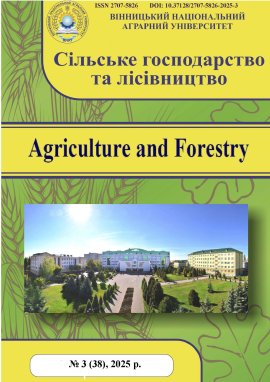
Issue №: 3 (38)
Publications contains the results of researches on optimization of technological methods of cultivation of crops, preservation of soil fertility, greening of agricultural production, modern directions of selection, reproduction of forest resources.
SOYBEAN GROWING AS A FACTOR IN RESTORING THE SOIL NUTRIENT REGIME
Tsyhanska Olena – candidate of agricultural sciences, associate professor of the department of forestry and landscape management of Vinnytsia National Agrarian University (21008, Vinnytsia, Soniachna Str. 3, e-mail: lenkatsiganskaya@gmail.com).
Pantsyreva Hanna candidate of agricultural sciences, associate professor of the department of forestry and landscape management of Vinnytsia National Agrarian University (21008, Vinnytsia, Soniachna Str. 3, e-mail: apantsyreva@ukr.net).
Mashenko Vitalii - post graduate student of the department of forestry and landscape management of Vinnytsia National Agrarian University (21008, Vinnytsia, Soniachna Str. 3).
According to the results of the research, the peculiarities of the influence of soybean cultivation technology on the processes of biological nitrogen accumulation were established and determined. In particular, according to the results of our research, it was found that the highest amount of biological nitrogen in the atmosphere of soybean plants, the Diadema Podillya variety 138.9 kg/ha and the Azimut variety 154.6 kg/ha on average over the years of research, was recorded in the experimental variants with the application of mineral fertilizers at a dose of P60K60 and pre-sowing treatment of seed material with the preparations Organic Balance Mono Phosphorus (1.5 l/t) + Melanoriz (2.0 l/t) + Anderiz (3.0 l/t), which is 74.4 and 75.0 kg/ha more than the control, respectively. The application of mineral fertilizers at a dose of P60K60 contributed to the maximum level of biological nitrogen accumulation, which exceeded the control variants by an average of 28.4 - 42.3 kg/ha, depending on the variety. The application of nitrogen (N30) together with phosphorus-potassium fertilizers negatively affected the biological fixation of nitrogen, while the level of its accumulation was 18.0 - 18.4 kg/ha higher compared to the control. It was also found that the greatest increase in the level of biological nitrogen accumulation in the Diadema Podillya variety (28.0 - 32.1 kg/ha) and in the Azimut variety (28.3 - 46.6 kg/ha) was ensured by the complex use of seed treatment with Organic Balance Mono Phosphorus (1.5 l/t) + Melanoriz (2.0 l/t) + Anderiz (3.0 l/t). It was found that the Diadema Podillya soybean variety accumulated slightly less plant residues in absolutely dry matter compared to the Azimut variety. When applying fertilizers at a dose of P60K60, the amount of accumulated root residues increased to 1.59 t/ha in the Diadema Podillya variety. Under conditions of mineral nutrition at a dose of N30P60K60, an increase in root residues was observed to 1.63 t/ha. The same trend was observed in the accumulation of surface plant residues in this variety. The maximum amount of both root and surface plant residues was recorded in the experimental variant where mineral fertilizers were applied at a dose of N30P60K60 and the biological preparations Organic Balance Mono Phosphorus (1.5 l/t) + Melanoriz (2.0 l/t) + Anderiz (3.0 l/t) were used for seed treatment in the Diadema Podillya variety. The maximum amount of both surface and root plant residues (2.86 t/ha) in the Azimut variety was noted in the experiment variant where mineral fertilizers were applied at a dose of N30P60K60 and pre-sowing seed treatment was performed with biological preparations Organic Balance Mono Phosphorus (1.5 l/t) + Melanoriz (2.0 l/t) + Anderiz (3.0 l/t). The obtained results of research on the amount of accumulation of biological nitrogen in the soil and the accumulation of plant residues in the 0-30 cm layer of the soil by sowing soybean varieties indicate the importance of using crops in crop rotations in order to restore soil fertility and enrich it with organic residues.
1. Didur I. M., Shevchuk V. V. (2020) Pidvyshchennia rodiuchosti gruntu v rezultati nakopychennia biolohichnoho azotu bobovymy kulturamy. [Increasing soil fertility as a result of the accumulation of biological nitrogen by legumes]. Silske hospodarstvo i lisivnytstvo − Agriculture and forestry. №1 (16). P 36-43. DOI: 10.37128/2707-5826-2020-1-4 [in Ukrainian].
2. Mazur O.V., Mazur O.V. (2023) Adaptyvna tsinnist sortiv soi za vyroshchuvannia v riznykh ekohradiientakh. [Adaptive value of soybean varieties for growing in various ecological environments]. Silske hospodarstvo i lisivnytstvo − Agriculture and forestry. № 2 (29). P. 172–180. DOI: 10.37128/2707-5826-2023-2-15 [in Ukrainian].
3. Moiseichenko V.F., Yeshenko V.O. (1994) Osnovy naukovykh doslidzhen v ahronomii. [Fundamentals of scientific research in agronomy]. K.: High school. 334 p. [in Ukrainian].
4. Tsyhanska O.I., Shevchuk O.V. (2024) Formuvannia fotosyntetychnoho potentsialu sortiv soi zalezhno vid doz mineralnykh dobryv ta pozakorenevoho pidzhyvlennia orhano-mineralnym dobryvom. [Formation of photosynthetic potential of soybean varieties depending on doses of mineral fertilizers and foliar feeding with organo-mineral fertilizer.]. Naukovi dopovidi NUBIP Ukrainy − Scientific Reports of the NULES of Ukraine. № 2. (108). DOI: http://dx.doi.org/10.31548/dopovidi.2(108).2024.008 [in Ukrainian].
5. Tsyhanskyi V. I., Tsyhanska O. I. (2020). Vplyv elementiv tekhnolohii vyroshchuvannia na aktyvizatsiiu roslynno-mikrobnoho symbiozu ta protsesy transformatsii azotu u ahrotsenozakh liutserny posivnoi. [The influence of elements of cultivation technology on the activation of plant-microbial symbiosis and nitrogen transformation processes in agrocenoses of alfalfa seed]. Silske hospodarstvo i lisivnytstvo − Agriculture and forestry. № 1 (16). P. 61-72. DOI: 10.37128/2707-5826-2020-1-5 [in Ukrainian].
6. Tsyhanska O. I., Tsyhanskyi V. I. (2019). Vplyv mineralnykh dobryv ta sposobiv vykorystannia kompleksu mikroelementiv na vysotu roslyn soi. [The effect of mineral fertilizers and methods of using a complex of trace elements on the height of soybean plants.] Silske hospodarstvo i lisivnytstvo − Agriculture and forestry. № 4 (15) P. 83-93. DOI: 10.37128/2707-5826-2019-3-4-8 [in Ukrainian].
7. Tsyhanska O. I. (2021). Vplyv mineralnykh dobryv ta biopreparatu na rist ta rozvytok roslyn soi. [The effect of mineral fertilizers and biological preparation on the growth and development of soybean plants.] Naukovi dopovidi NUBIP Ukrainy - Scientific Reports of the NULES of Ukraine. № 6 (94). http://journals.nubip.edu.ua/index.php/Dopovidi/article/view/dopovidi2021.06.008 [in Ukrainian].
8. Циганський В.І., Циганська О.І., Панцирева Г.В., Шевчук О.В. Накопичення біологічного азоту багаторічними бобовими травами та зернобобовими культурами як спосіб відновлення родючості ґрунту. Сільське господарство та лісівництво. 2025. № 1 (36). С. 16-27. DOI: 10.37128/2707-5826-2025-1-2.
9. Didur, I., Tsyhanskyi, V., & Tsyhanskа, O. (2023). Influence of biologisation of the nutrition system on the transformation of biological nitrogen and formation of soybean productivity. Plant and Soil Science. № 14(4). P. 86-97. DOI:https://doi.org/10.31548/plant4.2023.86 [In English].
10. Didur I. M., Tsyhanskyi V. I., Tsyhanska O.I., Malynka L. V., Butenko A. O., Masik I. M., Klochkova T. I. (2019). Effect of the cultivation technology elements on the activation of plant microbe symbiosis and the nitrogen transformation processes in alfalfa agrocoenoses. Modern Phytomorphology. Vol. 13. Р. 30–34. DOI: 10.5281/zenodo.3518830 [In English].
11. Didur I., Tsyhanskyi V., Tsyhanska O. (2024). The influence of biologization of the nutrition system on the formation of photosynthetic productivity of soybean crops. Modern Phytomorphology. Vol. 18. Issue 4. P. 119-123. DOI: 10.5281/zenodo.200121 [In English].
12. Drobitko, A., Kachanova, T., Smirnova, I. , & Drobitko, O. (2025). Potential of leguminous crops for sustainable development of the agricultural sector. Scientific Horizons. 28(6). P. 36-49. DOI:https://doi.org/10.48077/scihor6.2025.36 [In English].
13. Korobko, A., Kravets, R., Mazur, O., Mazur, O., Shevchenko, N. (2024). Nitrogen-fixing capacity of soybean varieties depending on seed inoculation and foliar fertilization with biopreparations. Journal of Ecological Engineering. 25(4). Р. 23-37. DOI: 10.12911/22998993/183497. [In English]
14. Khomina V., Lapchynskyi V., Pustova Z., Nebaba K., Plahtiy D. (2024). Microbial inoculants as a means of improving soil and crop yields. Scientific Horizons. 27(10). Р. 79-90. DOI: 10.48077/scihor10.2024.79. [In English].
15. Mazur V., Didur I., Tkachuk O., Pantsyreva H., Ovcharuk V. (2021). Agroecological stability of cultivars of sparsely distributed legumes in the context of climate change. Scientific Horizons. 24 (1). Р. 54-60. DOI: 10.48077/scihor.24(1). Р. 54-60 [In English].
16. Mazur O., Mazur O., Tymoshchuk T., Didur I., Tsyhanskyi V. (2024). Study of legume-rhizobia symbiosis in soybean for agroecosystem resilience. Scientific Horizons. 27(11). Р 68-89. DOI: 10.48077/scihor11.2024.68. [In English].
About the journal
Cluster Agricultural and veterinary sciences (H1 Agronomy, H4 Forestry)
Name of the publication «AGRICULTURE AND FORESTRY»
The aim of the journal "Agriculture and Forestry" is to highlight the results of fundamental and applied research in the fields of agriculture and forestry, aimed at improving the efficiency of agricultural production and introducing modern technologies into farming practice.
This goal defines the main objectives:
– to ensure the creation of open information access regarding the dissemination of relevant scientific research results to: lecturers of agricultural higher education institutions, postgraduate students, doctoral candidates, research staff, and agricultural production specialists;
– to promote the development of young scientists in agricultural sciences;
– to enhance communication between experienced researchers and young scientists in agronomy and forestry;
– to facilitate the expansion of ties between Vinnytsia National Agrarian University and domestic and foreign educational institutions, scientific establishments, and their academic communities.
The scientific, production, and educational journal "Agriculture and Forestry" is a peer-reviewed open-access publication that publishes original experimental research, theoretical and practice-oriented articles within the cluster of "Agricultural and Veterinary Sciences".
The journal's subject matter covers such areas as agronomy and forestry. Publications of scientific and practical significance address the experimental foundations of agricultural and forestry sector development, innovative production technologies, and the results of fundamental and applied research aimed at increasing productivity, product quality, and the sustainable development of natural and production systems.
Publisher: Vinnytsia National Agrarian University
EDRPOU code: 00497236
Publisher's ROR:05m3ysc06
Prefix DOI: 10.37128/
Frequency is quarterly
Publication languages: (Ukrainian, English)
Media ID R30-05174.
Editor in Chief Ihor Didur
According to the order of the Ministry of Education and Science of Ukraine dated 17.03.2020 № 409. The journal Agriculture and Forestry is included in the List of scientific professional publications of Ukraine Category "B" in agricultural sciences (specialties) - 101, 201, 202, 203, 205, 206.
State registration: Decision of the National Council of Ukraine on Television and Radio Broadcasting No. 1337 and No. 1181. Media identifier – R30-05174.
Scientific journal "AGRICULTURE AND FORESTRY" was founded in 1995; it was entitled as Bulletin of Vinnytsya State Agricultural Institute.
In 2010-2014 was enritled as Collection of scientific works of Vinnytsia National Agrarian University.
It has been named as Agriculture and Forestry since 2015.
Listed in the updated list of scientific professional editions of Ukraine on agricultural sciences under the name Agriculture and Forestry (Order of the Ministry of Education and Science of Ukraine of May 16, 2016; No. 515).
Since 2015, "Agriculture and Forestry". (archive of previous issues for 2015-2019) at http://forestry.vsau.edu.ua/.
The journal “Agriculture and Forestry (ISSN: 2707-5826)” passed the evaluation process of Index Copernicus positively and is indexed in the database of ICI Journals Master List ICV for 2018, 2019, 2020, 2021, 2022, 2023, 2024 is presented in the full list of indexed journals in the Master List International List
ICI Journals Master List Value
