

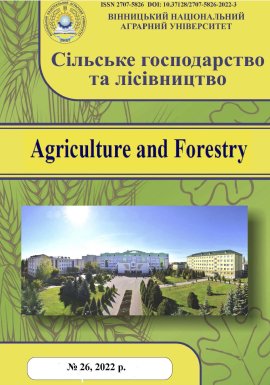
Issue №: 3 (26)
The issue of the magazine is devoted to the study of the optimization of the elements of the technology of growing agricultural crops. An important role is given to the influence of leguminous crops on improving soil fertility, adaptive breeding, mineral and foliar fertilization of agricultural crops, ecology and environmental protection, in particular, the impact of chemical treatment on the contamination of soil and grain products with pesticides, methods of combating harmful objects.
SELECTION OF NUTRIENT SOLUTION FOR CLONAL MICRO-PROPAGATION OF INTRODUCED ROSE VARIETIES (ROSA L.) IN THE CONDITIONS OF THE FOREST-STEPPE OF UKRAINE
Polishchuk Valentyn – Doctor of Agricultural Sciences, Professor, Dean of the Faculty of Forestry and Gardening, Uman National University of Horticulture (20300, Uman, Institutskaya St., 1, email: valentyn7613@gmail.com).
Ukrainets Oleksandra – postgraduate student of the Uman National University of Horticulture (20300, Uman, Institutskaya st., 1, email: sasha.ukrainets@gmail. com).
The article deals with the study on the inclusion of biotechnology in the selection of roses. Roses are heterozygous plants and by seed propagation give splitting. Therefore, to accelerate the reproduction of new and existing starting material, clonal micropropagation was included in the study. The in vitro reproduction process is influenced by various factors. It should be noted that, in the initial stages it is influenced by the age of the mother plant and the season of material isolation and even from which part of the plant the explant was selected and its size. The next step is to pay attention to the sterilizing agent and the sterilization exposure period. One of the main factors influencing the clonal micro-propagation is the plant genotype, the hormonal factor and the composition of the nutrient medium. At the last stage of clonal propagation, the main role is played by the condition of the regenerating plant and physical factors. The valuable varieties on decorativeness and permanent flowering capacity as well as various originators were used in the research. The article gives a brief description of valuable genotypes of roses. Highlighted data on the optimal composition of the nutrient in which the largest number of formed micro shoots was achieved. It was investigated that when the biotechnological unit was included in the selection of roses, it was determined that the optimal concentration of cytokinins, namely BAP is 0.5 mg/l and 1.0 mg/l. At such concentrations, no callus formation was observed in most cases, and the indicators of new micro shoots of genotypes and their length were the most optimal. In addition, it should be noted that the main factor in clonal micro-propagation is the genotype of the original sample. Thus, in our studies, the best genotypes for clonal micro-propagation with the largest number of micro shoots produced are Tchaikovski and Koralovyi Surpryz varieties.
1. Musiienko M.M. (2001). Kulʹtura izolʹovanykh klityn, tkanyn i orhaniv roslyn: metod. rekom [The culture of isolated cells, tissues and organs of plants: guidelines]. Kiev: Phytosocenter. 48. [in Ukrainian].
2. Kushnir H.P., Sarnatska, V.V. (2005). Mikroklonalʹne rozmnozhennya roslyn: teoriya i praktyka. [Microclonal plant reproduction: theory and practice]. Kiev: Naukova dumka. [in Ukrainian] .
3. Rubtsova O.L., Chyzhankova, V.I., Boiko, R.V. (2015). Selektsiya troyand: istoriya, dosyahnennya, suchasna stratehiya. Introduktsiya roslyn [Rose selection: history, achievements, modern strategy. Plant Introduction]. 1. 69 – 75. [in Ukrainian].
4. Khosravi P., Kermani M. J., Nematzadeh G. A., Bihamta M. R. (2007). A protocol for mass production of Rosa hybrida cv. Iceberg through in vitro propagation. Iranian journal of biotechnology, april. Vol. 5. 2. 100-104. [in English].
5. Roy P.K., Mamun A.N. K. and Ahmed G. (2004). In vitro plantlets regeneration of rose. Plant Tissue Cult. Vol. 14. 2. 149-154. [in English].
6. Martin C. (1985). Plant breeding in vitro. Endeavour 9, 81-86. [in English].
7. Canli F.A., Kazaz S. (2009). Biotechnology of Roses: Progress and Future Prospects. Süleyman Demirel Üniversitesi Orman Fakültesi Dergisi. Seri: A, 167-183. [in English].
8. Nitish Kumar, Reddy M. (2011). In vitro Plant Propagation: a review. Journal of Forest Science. Vol. 27. 61-72. [in English].
9. Ukrainets O.A., Polishchuk V.V. (2020). Pidbir sterylizuyuchoho ahenta ta periodu vvedenya eksplantiv dlya klonalʹnoho mikrorozmnozhennya introdukovanykh sortiv troyandy (Rosa L.). [Sterilize agents selection and the determination of explants introduction period for clonal micropropagation of introduced roses' varieties (Rosa L.)]. Zbirny`k naukovy`x pracz` Umans`kogo NUS − Collection of scientific works of Uman National University of Horticulture, Issue. 96 (1), 650-663 [in Ukrainian].
About the journal
Cluster Agricultural and veterinary sciences (H1 Agronomy, H4 Forestry)
Name of the publication «AGRICULTURE AND FORESTRY»
The aim of the journal "Agriculture and Forestry" is to highlight the results of fundamental and applied research in the fields of agriculture and forestry, aimed at improving the efficiency of agricultural production and introducing modern technologies into farming practice.
This goal defines the main objectives:
– to ensure the creation of open information access regarding the dissemination of relevant scientific research results to: lecturers of agricultural higher education institutions, postgraduate students, doctoral candidates, research staff, and agricultural production specialists;
– to promote the development of young scientists in agricultural sciences;
– to enhance communication between experienced researchers and young scientists in agronomy and forestry;
– to facilitate the expansion of ties between Vinnytsia National Agrarian University and domestic and foreign educational institutions, scientific establishments, and their academic communities.
The scientific, production, and educational journal "Agriculture and Forestry" is a peer-reviewed open-access publication that publishes original experimental research, theoretical and practice-oriented articles within the cluster of "Agricultural and Veterinary Sciences".
The journal's subject matter covers such areas as agronomy and forestry. Publications of scientific and practical significance address the experimental foundations of agricultural and forestry sector development, innovative production technologies, and the results of fundamental and applied research aimed at increasing productivity, product quality, and the sustainable development of natural and production systems.
Publisher: Vinnytsia National Agrarian University
EDRPOU code: 00497236
Publisher's ROR:05m3ysc06
Prefix DOI: 10.37128/
Frequency is quarterly
Publication languages: (Ukrainian, English)
Media ID R30-05174.
Editor in Chief Ihor Didur
According to the order of the Ministry of Education and Science of Ukraine dated 17.03.2020 № 409. The journal Agriculture and Forestry is included in the List of scientific professional publications of Ukraine Category "B" in agricultural sciences (specialties) - 101, 201, 202, 203, 205, 206.
State registration: Decision of the National Council of Ukraine on Television and Radio Broadcasting No. 1337 and No. 1181. Media identifier – R30-05174.
Scientific journal "AGRICULTURE AND FORESTRY" was founded in 1995; it was entitled as Bulletin of Vinnytsya State Agricultural Institute.
In 2010-2014 was enritled as Collection of scientific works of Vinnytsia National Agrarian University.
It has been named as Agriculture and Forestry since 2015.
Listed in the updated list of scientific professional editions of Ukraine on agricultural sciences under the name Agriculture and Forestry (Order of the Ministry of Education and Science of Ukraine of May 16, 2016; No. 515).
Since 2015, "Agriculture and Forestry". (archive of previous issues for 2015-2019) at http://forestry.vsau.edu.ua/.
The journal “Agriculture and Forestry (ISSN: 2707-5826)” passed the evaluation process of Index Copernicus positively and is indexed in the database of ICI Journals Master List ICV for 2018, 2019, 2020, 2021, 2022, 2023, 2024 is presented in the full list of indexed journals in the Master List International List
ICI Journals Master List Value
