

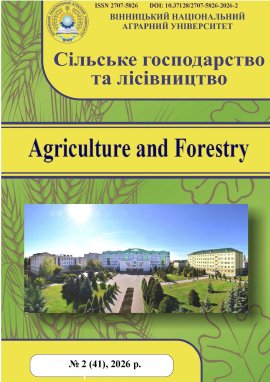
Issue №: 2 (41)
This issue of the journal is dedicated to current issues in improving technological methods for crop cultivation. Significant attention is given to the specifics of growing vegetable, grain and leguminous crops, which play a vital role in ensuring the state's food security. The scientific publications present the results of experimental research on the production of organic leguminous products, the importance of adaptive breeding to increase the resilience of agrocenoses, plant protection against harmful objects and the application of fertilizers to increase crop yields. Certain papers are devoted to the implementation of innovative methods for stimulating the seed productivity of forest seed plantations.
RESEARCH ON THE PRACTICAL USE OF PAULOWNIA SP., OXYTREE, AS AN ELEMENT OF CLIMATE-ADAPTIVE AGROFORESTRY SYSTEMS
Janusz Lisowski, PhD of Agricultural, Eng., prof. MANS International Academy of Applied Sciences in Lomza, Republic of Poland (19 Studencka St. Lomza 18-402 e-mail: janusz.lisowski @mans.edu.pl, ORCID:https://orcid.org/0000-0001-8613-1367).
The article summarizes current approaches to the practical use of paulownia (Paulownia sp., Oxytree) as an element of climate-adaptive agroforestry systems. The aim of the work is to assess the prospects for integrating paulownia into the structure of agricultural landscapes and to determine its potential role in increasing the ecological stability and productivity of agroecosystems under conditions of increasing climate risks (drought, uneven precipitation, erosion processes). The methodological basis was the analysis and systematization of literary sources, a comparative analysis of the biological, ecological, and economic characteristics of Paulownia spp., and an assessment of the possibilities for using the species in tree-field, agroforestry, and bioenergy schemes. The key properties that determine the suitability of paulownia for agroforestry plantations are considered: high growth rates at a young age, intensive biomass accumulation, the ability to regrow after cutting (important for short-rotation plantations), as well as the potential for the formation of microclimatic and anti-erosion effects as part of field protection plantations. Special attention is paid to the technological prerequisites for effective cultivation: light-loving, dependence of productivity on moisture supply, requirements for soil conditions (preference for well-drained soils), the feasibility of optimizing planting schemes (4×4, 5×5 m or wider row spacing) for combination with growing crops in the row spacing and ensuring mechanized care. The efficiency of using paulownia varies significantly depending on the species or clone and the cultivation technology (feeding, irrigation, shaping), and also requires consideration of limitations (frost risks, sensitivity to moisture deficiency) and biosecurity aspects, in particular the invasive potential of individual taxa in certain regions. The integration of Paulownia sp. (Oxytree) into climate-adaptive agroforestry systems can optimize the use of land resources, increase the ecological stability of agrolandscapes and form an additional source of wood biomass and wood products, provided that the implementation is controlled and scientifically sound.
1. Huber C., Moog D., Stingl R., Pramreiter M., Stadlmann A., Baumann G., Praxmarer G., Gutmann R., Eisler H., Müller U. (2023). Paulownia (Paulownia elongata S.Y.Hu) – importance for forestry and a general screening of technological and material properties. Wood Material Science & Engineering. Vol. 18 (5), P. 1663-1675. DOI: https://doi.org/10.1080/17480272.2023.2172690 [in English].
2. Barbu M.C., Tudor E.M., Buresova K., Petutschnigg A. (2023). Assessment of physical and mechanical properties considering the stem height and cross-section of Paulownia tomentosa (Thunb.) Steud. × elongata (S.Y.Hu) wood. Forests. Vol. 14 Issue 3. P. 589. DOI: https://doi.org/10.3390/f14030589 [in English].
3. Avram A., Lunguleasa A., Spirchez C., Ionescu C.S. (2023). Differences and similarities between the wood of three low-density and homogenous species: linden, balsa, and paulownia. Applied Sciences. Vol. 13, Issue 18. P. 10209. DOI: https://doi.org/10.3390/app131810209 [in English].
4. Röllig P., Tudor E.M., Barbu M.C., Direske M. (2024). Effect of the particle geometry on lightweight particleboard from paulownia using high-frequency pressing technology. Wood Material Science & Engineering. Vol. 19, Issue 3. P. 683–690. DOI: https://doi.org/10.1080/17480272.2023.2286625 [in English].
5. Nelis P.A., Mai C. (2021). The influence of low-density (Paulownia spp.) and high-density (Fagus sylvatica L.) wood species on various characteristics of light and medium-density three-layered particleboards. Wood Material Science & Engineering. Vol. 16, Issue 1. P. 21–26. DOI: https://doi.org/10.1080/17480272.2019.1659850 [in English].
6. Barbu M.C., Radauer H., Petutschnigg A., Tudor E.M., Kathriner M. (2023). Lightweight solid wood panels made of paulownia plantation wood. Applied Sciences. Vol. 13, Issue 20. P. 11234. DOI: https://doi.org/10.3390/app132011234 [in English].
7. Nelis P.A., Henke O., Mai C. (2019). Comparison of blockboards with core layers made of kiri (Paulownia spp.) and of spruce (Picea abies) regarding mechanical properties. European Journal of Wood and Wood Products. Vol. 77, P. 323–326. DOI: https://doi.org/10.1007/s00107-019-01381-3 [in English].
8. Ghazzawy H.S., Bakr A., Mansour A.T., Ashour M. (2024). Paulownia trees as a sustainable solution for CO₂ mitigation: assessing progress toward 2050 climate goals. Frontiers in Environmental Science. Vol. 12, P. 1307840. DOI: https://doi.org/10.3389/fenvs.2024.1307840 [in English].
9. Guo N., Zhai X.-Q., Fan G.-Q. (2023). Chemical composition, health benefits and future prospects of paulownia flowers: a review. Food Chemistry. Vol. 412, P. 135496. DOI: https://doi.org/10.1016/j.foodchem.2023.135496 [in English].
10. Kulak P., Komorowicz M., Lachowicz H. (2024). Fibre morphological characteristics, chemical composition and fuel properties of paulownia COTEVISA-2 wood. European Journal of Wood and Wood Products. Vol. 82 (5), P. 1605–1614. DOI: https://doi.org/10.1007/s00107-024-02108-9 [in English].
11. Barbu M.C., Burešova K., Tudor E.M., Sepperer T. (2025). Exploring paulownia as a sustainable alternative to balsa in plywood manufacturing. Forests. Vol. 16, Issue 9. P. 1436. DOI: https://doi.org/10.3390/f16091436 [in English].
12. Ishiguri F., Nezu I., Nihei M., Kato S., Otani N., Ohshima J., Yokota S. (2024). Preliminary evaluation of bending properties in dimension lumber of Paulownia tomentosa as a fast-growing tree species in Japan. Forest Products Journal. Vol. 74(2), P. 159–164. DOI: https://doi.org/10.13073/FPJ-D-23-00048 [in English].
13. Fos M., Oliver-Villanueva J.-V., Vazquez M. (2023). Radial variation in anatomical wood characteristics and physical properties of Paulownia elongata × Paulownia fortunei hybrid Cotevisa 2 from fast-growing plantations. European Journal of Wood and Wood Products. Vol. 81 (4), P. 819–831. DOI: https://doi.org/10.1007/s00107-023-01941-8 [in English].
14. Esteves B., Cruz-Lopes L., Viana H., Ferreira J., Domingos I., Nunes L.J.R. (2022). The influence of age on the wood properties of Paulownia tomentosa (Thunb.) Steud. Forests. Vol. 13, Issue 5. P. 700. DOI: https://doi.org/10.3390/f13050700 [in English].
15. Young S.N.R., Lundgren M.R. (2022). C4 photosynthesis in Paulownia? A case of inaccurate citations. Plants, People, Planet. Vol. 5, Issue 2. P. 292–303. DOI: https://doi.org/10.1002/ppp3.10343 [in English].
16. Lisowski J., Porwisiak H., Szydlik I., Pisarek L. (2023). Comparison of biometric traits and energy value of oxidized wood after the second and third year of vegetation. Ecology and Rational Nature Management: Education, Science and Practice: Proc. Int. Sci. Pract. Conf., Lomza – Zhytomyr, 15 Nov. Part 2. Lomza: MANS, 2023, P. 29–41. [in English].
17. Borusiewicz A., Lisowski J., Porwisiak H. (2025). Use of three-year-old trunks and branches of Oxytree trees for wood chip production and their energy value after combustion. Forest Education and Science: Current State, Problems and Prospects for Development: proceedings of the VІІ International scientific and practical online conference, Lomza–Malyn, 21 Mar. 2025. Part 1. Lomza: MANS, P. 14–16. DOI: https://doi.org/10.58246/AKEG9178 [in English].
18. Lisowski J., Cwalina P., Kaczyńska M., Obidziński K. (2025). Comparison of the energy values of three C4 group plants. Zeszyty Naukowe MANS, Vol. 98, № 2. P. 52–63. DOI: https://doi.org/10.58246/cq9yav64 [in English].
19. Litwińczuk W., Jacek B. (2023). Growth of Paulownia ssp. interspecific hybrid ‘Oxytree’ micropropagated nursery plants under the influence of plant-growth regulators. Agronomy. Vol. 13, Issue 10. P. 2474. DOI: https://doi.org/10.3390/ agronomy 13102474 [in English].
About the journal
Cluster Agricultural and veterinary sciences (H1 Agronomy, H4 Forestry)
Name of the publication «AGRICULTURE AND FORESTRY»
The aim of the journal "Agriculture and Forestry" is to highlight the results of fundamental and applied research in the fields of agriculture and forestry, aimed at improving the efficiency of agricultural production and introducing modern technologies into farming practice.
This goal defines the main objectives:
– to ensure the creation of open information access regarding the dissemination of relevant scientific research results to: lecturers of agricultural higher education institutions, postgraduate students, doctoral candidates, research staff, and agricultural production specialists;
– to promote the development of young scientists in agricultural sciences;
– to enhance communication between experienced researchers and young scientists in agronomy and forestry;
– to facilitate the expansion of ties between Vinnytsia National Agrarian University and domestic and foreign educational institutions, scientific establishments, and their academic communities.
The scientific, production, and educational journal "Agriculture and Forestry" is a peer-reviewed open-access publication that publishes original experimental research, theoretical and practice-oriented articles within the cluster of "Agricultural and Veterinary Sciences".
The journal's subject matter covers such areas as agronomy and forestry. Publications of scientific and practical significance address the experimental foundations of agricultural and forestry sector development, innovative production technologies, and the results of fundamental and applied research aimed at increasing productivity, product quality, and the sustainable development of natural and production systems.
Publisher: Vinnytsia National Agrarian University
EDRPOU code: 00497236
Publisher's ROR:05m3ysc06
Prefix DOI: 10.37128/
Frequency is quarterly
Publication languages: (Ukrainian, English)
Media ID R30-05174.
Editor in Chief Ihor Didur
According to the order of the Ministry of Education and Science of Ukraine dated 17.03.2020 № 409. The journal Agriculture and Forestry is included in the List of scientific professional publications of Ukraine Category "B" in agricultural sciences (specialties) - 101, 201, 202, 203, 205, 206.
State registration: Decision of the National Council of Ukraine on Television and Radio Broadcasting No. 1337 and No. 1181. Media identifier – R30-05174.
Scientific journal "AGRICULTURE AND FORESTRY" was founded in 1995; it was entitled as Bulletin of Vinnytsya State Agricultural Institute.
In 2010-2014 was enritled as Collection of scientific works of Vinnytsia National Agrarian University.
It has been named as Agriculture and Forestry since 2015.
Listed in the updated list of scientific professional editions of Ukraine on agricultural sciences under the name Agriculture and Forestry (Order of the Ministry of Education and Science of Ukraine of May 16, 2016; No. 515).
Since 2015, "Agriculture and Forestry". (archive of previous issues for 2015-2019) at http://forestry.vsau.edu.ua/.
The journal “Agriculture and Forestry (ISSN: 2707-5826)” passed the evaluation process of Index Copernicus positively and is indexed in the database of ICI Journals Master List ICV for 2018, 2019, 2020, 2021, 2022, 2023, 2024 is presented in the full list of indexed journals in the Master List International List
ICI Journals Master List Value
