

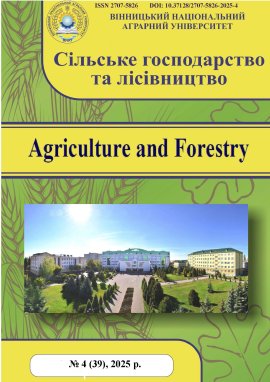
Issue №: 4 (39)
The issue of the magazine is dedicated to the study of the optimization of technological methods of growing agricultural crops. The impact of leguminous crops on improving soil fertility, methods of combating pests, greening territories, and adaptive selection of leguminous crops are considered.
PRODUCTIVITY OF MAIZE HYBRIDS DEPENDING ON PLANTING DENSITY
Palamarchuk Vitalii Dmytrovych – Doctor of agricultural sciences, associate professor of the department of plant production and horticulture, faculty of agronomy, horticulture and plant protection, educational and research institute of agricultural technologies and nature management, Vinnytsia national agrarian university (21008, Vinnytsia, Sonyachna st., 3 email: vd-palamarchuk@ukr.net, https://orcid.org/0000-0002-4906-3761).
Pohranychna Nataliya Mykhailivna – lecturer, department of Ukrainian and foreign languages. Vinnytsia national agrarian university (21008, Vinnytsia, Sonyachna st., 3, email: nataliapogranicna081094@gmail.com, https://orcid.org/0009-0008-7027-4441)
Borysov Valery Vitaliyovych – postgraduate of the Vinnytsia National Agrarian University (21008, Vinnytsia, 3 Soniacna St. email: borysov91@gmail.com, https://orcid.org/0009-0007-2108-2884).
This study presents the results of research on the effect of planting density on the growth, development, and productivity of maize hybrids of different maturity groups under the conditions of the Right-Bank Forest-Steppe of Ukraine. The primary objective was to determine the relationship between maize hybrid productivity and planting density, as well as to identify optimal plant spacing schemes that ensure the maximum realization of their genetic yield potential. The field experiments were conducted in 2024–2025 at the experimental field of the department of crop production and horticulture of Vinnytsia national agrarian university, within the farming enterprise LLC «Organik-D». The study involved maize hybrids representing various maturity groups: Anovie KS (FAO 220), ES Sirius (FAO 200), ES Perspektiv (FAO 240), DKC 3609 (FAO 260), DKC 3939 (FAO 320), and Harmonium (FAO 380). Planting densities ranged from 50,000 to 90,000 plants per hectare. The results revealed that plant height and ear attachment height were significantly influenced by the genetic characteristics of the hybrid, weather conditions, and planting density. Favorable hydrothermal conditions in 2025 contributed to an increase in average plant height to 268.0 cm, compared to 252.9 cm in 2024. The tallest plants were observed in mid-maturity hybrids – DKC 3939 (283.0 cm) and Harmonium (284.1 cm) – under an optimal density of 60,000–80,000 plants/ha. Yield analysis demonstrated that a longer vegetation period was associated with higher productivity. The average yield across two years ranged from 7.96 to 10.08 t/ha, depending on the hybrid. The highest yields (10.06–10.08 t/ha) were recorded for DKC 3939 (FAO 320) and Harmonium (FAO 380) at a planting density of 80,000 plants/ha. For early-maturing hybrids, the optimal density was 90,000 plants/ha. Excessive or insufficient plant density resulted in yield reduction. The findings highlight that adjusting plant density according to the hybrid’s maturity group is an effective agronomic strategy for optimizing maize cultivation and achieving stable yields under the conditions of the Forest-Steppe zone of Ukraine. Further research is recommended to refine hybrid-specific density parameters.
1. Rybka V., Liashenko N., Dudka M. (2018). Maize cultivation in Ukraine. What is the outlook? Agribusiness today. 12 (379), 52–54. [in Ukrainian].
2. Bahatchenko V.V., Tahantsova M.M., Stefkivska Yu.L. (2018). Effect of maize plant density on the seed productivity of parental components of Zea mays L. hybrids. Scientific papers of the institute of bioenergy crops and sugar beet, 26, 56–66. [in Ukrainian].
3. Kaletnik H.M., Palamarchuk V.D., Honcharuk I.V., Yemchyk T.V., Telekalo N.V. (2021). Prospects for the use of maize for energy-efficient and environmentally safe development of rural areas: Monograph. Vinnytsia: FOP Kushnir Yu.V. 260 p. [in Ukrainian].
4. Palamarchuk V.D., Krychkovskyi V.Yu., Palamarchuk O.D., Shuberanskyi V.E. (2024). Innovative Technologies in Crop Production: Textbook. Vinnytsia: LLC “Druk”. 582 p. [in Ukrainian].
5. Polishchuk M.I., Khavkhun A.A. (2023). Ways to increase maize hybrid productivity under climate warming conditions. Podillia bulletin: Agriculture, engineering, economics. Series: agricultural sciences, 2 (39), 54–59. DOI: https://doi.org/ 10.37406/2706-9052-2023-2.8. [in Ukrainian].
6. Yaroshko M., Shtangela Y. (2012). Maize – basic requirements for cultivation. Agronomist, 2 (36). 138–140. [in Ukrainian].
7. Nad’ Yanosh. (2012). Maize. Vinnytsia: FOP D. Yu. Korzun. 580 p. [in Ukrainian].
8. Mynkin M.V., Berdnikova O.H., Mynkina H.O. (2019). Formation of grain maize productivity depending on nutrition and plant density under conditions of southern Ukraine. Tavriiskyi Scientific Bulletin. 106, 103–109. [in Ukrainian].
9. Palamarchuk V.D., Kolisnyk O.M. (2022). Modern technology of maize cultivation for energy-efficient and environmentally safe development of rural areas: Monograph. Vinnytsia: LLC «Druk». 372 p. [in Ukrainian].
10. Liubovych O. A., Lebid Ye.M. (2005). System of agricultural management of Dnipropetrovsk region. Dnipropetrovsk. [in Ukrainian].
11. Hrabovskyi M.B., Hrabovska T. O. (2015). Maize productivity for silage depending on plant density. Agrobiology. 2, 77-82. [in Ukrainian].
12. Kutsenko O., Liashenko V., Keda L. (2023).Growth, development, and formation of corn hybrids’ plants of different ripening groups depending on plant stand density. Scientific Progress & Innovations. № 26 (4). 29–35. DOI: 10.31210/spi2023.26.04.06. [in Ukrainian].
13. Bukhalo V.Ya., Sukhova H.I. (2012). Effect of plant density on grain maize yield formation under the conditions of the eastern Forest-Steppe of Ukraine. Bulletin of KhNAU. Series: crop production, breeding and seed production, fruit and vegetable growing, 2. 172–176. [in Ukrainian].
14. Kosarskyi V.Yu., Hrytsun O.L. (2010). Effect of plant density on maize grain yield in the eastern part of the Ukrainian Steppe. Agronomist, 3. 70–72. [in Ukrainian].
15. Yeshchenko V.O., Kopytko P.H., Opryshko V.P. (2014). Fundamentals of Scientific Research in Agronomy: Textbook (V. O. Yeshchenko, Ed.). Vinnytsia: PP «TD Edelveis i K». [in Ukrainian].
16. Vovkodav V.V. (2001). Methodology of State Variety Testing of Agricultural Crops (Cereals, Grain-Fodder, and Legumes). Kyiv. [in Ukrainian].
17.Palamarchuk V.D., Didur I.M., Kolisnyk O.M., Alekseiev O.O. (2020). Aspects of modern technology for growing high-starch maize under the conditions of the Right-Bank Forest-Steppe: Monograph. Vinnytsia: LLC «Druk». [in Ukrainian].
About the journal
Cluster Agricultural and veterinary sciences (H1 Agronomy, H4 Forestry)
Name of the publication «AGRICULTURE AND FORESTRY»
The aim of the journal "Agriculture and Forestry" is to highlight the results of fundamental and applied research in the fields of agriculture and forestry, aimed at improving the efficiency of agricultural production and introducing modern technologies into farming practice.
This goal defines the main objectives:
– to ensure the creation of open information access regarding the dissemination of relevant scientific research results to: lecturers of agricultural higher education institutions, postgraduate students, doctoral candidates, research staff, and agricultural production specialists;
– to promote the development of young scientists in agricultural sciences;
– to enhance communication between experienced researchers and young scientists in agronomy and forestry;
– to facilitate the expansion of ties between Vinnytsia National Agrarian University and domestic and foreign educational institutions, scientific establishments, and their academic communities.
The scientific, production, and educational journal "Agriculture and Forestry" is a peer-reviewed open-access publication that publishes original experimental research, theoretical and practice-oriented articles within the cluster of "Agricultural and Veterinary Sciences".
The journal's subject matter covers such areas as agronomy and forestry. Publications of scientific and practical significance address the experimental foundations of agricultural and forestry sector development, innovative production technologies, and the results of fundamental and applied research aimed at increasing productivity, product quality, and the sustainable development of natural and production systems.
Publisher: Vinnytsia National Agrarian University
EDRPOU code: 00497236
Publisher's ROR:05m3ysc06
Prefix DOI: 10.37128/
Frequency is quarterly
Publication languages: (Ukrainian, English)
Media ID R30-05174.
Editor in Chief Ihor Didur
According to the order of the Ministry of Education and Science of Ukraine dated 17.03.2020 № 409. The journal Agriculture and Forestry is included in the List of scientific professional publications of Ukraine Category "B" in agricultural sciences (specialties) - 101, 201, 202, 203, 205, 206.
State registration: Decision of the National Council of Ukraine on Television and Radio Broadcasting No. 1337 and No. 1181. Media identifier – R30-05174.
Scientific journal "AGRICULTURE AND FORESTRY" was founded in 1995; it was entitled as Bulletin of Vinnytsya State Agricultural Institute.
In 2010-2014 was enritled as Collection of scientific works of Vinnytsia National Agrarian University.
It has been named as Agriculture and Forestry since 2015.
Listed in the updated list of scientific professional editions of Ukraine on agricultural sciences under the name Agriculture and Forestry (Order of the Ministry of Education and Science of Ukraine of May 16, 2016; No. 515).
Since 2015, "Agriculture and Forestry". (archive of previous issues for 2015-2019) at http://forestry.vsau.edu.ua/.
The journal “Agriculture and Forestry (ISSN: 2707-5826)” passed the evaluation process of Index Copernicus positively and is indexed in the database of ICI Journals Master List ICV for 2018, 2019, 2020, 2021, 2022, 2023, 2024 is presented in the full list of indexed journals in the Master List International List
ICI Journals Master List Value
