

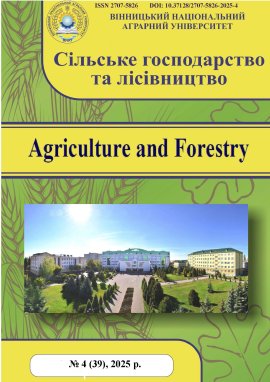
Issue №: 4 (39)
The issue of the magazine is dedicated to the study of the optimization of technological methods of growing agricultural crops. The impact of leguminous crops on improving soil fertility, methods of combating pests, greening territories, and adaptive selection of leguminous crops are considered.
PRODUCTIVITY OF BRUSSELS SPREADS, ITS MARKETABILITY AND QUALITY UNDER ORGANIC GROWING
Serbin Yevhenii Oleksandrovych – graduate student of the Department of Plant Breeding and Horticulture of the Vinnytsia National Agrarian University (21008, Vinnytsia, 3 Sonyachna Street. email: Ap.nt1982@gmail.com, https://orcid.org/0009-0002-0731-155X).
An assessment of organic Brussels sprout cultivation technology in open ground and its productivity is presented. Scientific observations were conducted in 2023-2025 in open ground conditions on Brilliant F1, Abacus F1, Diablo F1 hybrids and Rosella and Cassiopeia varieties. Seedlings were planted in rows according to a 70x50 cm pattern in the second decade of May. During the research, organic technology for growing Brussels sprouts was used, which included the use of BTU bacterial biological products, namely: to combat bacterial diseases and fusarium wilt, Phytohelp (2 l/ha twice during the vegetative growth phase) and Mycohelp (3 l/ha twice during the product organ growth phase) were used to combat bacterial diseases and fusarium wilt, while Actoverm formula (5 l/ha every 14 days during the vegetative mass growth and product organ growth phases) and biological stimulants Organic Balance 0.5 l/ha + Liposam 0.3 l/ha (application at intervals of 10-15 days during the phase of vegetative mass growth and growth of the product organ). Plants of the Rosella variety and the Diablo F1 hybrid, which were not treated with biological products, served as controls. Organic technology affects the biometric indicators of plants: it promotes the formation of more leaves on plants of the Brilliant F1 and Abacus F1 hybrids by 8-10 pieces; positively affects the diameter of the plant rosette in the Abacus F1 hybrid and Cassiopeia variety; the height of Brilliant F1 and Abacus F1 hybrid plants increases by as much as 6 cm. With proper plant protection and appropriate growth stimulation in organic cultivation, the largest head weight can be obtained for the Abacus F1 hybrid (8.9 g) and the Cassiopeia variety (8.8 g), and the head weight of the Brilliant F1 hybrid can increase by 2%. When growing the Rosella and Cassiopeia varieties, the number of heads per plant is higher than for hybrids. Organic Brussels sprout cultivation technology ensures the formation of the largest number of edible organs, namely 50 and 33 per Cassiopeia variety and Abacus F1 hybrid, respectively. Organic cultivation contributes to the highest yield of Brussels sprouts for the Cassiopeia variety and the Abacus F1 hybrid, where the yield can be 12.5 and 8.4 t/ha. The Rosella and Cassiopeia varieties (90-95%) and the Brilliant F1 (87%) and Abacus F1 (88%) hybrids are characterized by high marketability, with marketability increasing by 3-5%. Adherence to this technology contributes to obtaining a high dry matter content in Abacus F1 and Brilliant F1 hybrids, with a value of 15.00-15.79%. Among the varieties, Cassiopeia is characterized by a high dry matter content, which can increase by 1.2 times, and the Abacus F1 and Brilliant F1 hybrids and the Cassiopeia variety are characterized by high protein and sugar content in the edible parts of Brussels sprouts. The proposed technology increases the protein content by 0.03% and the sugar content by 0.1-0.3% during the cultivation of these hybrids, and by 1.3 and 1.2 times, respectively, for the Cassiopeia variety.
1.Barabash O.Yu., Taranenko L.K., Sich Z.D. (2005). Biologichni osnovi ovochivnictva. [Biological foundations of vegetable growing]. K.: Aristej, 348 s [in Ukrainian].
2.Barabash O.Yu., Hareba V.V. (2000). Kapusta. [Cabbage]. K.: Agrarna nauka. 24 s [in Ukrainian].
3.Vitanov O.D. (2023). Tehnologichni aspekti virobnictva nasinnya ovochevih kultur. [Technological aspects of vegetable seed production]. Navchalno-metodichnij posibnik. Vinnicya: TVORI. [in Ukrainian].
4.Zhuk O.Ya., Sidorova I.M., Fedosij I.O. (2013). Kapusta bryusselska: monografiya. [Brussels sprouts: monograph]. Kiyiv: Nilan-LTD, 2013. [in Ukrainian].
5.Zhuk O.I., Sribna I.M. (2006). Vplyv strokiv sivby na formuvannia holovochok ta vrozhainist kapusty briusselskoi [The influence of sowing dates on the formation of heads and yield of Brussels sprouts]. Visnyk Bilotserkivskoho derzhavnoho ahrarnoho universytetu − Bulletin of the Bilotserki State Agrarian University. Issue 37. 126-132. [in Ukrainian].
6.Zhuk O.Ya., Sribna I.M. (2004). Gospodarsko-biologichna ocinka serednopiznih sortiv kapusti bryusselskoyi v umovah Lisostepu Ukrayini [Economic and biological assessment of medium-late varieties of Brussels sprouts in the conditions of the Forest-Steppe of Ukraine]. Visnyk Lvivskoho derzhavnoho ahrarnoho universytetu. Ceriia Ahronomiia − Bulletin of the Lviv State Agrarian University. Agronomy series. 227–231 [in Ukrainian].
7.Zhuk O.Ya., Sribna I.M. (2004). Produktivnist piznostiglih sortiv kapusti bryusselskoyi v umovah Lisostepu. [Productivity of late-ripening varieties of Brussels sprouts in the conditions of the Forest-Steppe]. Ovochivnictvo i bashtannictvo − Vegetable and melon growing. № 49. 268–274 [in Ukrainian].
8.Korniyenko S.I. (2015). Osoblivosti tehnologiyi viroshuvannya maloposhirenih ovochevih roslin [Features of the technology of growing rare vegetable plants]. Vinnicya.: TOV «Nilan- LTD». [in Ukrainian].
9.Korniyenko S.I., Romanova L.V., Rud V.P., Gumenyuk A.V. (2014). Formuvannya marketingu v ovochevih pidpriyemstvah: monografiya [Formation of marketing in vegetable enterprises: monograph]. Harkiv: Apostrof [in Ukrainian].
10. Kotyuk N.V., Barabash O.Yu. (2004). Sorti i gibridi ta dovidkovij material z tehnologij viroshuvannya ovochevih kultur. [Varieties and hybrids and reference material on vegetable cultivation technologies]. [in Ukrainian].
11. Kocur V. (2005). Integrovana sistema zahistu ovochevih kultur vid hvorob, shkidnikiv i bur’yaniv [Integrated system for protecting vegetable crops from diseases, pests and weeds]. Ahroohliad − Agrooglyad. № 5. 12–17 [in Ukrainian].
12. Kutovenko V.B., Shemetun O.V., Gavris I.L. (2019). Progresivni tehnologiyi ovochivnictva vidkritogo i zakritogo gruntu: navchalnij posibnik. [Progressive technologies of open and closed vegetable growing: a textbook]. K.: Komprint [in Ukrainian].
13. Lapa O.M., Drozda V.F., Pshec N.V. (2006). Ekologichno bezpechni intensivni tehnologiyi viroshuvannya i zahistu ovochevih kultur [Ecologically safe intensive technologies for growing and protecting vegetable crops]. Kiyiv: Universal Druk. [in Ukrainian].
14. Metodika doslidnoyi spravi v ovochivnictvi i bashtannictvi (2001). [Research methodology in vegetable and melon growing]. Za red. G.L. Bondarenka, K.I. Yakovenka. H.: Osnova [in Ukrainian].
15. Osnovi naukovih doslidzhen v agronomiyi (2005). [Fundamentals of scientific research in agronomy]. Pid red. V.O. Yeshenka. Kiyiv: Diya. [in Ukrainian].
About the journal
Cluster Agricultural and veterinary sciences (H1 Agronomy, H4 Forestry)
Name of the publication «AGRICULTURE AND FORESTRY»
The aim of the journal "Agriculture and Forestry" is to highlight the results of fundamental and applied research in the fields of agriculture and forestry, aimed at improving the efficiency of agricultural production and introducing modern technologies into farming practice.
This goal defines the main objectives:
– to ensure the creation of open information access regarding the dissemination of relevant scientific research results to: lecturers of agricultural higher education institutions, postgraduate students, doctoral candidates, research staff, and agricultural production specialists;
– to promote the development of young scientists in agricultural sciences;
– to enhance communication between experienced researchers and young scientists in agronomy and forestry;
– to facilitate the expansion of ties between Vinnytsia National Agrarian University and domestic and foreign educational institutions, scientific establishments, and their academic communities.
The scientific, production, and educational journal "Agriculture and Forestry" is a peer-reviewed open-access publication that publishes original experimental research, theoretical and practice-oriented articles within the cluster of "Agricultural and Veterinary Sciences".
The journal's subject matter covers such areas as agronomy and forestry. Publications of scientific and practical significance address the experimental foundations of agricultural and forestry sector development, innovative production technologies, and the results of fundamental and applied research aimed at increasing productivity, product quality, and the sustainable development of natural and production systems.
Publisher: Vinnytsia National Agrarian University
EDRPOU code: 00497236
Publisher's ROR:05m3ysc06
Prefix DOI: 10.37128/
Frequency is quarterly
Publication languages: (Ukrainian, English)
Media ID R30-05174.
Editor in Chief Ihor Didur
According to the order of the Ministry of Education and Science of Ukraine dated 17.03.2020 № 409. The journal Agriculture and Forestry is included in the List of scientific professional publications of Ukraine Category "B" in agricultural sciences (specialties) - 101, 201, 202, 203, 205, 206.
State registration: Decision of the National Council of Ukraine on Television and Radio Broadcasting No. 1337 and No. 1181. Media identifier – R30-05174.
Scientific journal "AGRICULTURE AND FORESTRY" was founded in 1995; it was entitled as Bulletin of Vinnytsya State Agricultural Institute.
In 2010-2014 was enritled as Collection of scientific works of Vinnytsia National Agrarian University.
It has been named as Agriculture and Forestry since 2015.
Listed in the updated list of scientific professional editions of Ukraine on agricultural sciences under the name Agriculture and Forestry (Order of the Ministry of Education and Science of Ukraine of May 16, 2016; No. 515).
Since 2015, "Agriculture and Forestry". (archive of previous issues for 2015-2019) at http://forestry.vsau.edu.ua/.
The journal “Agriculture and Forestry (ISSN: 2707-5826)” passed the evaluation process of Index Copernicus positively and is indexed in the database of ICI Journals Master List ICV for 2018, 2019, 2020, 2021, 2022, 2023, 2024 is presented in the full list of indexed journals in the Master List International List
ICI Journals Master List Value
