

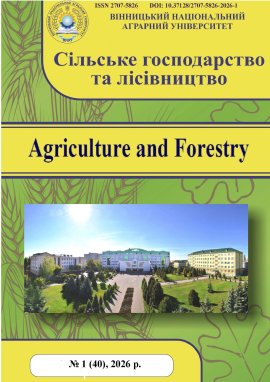
Issue №: 1 (40)
This issue of the journal is devoted to current issues related to the optimization of technological elements in the cultivation of agricultural crops. Considerable attention is paid to the specific features of growing vegetable and cereal crops, which play an important role in ensuring the state’s food security. The scientific publications present research results on the role of leguminous crops in improving soil fertility, the development of domestic and international adaptive breeding, as well as the application of mineral and foliar fertilization to increase the productivity of agroecosystems. Separate studies are devoted to improving the efficiency of forest management and to issues related to landscape greening.
PHYTOMELIORATIVE INFLUENCE OF ANNUAL LEGUME PERENNIAL GRASSES ON THE AGROECOLOGICAL CONDITION OF SOIL IN INTENSIVE CROP ROTATION
Оleksandr Tkachuk, doctor of agricultural sciences, professor, head of the department of ecology and environmental protection of Vinnytsia National Agrarian University (Str. Sunny, 3, Vinnitsa city, 21008. tel. 0679546095, e-mail: tkachukop@ukr.net, ORCID ID: https://orcid.org/0000-0002-0647-6662).
Nadiya Viter, Doctor of Philosophy in Agronomy, Senior Lecturer at the Department of Ecology and Environmental Protection of Vinnytsia National Agrarian University (3 Sonyachna Street, Vinnytsia, 21008. tel. 0961089281, e-mail: viternadia5@gmail.com, ORCID ID: https://orcid.org/0000–0003–1436–9055).
Two-year cultivation of meadow clover on gray podzolized medium loam soils allows to increase the content of humus by 0.01%, mobile phosphorus by 2.5%, exchangeable potassium by 16.9%. Also, the share of agronomically valuable soil aggregates increases by 8.5%, the structural coefficient by 2.3, the share of water-resistant soil aggregates by 6.0% and the soil density decreases by 25.8%. At the same time, the content of alkaline hydrolyzed nitrogen in the soil decreases by 1.5%. During the two-year cultivation of white sweet clover, there is an increase in the content of humus in the soil by 0.02%, mobile phosphorus by 4.4%, exchangeable potassium by 15.8%, an increase in the share of agronomically valuable soil aggregates by 0.1%, the structural coefficient by 0.1, the share of water-resistant soil aggregates by 37.3%, and there is soil loosening by 5.8% in terms of soil bulk density. However, there is a decrease in the content of alkaline hydrolyzed nitrogen by 2.3%. Comparison of phytomeliorative potential regarding the positive impact on the agroecological condition of the soil of two-year cultivation of meadow clover and white sweet clover had shown that white sweet clover has an advantage in the accumulation of humus by 0.01%, mobile phosphorus - by 1.9% and an increase in the share of water-resistant soil aggregates by 31.3%. The cultivation of meadow clover is superior to white sweet clover in the accumulation of exchangeable potassium - by 1.1%, in the increase in the share of agronomically valuable soil aggregates by 8.4% and the structural coefficient - by 2.2, as well as in the amount of soil loosening by 20.0%. Therefore, growing of white sweet clover for phyto-ameliorative purposes will be more appropriate for a rapid increase in the soil content of humus, mobile phosphorus and the cessation of water erosion of the soil. At the same time, in order to solve quickly the problem of low soil supply with exchangeable potassium, soil flooding and destruction of its structure, as well as over-compaction, it is advisable to grow meadow clover.
1. Getman N.Ya., Chepernatyy E.V., Danylyuk B.M., Zakharchuk V.V. (2024). Bobovi travy − faktor intensyfikatsii zemlerobstva [Legumes – a factor in the intensification of agriculture]. Silske hospodarstvo ta lisivnytstvo – Agriculture and forestry. № 4 (35). DOI: https://doi.org/10.37128/2707-5826-2024-4-7 [in Ukrainian].
2. Goncharuk I.V., Novytska L.I., Mazur G.M. (2022). Vprovadzhennia tekhnolohii tochnoho zemlerobstva yak chynnyk vplyvu na ekoloho-ekonomichnu skladovu silskoho hospodarstva [Implementation of precision farming technologies as a factor of influence on the ecological and economic component of agriculture]. Ekonomika, finansy, menedzhment: aktualni pytannia nauky i praktyky – Economics, Finance, Management: Current Issues of Science and Practice. № 3 (61). DOI: https://doi.org/10.37128/2411-4413-2022-3-7 [in Ukrainian].
3. Tkachuk O.P. (2022). Peredumovy perekhodu zemlerobstva v Ukraini na ekoloho-zbalansovani pryntsypy [Prerequisites for the transition of agriculture in Ukraine to ecologically balanced principles]. Ekolohichni nauky – Ecological Sciences. № 5 (44). DOI: https://doi.org/10.32846/2306-9716/2022.eco.5-44.21 [in Ukrainian].
4. Alekseev O.O. (2020). Mekhanizm vidtvorennia i zberezhennia u systemi orhanichnoho zemlerobstva [The mechanism of reproduction and preservation in the system of organic farming]. Silske hospodarstvo ta lisivnytstvo – Agriculture and forestry. № 3 (18). DOI: https://doi.org/10.37128/2707-5826-2020-3-16 [in Ukrainian].
5. Tsyganskyi V.I., Tsyganska O.I., Pantsyreva G.V., Shevchuk O.V. (2025). Nakopychennia biolohichnoho azotu bahatorichnymy bobovymy travamy ta zernobobovymy kulturamy yak sposib vidnovlennia rodiuchosti gruntu. [Accumulation of biological nitrogen by perennial leguminous grasses and leguminous crops as a way to restore soil fertility]. Silske hospodarstvo ta lisivnytstvo – Agriculture and forestry. № 1 (36). DOI: https://doi.org/10.37128/2707-5826-2025-1-2 [in Ukrainian].
6. Razanov S.F. (2020). Ekolohichna efektyvnist vykorystannia bobovykh bahatorichnykh poperednykiv pshenytsi ozymoi [Ecological efficiency of using legume perennial predecessors of winter wheat]. Silske hospodarstvo ta lisivnytstvo – Agriculture and forestry. № 2 (17). DOI: https://doi.org/10.37128/2707-5826-2020-2-15 [in Ukrainian].
7. Didur I.M., Shevchuk V.V. (2020). Pidvyshchennia rodiuchosti gruntu v rezultati nakopychennia biolohichnoho azotu bobovymy kulturamy [Increasing soil fertility as a result of the accumulation of biological nitrogen by legumes]. Silske hospodarstvo ta lisivnytstvo – Agriculture and Forestry. № 1 (16). DOI: https://doi.org/10.37128/2707-5826-2020-1-4 [in Ukrainian].
8. Didur I.M., Pantsyreva G.V. (2024). Porivnialna urozhainist posiviv pshenytsi ozymoi pislia koniushyny luchnoi ta burkunu biloho [Comparative yield of winter wheat crops after meadow clover and white clover]. Ahrarni innovatsii – Agrarian Innovations. № 28. DOI: https://doi.org/10.32848/ agrar.innov.2024.28.6 [in Ukrainian].
9. Zabarna T.A. (2021). Formuvannia produktyvnosti koniushyny luchnoi zalezhno vid faktoriv intensyfikatsii [Formation of productivity of meadow clover depending on intensification factors]. Silske hospodarstvo ta lisivnytstvo – Agriculture and forestry. № 2 (21). DOІ: https://doi.org/10.37128/2707-5826-2021-2-8 [in Ukrainian].
10. Vozhegova R.A., Vlashchuk A.M., Drobit O.S., Belov V.O. (2022). Udoskonalennia ahrotekhniky vyroshchuvannia burkunu biloho odnorichnoho v umovakh Pivdennoho Stepu Ukrainy [Improving the agricultural technology of growing annual white yam in the conditions of the Southern Steppe of Ukraine]. Visnyk ahrarnoi nauky – Bulletin of Agrarian Science. № 2. DOI: https://doi.org/10.31073/agrovisnyk202202-01 [in Ukrainian].
11. Alekseev O.O., Vradiy O.I. (2025). Vyvchennia intensyvnosti nakopychennia vazhkykh metaliv roslynamy burkunu biloho (Melilotus Albus) na gruntakh, shcho zaznaly vplyvu boiovykh dii [Study of the intensity of heavy metal accumulation by white sweet clover (Melilotus Albus) plants on soils affected by hostilities]. Ahrarni innovatsii – Agrarian Innovations. № 30. DOI: https://doi.org/10.32848/agrar.innov.2025.30.2 [in Ukrainian].
12. Romanyuk O., Romanyuk G., Shevchik-Kostyuk L., Oshchapovsky I. (2025). Perspektyvy vykorystannia burkunu biloho ta burkunu zhovtoho dlia vidnovlennia zemel Ukrainy: ohliad [Prospects for the use of white and yellow sedge for the restoration of Ukrainian lands: a review]. Visnyk Zaporizkoho natsionalnoho universytetu. Biolohichni nauky – Bulletin of the Zaporizhia National University. Biological Sciences. № 1. DOI: https://doi.org/10.26661/2410-0943-2025-1-02 [in Ukrainian].
13. Vlashchuk A.M., Drobit O.S., Shapar L.V., Koblai O.O., Shablya O.S. (2024). Suchasni tendentsii vyroshchuvannia bobovykh kormovykh kultur na pivdni Ukrainy za umov zminy klimatu [Current trends in growing legume fodder crops in southern Ukraine under climate change]. Visnyk ahrarnoi nauky – Bulletin of Agrarian Science. № 4 (853). 60-67. DOI: https://doi.org/10.31073/agrovisnyk 202404-09 [in Ukrainian].
14. Tsyhanskyi V.I., Tsyhanska O.I. (2020). Vplyv elementiv tekhnolohii vyroshchuvannia na aktyvizatsiiu roslynno-mikrobnoho symbiozu ta protsesy transformatsii azotu u ahrotsenozakh liutserny posivnoi [The influence of elements of cultivation technology on the activation of plant-microbial symbiosis and nitrogen transformation processes in agrocenoses of alfalfa seed]. Silske hospodarstvo i lisivnytstvo − Agriculture and forestry. № 1 (16). DOI: https://doi.org/10.37128/ 2707-5826-2020-1-5 [in Ukrainian].
15. Moiseichenko V.F., Yeshchenko V.O. (1994). Osnovy naukovykh doslidzhen v ahronomii [Fundamentals of Scientific Research in Agronomy]. Kyiv: Vyscha Shkola. [in Ukrainian].
About the journal
Cluster Agricultural and veterinary sciences (H1 Agronomy, H4 Forestry)
Name of the publication «AGRICULTURE AND FORESTRY»
The aim of the journal "Agriculture and Forestry" is to highlight the results of fundamental and applied research in the fields of agriculture and forestry, aimed at improving the efficiency of agricultural production and introducing modern technologies into farming practice.
This goal defines the main objectives:
– to ensure the creation of open information access regarding the dissemination of relevant scientific research results to: lecturers of agricultural higher education institutions, postgraduate students, doctoral candidates, research staff, and agricultural production specialists;
– to promote the development of young scientists in agricultural sciences;
– to enhance communication between experienced researchers and young scientists in agronomy and forestry;
– to facilitate the expansion of ties between Vinnytsia National Agrarian University and domestic and foreign educational institutions, scientific establishments, and their academic communities.
The scientific, production, and educational journal "Agriculture and Forestry" is a peer-reviewed open-access publication that publishes original experimental research, theoretical and practice-oriented articles within the cluster of "Agricultural and Veterinary Sciences".
The journal's subject matter covers such areas as agronomy and forestry. Publications of scientific and practical significance address the experimental foundations of agricultural and forestry sector development, innovative production technologies, and the results of fundamental and applied research aimed at increasing productivity, product quality, and the sustainable development of natural and production systems.
Publisher: Vinnytsia National Agrarian University
EDRPOU code: 00497236
Publisher's ROR:05m3ysc06
Prefix DOI: 10.37128/
Frequency is quarterly
Publication languages: (Ukrainian, English)
Media ID R30-05174.
Editor in Chief Ihor Didur
According to the order of the Ministry of Education and Science of Ukraine dated 17.03.2020 № 409. The journal Agriculture and Forestry is included in the List of scientific professional publications of Ukraine Category "B" in agricultural sciences (specialties) - 101, 201, 202, 203, 205, 206.
State registration: Decision of the National Council of Ukraine on Television and Radio Broadcasting No. 1337 and No. 1181. Media identifier – R30-05174.
Scientific journal "AGRICULTURE AND FORESTRY" was founded in 1995; it was entitled as Bulletin of Vinnytsya State Agricultural Institute.
In 2010-2014 was enritled as Collection of scientific works of Vinnytsia National Agrarian University.
It has been named as Agriculture and Forestry since 2015.
Listed in the updated list of scientific professional editions of Ukraine on agricultural sciences under the name Agriculture and Forestry (Order of the Ministry of Education and Science of Ukraine of May 16, 2016; No. 515).
Since 2015, "Agriculture and Forestry". (archive of previous issues for 2015-2019) at http://forestry.vsau.edu.ua/.
The journal “Agriculture and Forestry (ISSN: 2707-5826)” passed the evaluation process of Index Copernicus positively and is indexed in the database of ICI Journals Master List ICV for 2018, 2019, 2020, 2021, 2022, 2023, 2024 is presented in the full list of indexed journals in the Master List International List
ICI Journals Master List Value
