

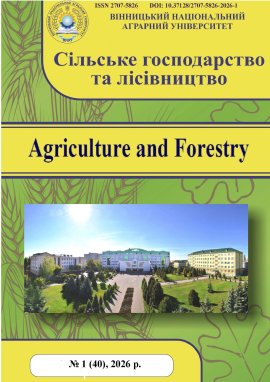
Issue №: 1 (40)
This issue of the journal is devoted to current issues related to the optimization of technological elements in the cultivation of agricultural crops. Considerable attention is paid to the specific features of growing vegetable and cereal crops, which play an important role in ensuring the state’s food security. The scientific publications present research results on the role of leguminous crops in improving soil fertility, the development of domestic and international adaptive breeding, as well as the application of mineral and foliar fertilization to increase the productivity of agroecosystems. Separate studies are devoted to improving the efficiency of forest management and to issues related to landscape greening.
PECULIARITIES OF THE FORMATION OF THE PHYSICAL QUALITY OF QUERCUS ROBUR L WOOD IN THE UKRAINIAN CARPATHIANS
Ivan Sopushynskyi, Doctor of Agricultural Sciences, Professor of the Department of Forestry and Sustainable Nature Management of the Cherkasy State University of Technology (18006, Cherkasy, Shevchenko Blvd., 460. e-mail: i.sopushynskyi@chdtu.edu.ua, ORCID ID: https://orcid.org/0000-0002-7392-9385).
Ruslan Maksymchuk, Doctor of Philosophy in Forestry, Associate Professor of the Department of Forestry and Sustainable Nature Management of the Cherkasy State University of Technology (18006, Cherkasy, Shevchenko Boulevard, 460. e-mail: maksymchuktaras@ gmail.com, ORCID ID: https://orcid.org/0000-0001-5297-4542).
Yaroslav Kopolovets, Doctor of Philosophy in Forestry, Associate Professor of the Department of Forestry of the Uzhgorod National University (88000, Uzhgorod, Pidhirna St., 46. e-mail: yaroslav.kopolovets@uzhnu.edu.ua, ORCID ID: https://orcid.org/0009-0006-4008-4052).
Ludmyla Bilyk, Doctor of Pedagogical Sciences, Professor, Department of Forestry and Sustainable Nature Management, Cherkasy State University of Technology (18006, Cherkasy, Shevchenko Boulevard, 460. e-mail: bilyk218@ukr.net, ORCID ID: https://orcid.org/0000-0003-3802-6145).
The article presents the results of a comprehensive study of the physical properties of pedunculate oak (Quercus robur L.) wood of seed and vegetative origin, growing in a fresh hornbeam stand of the Ukrainian Carpathians. The relevance of the work is due to the growing global demand for wood raw materials, increasing requirements for its quality and the need for rational use of forest resources in the context of the formation of a bioeconomy and the transition to low-carbon technologies. Particular attention is paid to pedunculate oak as one of the most valuable hardwoods, the wood of which is widely used in the woodworking and furniture industries. The object of the study was oak stands of seed and vegetative origin, located at an altitude of 500–550 m above sea level. 12 model trees were selected for the study, from which 360 samples of wood of standard sizes were made. The indicators of absolutely dry, basic and fresh-cut wood density, absolute and basic wood porosity, as well as linear and volumetric shrinkage of wood in different anatomical directions were determined. Statistical processing of the results was performed using SPSS and Microsoft Excel software. It was established that oak wood of seed origin is characterized by higher values of absolutely dry and basic wood density, lower wood porosity and higher physical quality compared to wood of vegetative origin. The processes of wood drying have a pronounced anisotropic nature, with the largest values recorded in the tangential direction. It was shown that there is a close linear relationship between the basic wood density and the indicators of tangential and volumetric shrinkage, while radial shrinkage showed a weaker dependence on wood density. An inverse linear relationship between the basic wood density and absolute porosity of wood was also established, regardless of its origin. The results obtained indicate that the origin of pedunculate oak significantly affects the formation of the physical quality of wood. Wood of seed origin is more suitable for use in responsible structural and furniture products, while wood of vegetative origin can be more effectively used in impregnation and modification technologies. The results of the study have practical significance for optimizing the use of oak wood, improving its processing technologies and increasing the economic efficiency of forest management, taking into account the morphogenetic characteristics of plantations.
1. Vintoniv I.S., Sopushynskyi I.M., Teischinger A. (2007). Derevynoznavstvo [Wood Science]: nawchal. pos. Vyd. 2-he, pererob. i dopov. Lviv : Apriori. [in Ukrainian].
2. FAO. Global Forest Resources Assessment 2020 (FRA 2020), Food and Agricultural Organization of the United Nations; FAO: Rome, Italy. [In English].
3. Gundersen V., Vistad O.I., Skjeggedal T. (2022). Forest Owners’ Perspectives on Forest Protection in Norway. Scand. J. For. Res. 37, P. 276–286. DOI: https://doi.org/10.1080/ 02827581.2022.2075448 [In English].
4. Kupčák V., Pek R. (2015). The Level of the Wood Raw Material Base Processing in the Czech Republic, Procedia Economics and Finance, Vol. 34, P. 557-564. DOI: https://doi.org/ 10.1016/S2212-5671(15)01668-8 [In English].
5. Nepal P., Johnston C.M.T., Ganguly I. (2021). Effects on Global Forests and Wood Product Markets of Increased Demand for Mass Timber. Sustainability, 13, P. 13943. DOI: https:// doi.org/10.1080/02827581.2022.2075448 [In English].
6. Normen für Holz: (2009).DIN-Taschenbuch 31: 8te Aufl. Berlin : Beuth, 604. [In English].
7. Sandberg D., Kutnar A., Mantanis G. (2017). Wood Modification Technologies-a Review. Iforest-Biogeosci. For. 10, P. 895. DOI: https://doi.org/ 10.3832/ifor2380-010. [In English].
8. Tomczak K., Mania P., Cukor J., Vacek Z., Komorowicz M., Tomczak A. (2024). Wood Quality of Pendulate Oak on Post-Agricultural Land: A Case Study Based on Physico-Mechanical and Anatomical Properties. Forests. 15, P. 1394. DOI:https://doi.org/10.3390/f15081394 [In English].
9. Yukhnovskyi V.Y., Lobchenko G.B., Khodash A.B., Mosquera-Losada M. R., Borek R. (2017). Надземна фітомаса дуба звичайного у полезахисних лісових смугах центральної частини України. Scientific Bulletin of UNFU, 27 (8), P. 111-117. DOI:https://doi.org/10.15421/40270818. [In English].
About the journal
Cluster Agricultural and veterinary sciences (H1 Agronomy, H4 Forestry)
Name of the publication «AGRICULTURE AND FORESTRY»
The aim of the journal "Agriculture and Forestry" is to highlight the results of fundamental and applied research in the fields of agriculture and forestry, aimed at improving the efficiency of agricultural production and introducing modern technologies into farming practice.
This goal defines the main objectives:
– to ensure the creation of open information access regarding the dissemination of relevant scientific research results to: lecturers of agricultural higher education institutions, postgraduate students, doctoral candidates, research staff, and agricultural production specialists;
– to promote the development of young scientists in agricultural sciences;
– to enhance communication between experienced researchers and young scientists in agronomy and forestry;
– to facilitate the expansion of ties between Vinnytsia National Agrarian University and domestic and foreign educational institutions, scientific establishments, and their academic communities.
The scientific, production, and educational journal "Agriculture and Forestry" is a peer-reviewed open-access publication that publishes original experimental research, theoretical and practice-oriented articles within the cluster of "Agricultural and Veterinary Sciences".
The journal's subject matter covers such areas as agronomy and forestry. Publications of scientific and practical significance address the experimental foundations of agricultural and forestry sector development, innovative production technologies, and the results of fundamental and applied research aimed at increasing productivity, product quality, and the sustainable development of natural and production systems.
Publisher: Vinnytsia National Agrarian University
EDRPOU code: 00497236
Publisher's ROR:05m3ysc06
Prefix DOI: 10.37128/
Frequency is quarterly
Publication languages: (Ukrainian, English)
Media ID R30-05174.
Editor in Chief Ihor Didur
According to the order of the Ministry of Education and Science of Ukraine dated 17.03.2020 № 409. The journal Agriculture and Forestry is included in the List of scientific professional publications of Ukraine Category "B" in agricultural sciences (specialties) - 101, 201, 202, 203, 205, 206.
State registration: Decision of the National Council of Ukraine on Television and Radio Broadcasting No. 1337 and No. 1181. Media identifier – R30-05174.
Scientific journal "AGRICULTURE AND FORESTRY" was founded in 1995; it was entitled as Bulletin of Vinnytsya State Agricultural Institute.
In 2010-2014 was enritled as Collection of scientific works of Vinnytsia National Agrarian University.
It has been named as Agriculture and Forestry since 2015.
Listed in the updated list of scientific professional editions of Ukraine on agricultural sciences under the name Agriculture and Forestry (Order of the Ministry of Education and Science of Ukraine of May 16, 2016; No. 515).
Since 2015, "Agriculture and Forestry". (archive of previous issues for 2015-2019) at http://forestry.vsau.edu.ua/.
The journal “Agriculture and Forestry (ISSN: 2707-5826)” passed the evaluation process of Index Copernicus positively and is indexed in the database of ICI Journals Master List ICV for 2018, 2019, 2020, 2021, 2022, 2023, 2024 is presented in the full list of indexed journals in the Master List International List
ICI Journals Master List Value
