

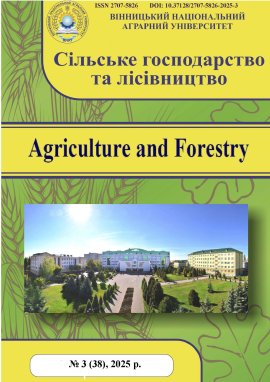
Issue №: 3 (38)
Publications contains the results of researches on optimization of technological methods of cultivation of crops, preservation of soil fertility, greening of agricultural production, modern directions of selection, reproduction of forest resources.
OPTIMIZATION OF TECHNOLOGICAL TECHNIQUES OF SOYBEAN CONDITIONS OF NNVK "ALL-UKRAINIAN SCIENTIFIC AND EDUCATIONAL CONSORTIUM" (ULADOVO-LULINETSKA RESEARCH AND SELECTION STATION)
Mazur Viktor – Candidate of Agricultural Sciences, Professor of the Department of crop production and garden, Rector of the Vinnytsia National Agrarian University, Vice-President of ESPC Ukrainian Scientific-Educational Consortium (21008, Vinnytsia, Soniachna St.3, е-mail: rector@vsau.org ).
Branitskyi Yurii Yuriyovych – Candidate of Agricultural Sciences, Director of the Uladovo-Lyulinetsky Experimental Breeding Station of the Institute of Bioenergetic Cultures and Sugar Beet NAAS (Vinnytia region, Kalynivka, district, Uladivske, Samolevska Str., 15).
Yakovets Volodymyr Ihorovych − graduate student of the department of plant and horticulture of VNAU (21008, Vinnytsia, 3 Sonyachna St.).
The article shows the results of studies of the effect of seed inoculation and fertilization on the field germination of seeds, indicators of plant preservation, leaf surface area and yield of soybean varieties. It is established that the lowest rates of seed germination, plant safety, leaf surface area and seed yields were observed on the control version of the experiment. The density of soybean plants depends on the formation of the field germination of plants and the resistance of plants to adverse abiotic and biotic conditions, which are formed during the growing season of cultivation of soybean varieties. The absolute control shows the lowest indicators of plants, which were made of Betin and embroidery varieties - 89.7 %. The maximum area of the leaf surface of plants is observed in the flowering phase (BBCH Microstadia 60-69) on all variants of the experiment. However, the lowest rates were noted on absolute control - 43.1 and 42.3 thousand m2/ha. Like the lowest yield of soybean varieties, which was 1.6 and 1.4 t/ha. The maximum indicators of saving soybean varieties-95.5 and embroidery-94.7% was noted in the Option of the Experiment, which conducted joint treatment of the wonder yelow crops at the Microstadium of VSN 14-15 and Wonder Bor on the HIPSCC Fertilizers N20P 20S9, as well as seed treatment by Maxim XL, is 5.8 and 5.0%, respectively. In this version of the experiment, the maximum area of soybean leaf surface was noted on the microstadium 60-69, in particular in Betin variety-47.2 thousand m2/ha and Vyshivanka variety-47 thousand m2/ha, which is higher compared to absolute control by 4.1 and 4.7 thousand m2/ha. Like the highest yield level, in particular Betin - 3.0 and embroidery variety - 2.6 t/ha or 1.4 and 1.2 t/ha compared to absolute control
1. Drobitko A.V., Kokovikhin S.V. (2020). Vplyv peredposivnoi inokuliatsii nasinnia na produktyvnist sortiv soi v umovakh Stepu Ukrainy [Influence of presowing inoculation of seeds on the productivity of soybean varieties in the conditions of the steppe of Ukraine]. Ahrarni innovatsii − Agrarian innovations. №1. 40-45. DOI: https://doi.org/10.32848/agrar.innov.2020. [in Ukrainian].
2. Vyshnivskyi P.S., Furman O.V. (2020). Produktyvnist soi zalezhno vid elementiv tekhnolohii vyroshchuvannia v umovakh Pravoberezhnoho Lisostepu Ukrainy [Soybean productivity depending on the elements of cultivation technology in the conditions of the Right -Bank Forest -Steppe of Ukraine]. Plant and soil science. Vol. 11. № 1. 13-22. DOI: hpps://doi.org10.31548/agr2020.01.013. [in Ukrainian].
3. Kryzhanivskyi M.V., Bakhmat O.M. (2022). Produktyvnist soi zalezhno vid zastosuvannia orhanichnykh dobryv, inokuliatsii nasinnia ta rehuliatoriv rostu roslyn [Soybean productivity, depending on the use of organic fertilizers, seeds of seeds and plant growth regulators]. Podilskyi visnyk: silske hospodarstvo, tekhnika, ekonomika − Podilsky Bulletin: Agriculture, Technology, Economics. № 37. 26-31. DOI: https://doi.org/10.37406/2706-9052-2022-2-4. [in Ukrainian].
4. Cherkas V. (2021). Vyroshchuvannia soi: na shcho slid zvernuty uvahu [Growing soybean: what to look for]. Ahorobiznez sohodni − Agobizaza today. URL: http://agro-busi-ness.com.ua/agro/ahronomiia-sohodni/item/20930-vyroshchu-vannia-soi-na -shcho-slid-zvernuty-uvahu.html. [in Ukrainian].
5. Vorobei N.A., Kukol K.P., Pukhtaievych P.P., Kots S.Ia. (2023). Kompleksna inokuliatsiia soi bulbochkovymy bakteriiamy Bradyrhizobium japonicum yak zasib optymizatsii symbiotychnoi azotfiksatsii [Complex inoculation of soybean bacteria Bradyrhizobium japonicum as a means of optimizing symbiotic nitrogen fixation]. Silskohospodarska mikrobiolohiia − Agricultural microbiology. Issue. 38. 29–39. DOI: https://doi.org/10.35868/1997-3004.38.29-39.[in Ukrainian].
6. Shevnikov M.Ia., Koblai O.O. (2015). Zastosuvannia biolohichnykh, khimichnykh ta fizychnykh zasobiv u tekhnolohiiakh vyroshchuvannia soi ta kukurudzy [The use of biological, chemical and physical means in soybean and corn cultivation technologies]. Poltava. 42 s. [in Ukrainian].
7. Griebsh A., Matschavelli N., Lewandowska S., Schmidtke K. (2020). Presence of Bradyrhizobium sp. under continental conditions in central Europe. Agriculture. № 10 (10), 44 DOI:10.3390/agriculture10100446. [in English].
8. Salvagiotti F., Cassman K.G., Specht J.E., Walters D.T., Weiss A., Dobermann A. (2008). Nitrogen uptake, fixation and response to fertilizer N in soybeans: A review. Field Crops Research, № 108 (1), 1–13 DOI: https://doi.org/10.1016/j.fcr.2008.03.001. [in English].
9. Du Y., Zhao Q., Li S., Yao X., Xie F., Zhao M. (2019). Shoot/root interactions affect soybean photosynthetic traits and yield formation: a case study of grafting with record-yield culti-vars. Frontiers in Plant Science. 10, 445 DOI: https://doi.org/10.3389/fpls.2019.00445. [in English].
10. Thilakarathna M.S., Raizada M.N. (2017). A meta-analysis of the effectiveness of diverse rhizobia inoculants on soybean traits under field conditions. Soil Biology and Biochemistry. 105. 177–196. DOI: https://doi.org/10.1016/j. soilbio.2016.11.022. [in English].
11.Kobylynskyi I. (2024). The peculiarities of inoculation at soybean cultivation. Scientific Progress & Innovations. 27 (2), 22–26. DOI: 10.31210/spi2024.27.02.04. [in English].
12. Novytska N., Gadzovskiy G., Mazurenko B., Martynov O. (2020). Effect of seed inoculation and foliar fertilizing on structure of soybean yield and yield structure in western polissya of Ukraine. Agronomy Research. 18 (4). P. 2512–2519. DOI: 10.15159/AR.20.203. [in English].
13. Bakhmat O.M., Chynchyk O.S. (2010). Vplyv ahrotekhnichnykh pryiomiv na nasinnievu produktyvnist soi v umovakh zakhidnoho rehionu Ukrainy [Influence of agrotechnical techniques on seed productivity of soybeans in the Western region of Ukraine]. Naukovi pratsi PDAA − Scientific works of PDAA. Vol. 7 (26). 61–64.
14. Adamenko S.M., Hrytsak I.P. (2011). Dobryva dlia soi vid kompanii «Nutritekh Ukraina» [Fertilizers for soybean from Nutrith Ukraine]. Ahronom − Agronomist. № 2. 38–40. [in Ukrainian].
15. Moskalets V.V., Shynkarenko V.K. (2004). Zastosuvannia mikrobnykh preparativ i mikroelementnykh dobryv na yakist zerna soi [Application of microbial preparations and microelement fertilizers on the quality of soybean grain]. Ahroekolohichnyi zhurnal − Agroecological Journal. № 3. 20-27. [in Ukrainian].
16. Vovkodav V.V. (2001). Metodyka derzhavnoho sortovyprobuvannia silskohospodarskykh kultur (zernovi, krupiani ta zernobobovi) [Methods of state varietal testing of crops (cereals, cereals and legumes)]. K. 2. [in Ukrainian].
About the journal
Cluster Agricultural and veterinary sciences (H1 Agronomy, H4 Forestry)
Name of the publication «AGRICULTURE AND FORESTRY»
The aim of the journal "Agriculture and Forestry" is to highlight the results of fundamental and applied research in the fields of agriculture and forestry, aimed at improving the efficiency of agricultural production and introducing modern technologies into farming practice.
This goal defines the main objectives:
– to ensure the creation of open information access regarding the dissemination of relevant scientific research results to: lecturers of agricultural higher education institutions, postgraduate students, doctoral candidates, research staff, and agricultural production specialists;
– to promote the development of young scientists in agricultural sciences;
– to enhance communication between experienced researchers and young scientists in agronomy and forestry;
– to facilitate the expansion of ties between Vinnytsia National Agrarian University and domestic and foreign educational institutions, scientific establishments, and their academic communities.
The scientific, production, and educational journal "Agriculture and Forestry" is a peer-reviewed open-access publication that publishes original experimental research, theoretical and practice-oriented articles within the cluster of "Agricultural and Veterinary Sciences".
The journal's subject matter covers such areas as agronomy and forestry. Publications of scientific and practical significance address the experimental foundations of agricultural and forestry sector development, innovative production technologies, and the results of fundamental and applied research aimed at increasing productivity, product quality, and the sustainable development of natural and production systems.
Publisher: Vinnytsia National Agrarian University
EDRPOU code: 00497236
Publisher's ROR:05m3ysc06
Prefix DOI: 10.37128/
Frequency is quarterly
Publication languages: (Ukrainian, English)
Media ID R30-05174.
Editor in Chief Ihor Didur
According to the order of the Ministry of Education and Science of Ukraine dated 17.03.2020 № 409. The journal Agriculture and Forestry is included in the List of scientific professional publications of Ukraine Category "B" in agricultural sciences (specialties) - 101, 201, 202, 203, 205, 206.
State registration: Decision of the National Council of Ukraine on Television and Radio Broadcasting No. 1337 and No. 1181. Media identifier – R30-05174.
Scientific journal "AGRICULTURE AND FORESTRY" was founded in 1995; it was entitled as Bulletin of Vinnytsya State Agricultural Institute.
In 2010-2014 was enritled as Collection of scientific works of Vinnytsia National Agrarian University.
It has been named as Agriculture and Forestry since 2015.
Listed in the updated list of scientific professional editions of Ukraine on agricultural sciences under the name Agriculture and Forestry (Order of the Ministry of Education and Science of Ukraine of May 16, 2016; No. 515).
Since 2015, "Agriculture and Forestry". (archive of previous issues for 2015-2019) at http://forestry.vsau.edu.ua/.
The journal “Agriculture and Forestry (ISSN: 2707-5826)” passed the evaluation process of Index Copernicus positively and is indexed in the database of ICI Journals Master List ICV for 2018, 2019, 2020, 2021, 2022, 2023, 2024 is presented in the full list of indexed journals in the Master List International List
ICI Journals Master List Value
