

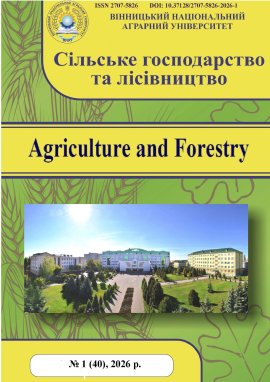
Issue №: 1 (40)
This issue of the journal is devoted to current issues related to the optimization of technological elements in the cultivation of agricultural crops. Considerable attention is paid to the specific features of growing vegetable and cereal crops, which play an important role in ensuring the state’s food security. The scientific publications present research results on the role of leguminous crops in improving soil fertility, the development of domestic and international adaptive breeding, as well as the application of mineral and foliar fertilization to increase the productivity of agroecosystems. Separate studies are devoted to improving the efficiency of forest management and to issues related to landscape greening.
MAIZE BREEDING FOR ENHANCED ADAPTABILITY TO CLIMATE CHANGE IN EUROPE
Bronisław Puczel, dr inż. International Academy of Applied Sciences in Łomża, Poland, bronekpuczel@gmail.com ORCID: https://orcid.org/0009-0008-5097-9639.
Based on a structured statistical assessment of the implementation outcomes of European Union maize breeding programs, particularly regarding their efforts to enhance the adaptive potential of modern maize genotypes, a set of generalizations and conclusions on the effectiveness of these programs has been formulated. The network of national institutions and genetic-breeding centers across Europe has been analyzed and characterized. These institutions focus on targeted maize breeding using local landraces or base populations, applying mono- or multi-trait selection for resistance to key stress factors that significantly limit the yield potential of Europe’s high-intensity maize hybrids. The content of breeding programs from leading European seed companies –such as KWS, Limagrain, Syngenta, Corteva Agriscience, MAS Seeds, and Euralis (Lidea brand) – has been summarized and reviewed. These programs were specifically assessed regarding the incorporation of current and projected climate change impacts across Europe, with attention to scaling these strategies to other regions. Key traits emphasized included drought and cold tolerance, heat and osmotic stress resistance, and comprehensive tolerance to the most damaging diseases and pests. Over a 45-year evaluation period, the incremental improvements in resistance traits of developed maize hybrids were systematized, focusing on their responses to climatic variability during the growing season, soil fertility requirements, lodging resistance, and resistance to phytophagous pests and phytopathogens. This analysis considered the close relationship between the intensity of stress factors affecting plant growth and development, the realization of bioproductivity, and the dynamics of regional climatic regimes (temperature, water availability, etc.). As a final outcome, the most successful European-bred genotypes in terms of climatic adaptability and abiotic stress resistance were identified. These genotypes have gained recognition both in Europe and globally and are also suitable for cultivation in Ukraine.
1. Bilgili M., Tokmakci M. (2025). Climate change and trends in Europe and globally over the period 1970–2023. Physics and Chemistry of the Earth. Parts A/B/C 139. P. 103928. DOI: 10.1016/j.pce.2025.103928 [in English].
2. Moore F.C., Lobell D.B. (2015). The fingerprint of climate trends on European crop yields. Proceedings of the National Academy of Sciences of the United States of America. Vol. 112. № 9. P. 2670–2675 DOI: 10.1073/pnas.1409606112 [in English].
3. Florea A. C., Sumedrea D. I., Rodino S., Ion M., Dragomir V., Dumitru A.-M., Pîrcalabu L., Dinu D. G. (2025). The Impact of Climate Change on Eastern European Viticulture: A Review of Smart Irrigation and Water Management Strategies. Horticulturae. Vol. 11. №11. P.1282. DOI: 10.3390/horticulturae11111282 [in English].
4. Georgopoulou E., Gakis N., Voloudakis D., Daskalakis M., Sarafidis Y., Lalas D. P., Mirasgedis S. (2024). Effectiveness of Options for the Adaptation of Crop Farming to Climate Change in a Country of the European South. Agriculture. Vol. 14. № 10. P. 1814. DOI: 10.3390/agriculture14101814 [in English].
5. Olesen J.E., Trnka M., Kersebaum K.C., Skjelvåg A.O., Seguin B., Peltonen-Sainio P., Rossi F., Kozyra J., Micale F. (2011). Impacts and adaptation of European crop production systems to climate change. European Journal of Agronomy. Vol. 34. P. 96–112. DOI: 10.1016/j.eja.2010.11.003 [in English].
6. Snowdon R.J., Wittkop B., Chen T.W., Stahl A. (2021). Crop adaptation to climate change as a consequence of long-term breeding. Theoretical and Applied Genetics. Vol. 134. P. 1613–1623 DOI: 10.1007/s00122-020-03729-3 [in English].
7. Abdulmalik R.O., Menkir A., Meseka S.K., Unachukwu N., Ado S.G., Olarewaju J.D., Aba D.A., Hearne S., Crossa J., Gedil M. (2017). Genetic gains in grain yield of a maize population improved through marker assisted recurrent selection under stress and nonstress conditions in West Africa. Frontiers in Plant Science. Vol. 8. P. 84. DOI: 10.3389/ fpls.2017.00841 [in English].
8. Challinor A. J., Watson J., Lobell D. B.; Howden S. M., Smith D. R., Chhetri N. (2014). A meta-analysis of crop yield under climate change and adaptation. Nature Climate Change. Vol. 4. P. 287–291. DOI: 10.1038/nclimate2153 [in English].
9. Takou M., Schulz K., Stetter M. G. (2025). Local Selection Shaped the Diversity of European Maize Landraces. Molecular Ecology. Vol. 34. № 24. P. 17720. DOI: 10.1111/mec.17720 [in English].
10. Duvick D. N., Smith J. S. C., Cooper M. (2004). Long-term selection in a commercial hybrid maize breeding program. Plant Breeding Reviews. Vol. 24. №2. Р. 109–152. DOI: 10.1002/9780470650288.ch4 [in English].
11. Kadoumi R., Heslot N., Henriot F. Murigneux A., Berton M., Moreau L., Charcosset A. (2025). Evolution of population structure in a commercial European hybrid dent maize breeding program and consequences on genetic diversity. Theoretical and Applied Genetics. Vol. 138. P. 233. DOI: 10.1007/s00122-025-05008-5 [in English].
12. Galic V., Salaic M., Zdunic Z., Šimic D., Brkic A., Ledencan T., Brkic J., Atakul E., Er Ü., Guberac V., Jambrovic A. (2024). Maize yields could benefit from increased vapor pressure deficit in hot managed environments. Environmental Research Communications. Vol. 6. P. 121007. DOI:10.1088/2515-7620/ad9b75 [in English].
13. Danalatos G. J. N., Wright E. E., Reiman M., Trifunovic S., Olson B., Castellano M. J., Archontoulis S.V. (2026). Modern maize hybrids have improved tolerance to drought stress and increased yield potential. Agronomy Journal. Vol. 118. P. 70294. DOI: 10.1002/agj2.70294 [in English].
14. Li Z., Zhang J., Song X. (2024). Breeding Maize Hybrids with Improved Drought Tolerance Using Genetic Transformation. International Journal of Molecular Sciences. Vol. 25. № 19. P. 10630. DOI: 10.3390/ijms251910630 [in English].
15. Popa C., Călugăr R. E., Varga A., Muntean E., Băcilă I., Vana C. D., Racz I., Tritean N., Berindean I. V., Ona A. D., Muntean L. (2025). Evaluating Maize Hybrids for Yield, Stress Tolerance, and Carotenoid Content: Insights into Breeding for Climate Resilience. Plants. Vol. 14. № 1. P. 138. DOI: 10.3390/plants14010138 [in English].
16. Sheoran S, Kaur Y, Kumar S, Shukla S, Rakshit S, Kumar R. (2022). Recent Advances for Drought Stress Tolerance in Maize (Zea mays L.): Present Status and Future Prospects. Frontiers in Plant Science. Vol. 13. P. 872566. DOI: 10.3389/fpls.2022.872566 [in English].
17. Călugăr R.E., Varga A., Vana C.D., Ceclan L.A., Racz I., Chețan F., Șimon A., Popa C., Tritean N., Russu F., Ghețe A.B., Muntean L. (2024). Influence of Changing Weather on Old and New Maize Hybrids: A Case Study in Romania. Plants (Basel). Vol. 13. № 23. P. 3322. DOI: 10.3390/plants13233322 [in English].
18. Glenn K.C., Alsop B., Bell E., Goley M., Jenkinson J., Liu B., Martin C., Parrott W., Souder C., Sparks O., Urquhart W., Ward J.M., Vicini J.L. (2017). Bringing new plant varieties to market: plant breeding and selection practices advance beneficial characteristics while minimizing unintended changes. Crop Science. Vol. 57. P. 2906–2921. DOI: 10.2135/cropsci2017.03.0199 [in English].
19. Elsen A., Gotor A. A., di Vicente C., Traon D., Gennatas J., Amat L., Negri V., Chable V. (2013). Plant breeding for an EU bio-based economy. The potential of public sector and public/private partnerships. Luxembourg: Publications Office of the European Union. DOI: 10.2791/94661 [in English].
20. Ordóñez R. A., Olmedo-Pico L., Ferela A., Trifunovic S., Eudy D., Archontoulis S., Vyn T. J. (2025). Modern maize hybrids have increased grain yield and efficiency tolerances to nitrogen-limited conditions. European Journal of Agronomy. Vol. 168. P. 127621. DOI: 10.1016/j.eja.2025.127621 [in English].
21. Miedaner T., Juroszek P. (2021). Global warming and increasing maize cultivation demand comprehensive efforts in disease and insect resistance breeding in north-western Europe. Plant Pathology. Vol. 70. P. 1032–1046. DOI: 10.1111/ppa.13365 [in English].
21. Balconi C., Galaretto A., Malvar R. A., Nicolas S. D., Redaelli R., Andjelkovic V., Revilla P., Bauland C., Gouesnard B., Butron A., Torri A., Barata A. M., Kravic N., Combes V., Mendes-Moreira P., Murariu D., Šarčević H., Schierscher-Viret B., Vincent M., Goritschnig S. (2024). Genetic and Phenotypic Evaluation of European Maize Landraces as a Tool for Conservation and Valorization of Agrobiodiversity. Biology. Vol. 13. № 6. P. 454. DOI: 10.3390/biology13060454 [in English].
22. Millet E.J., Welcker C., Kruijer W., Negro S., Coupel-Ledru A., Nicolas S.D., Laborde J., Bauland C., Praud S., Ranc N., Presterl T., Tuberosa R., Bedo Z., Draye X., Usadel B., Charcosset A., Van Eeuwijk F., Tardieu F. (2016). Genome-Wide Analysis of Yield in Europe: Allelic Effects Vary with Drought and Heat Scenarios. Plant Physiologist. Vol. 172. № 2. P. 749–764. DOI: 10.1104/pp.16.00621 [in English].
23. Haberer G., Kamal N., Bauer E. Gundlach H., Fischer I., Seidel M.A., Spannagl M., Marcon C., Ruban A., Urbany C., Nemri A., Hochholdinger F., Ouzunova M., Houben A., Schön C., Mayer K. F. X. (2020). European maize genomes highlight intraspecies variation in repeat and gene content. Nature Genetics. Vol. 52. P. 950–957. DOI: 10.1038/s41588-020-0671-9 [in English].
24. Aiyesa L.V., Kaufmann D., Zumbach B., Link W., Scholten S., Beissinger T. (2025). Individual plant genetics reveal the control of local adaptation in European maize landraces. BMC Biology. Vol. 23. № 1. P. 138. DOI: 10.1186/s12915-025-02241-8 [in English].
25. Yue H., Olivoto T., Bu J., Li J., Wei J., Xie J., Chen S., Peng H., Nardino M., Jiang X. (2022). Multi-trait selection for mean performance and stability of maize hybrids in mega-environments delineated using envirotyping techniques. Frontiers in Plant Science. Vol. 13. P. 1030521. DOI: 10.3389/fpls.2022.1030521 [in English].
26. Resende R.T., Xavier A., Silva P.I.T., Resende M.P.M., Jarquin D., Marcatti G.E. (2025). GIS-based G × E modeling of maize hybrids through enviromic markers engineering. New Phytologist. Vol. 45. № 1. P. 102–116. DOI: 10.1111/nph.19951 [in English].
27. Muntean L. A., Ona I., Berindean I., Muntean R.S. (2022). Maize breeding: From domestication to genomic tools. Agronomy. Vol. 12. № 10. P. 2365. DOI: 10.3390/agronomy12102365 [in English].
28. Byerlee D. (2020). The globalization of hybrid maize, 1921–70. Journal of Global History. Vol. 15. №1. Р. 101–122. DOI: 10.1017/S1740022819000354 [in English].
29. Zhao H., Tack J.B., Kluitenberg G.J., Kirkham M. B., Sassenrath G. F., Zhang L., Wan N., Liu Z., Zhao J., Ashworth A., Gowda P.H., Lin X. (2025). Concurrent improvements in maize yield and drought resistance through breeding advances in the U.S. Corn Belt. Nature Communications. Vol. 16, P. 9389. DOI: 10.1038/s41467-025-64454-3 [in English].
30. Buhiniček I., Kaučić D., Kozić Z., Jukić M., Gunjača J., Šarčević H., Stepinac D., Šimić D. (2021). Trends in Maize Grain Yields across Five Maturity Groups in a Long-Term Experiment with Changing Genotypes. Agriculture. Vol. 11. №9. P. 887. DOI: 10.3390/agriculture11090887 [in English].
31.Eurostat. Agricultural production – crops. URL: https://ec.europa.eu/eurostat/statistics-explained/index.php? title=Agricultural_ production_-_crops (date accessed 25.02.2026) [in English].
32. Europe Maize Market Analysis 2026 and Forecasts 2034: Unveiling Growth Opportunities. URL: https://www.datainsightsmarket.com/report/europe-maize-market-74/sample-report (date accessed 25.02.2026) [in English].
33. Europe Maize Market Size & Share Analysis - Growth Trends and Forecast (2026–2031) URL: https://www.mordorintelligence.com/industry-reports/europe-maize-market (date accessed 25.02.2026) [in English].
34. ECPGR European Evaluation Network (EVA) for Maize URL: https://www.ecpgr.org/eva/eva-networks/maize (date accessed 25.02.2026) [in English].
35. Nisbet R., Miner G., Yale K. (2017). Handbook of Statistical Analysis and Data Mining Applications (Second Edition). Academic Press. DOI: 10.1016/B978-0-12-416632-5.00023-8 [in English].
About the journal
Cluster Agricultural and veterinary sciences (H1 Agronomy, H4 Forestry)
Name of the publication «AGRICULTURE AND FORESTRY»
The aim of the journal "Agriculture and Forestry" is to highlight the results of fundamental and applied research in the fields of agriculture and forestry, aimed at improving the efficiency of agricultural production and introducing modern technologies into farming practice.
This goal defines the main objectives:
– to ensure the creation of open information access regarding the dissemination of relevant scientific research results to: lecturers of agricultural higher education institutions, postgraduate students, doctoral candidates, research staff, and agricultural production specialists;
– to promote the development of young scientists in agricultural sciences;
– to enhance communication between experienced researchers and young scientists in agronomy and forestry;
– to facilitate the expansion of ties between Vinnytsia National Agrarian University and domestic and foreign educational institutions, scientific establishments, and their academic communities.
The scientific, production, and educational journal "Agriculture and Forestry" is a peer-reviewed open-access publication that publishes original experimental research, theoretical and practice-oriented articles within the cluster of "Agricultural and Veterinary Sciences".
The journal's subject matter covers such areas as agronomy and forestry. Publications of scientific and practical significance address the experimental foundations of agricultural and forestry sector development, innovative production technologies, and the results of fundamental and applied research aimed at increasing productivity, product quality, and the sustainable development of natural and production systems.
Publisher: Vinnytsia National Agrarian University
EDRPOU code: 00497236
Publisher's ROR:05m3ysc06
Prefix DOI: 10.37128/
Frequency is quarterly
Publication languages: (Ukrainian, English)
Media ID R30-05174.
Editor in Chief Ihor Didur
According to the order of the Ministry of Education and Science of Ukraine dated 17.03.2020 № 409. The journal Agriculture and Forestry is included in the List of scientific professional publications of Ukraine Category "B" in agricultural sciences (specialties) - 101, 201, 202, 203, 205, 206.
State registration: Decision of the National Council of Ukraine on Television and Radio Broadcasting No. 1337 and No. 1181. Media identifier – R30-05174.
Scientific journal "AGRICULTURE AND FORESTRY" was founded in 1995; it was entitled as Bulletin of Vinnytsya State Agricultural Institute.
In 2010-2014 was enritled as Collection of scientific works of Vinnytsia National Agrarian University.
It has been named as Agriculture and Forestry since 2015.
Listed in the updated list of scientific professional editions of Ukraine on agricultural sciences under the name Agriculture and Forestry (Order of the Ministry of Education and Science of Ukraine of May 16, 2016; No. 515).
Since 2015, "Agriculture and Forestry". (archive of previous issues for 2015-2019) at http://forestry.vsau.edu.ua/.
The journal “Agriculture and Forestry (ISSN: 2707-5826)” passed the evaluation process of Index Copernicus positively and is indexed in the database of ICI Journals Master List ICV for 2018, 2019, 2020, 2021, 2022, 2023, 2024 is presented in the full list of indexed journals in the Master List International List
ICI Journals Master List Value
