

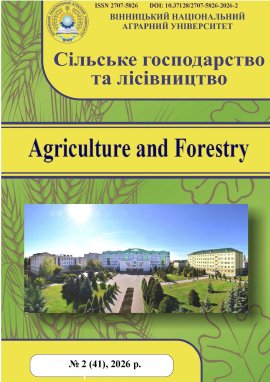
Issue №: 2 (41)
This issue of the journal is dedicated to current issues in improving technological methods for crop cultivation. Significant attention is given to the specifics of growing vegetable, grain and leguminous crops, which play a vital role in ensuring the state's food security. The scientific publications present the results of experimental research on the production of organic leguminous products, the importance of adaptive breeding to increase the resilience of agrocenoses, plant protection against harmful objects and the application of fertilizers to increase crop yields. Certain papers are devoted to the implementation of innovative methods for stimulating the seed productivity of forest seed plantations.
INFLUENCE OF VARIETAL CHARACTERISTICS ON THE DURATION OF VEGETATIVE AND INTERPHASE PERIODS IN CARROT
Ihor Didur, Doctor of Agricultural Sciences, Professor, Acting the director of the Institute of Agricultural Technologies and Nature Management of the Vinnytsia National Agrarian University (21008, Soniachna Str. 3, Vinnytsia, email: e-mail: ascience@ukr.net; ORCID: https://orcid.org/0000-0002-6612-6592).
Yevgeny Nachtman, graduate student of the Department of Plant Production and Horticulture, Vinnytsia National Agrarian University (21008, Vinnytsia, Sonyachna St., 3. е-mail: evgenijnahtman@gmail.com; ORCID: https://orcid.org/0000-0002-7305-9594).
The article presents the results of a study on the influence of the assortment of carrot varieties and hybrids on the expression of phenological traits in table carrots. Carrot is an important vegetable root crop with diverse uses, belonging to the so-called «borsch group». It is characterized by versatility and provides stable marketing channels for agricultural producers. Carrots are grown for fresh consumption as well as for processing, including freezing and heat treatment. The research was conducted during 2023–2025 on the experimental field of the LLC «Organic-D» on gray light loamy soils in open-field conditions. The total area of the experimental plot was 0.45 ha, while the accounting area was 25 m2 for each variant. The study included common carrot hybrids Bolivar F1, Canada F1, Olimpo F1, and Charisma F1, as well as the varieties Kampino, Carlena, Chantenay, and Yaskrava. The control variants were the Bolivar F1 hybrid and the Carlena variety, respectively. It was established that the duration of interphase periods and the overall vegetative period are largely determined by the genetic characteristics of carrot varieties and hybrids. In the experiment, the vegetative period ranged from 119 to 124 days. In the control variants, it was 119 days for both the Bolivar F1 hybrid and the Carlena variety. The longest period was observed in the Canada F1 hybrid – 121 days, and in the Chantenay Red Heart variety – 124 days, exceeding the control values by 2-5 days. The duration of the «sowing to full emergence» period in the studied carrot varieties and hybrids ranged from 31 to 34 days, the «full emergence to first leaf formation» period – 3-4 days, while the «first leaf to full leaf rosette formation» period ranged from 15 to 17 days. The «leaf rosette formation to the beginning of root formation» period in the studied carrot varieties and hybrids ranged from 13 to 15 days and was strongly determined by the genetic traits of each specific form. The duration of the interphase period «root formation to technical maturity» was 86-91 days. In the studied hybrids, it ranged from 86 to 87 days, whereas in the varieties it ranged from 86 to 91 days, on average exceeding the hybrid values by 1-5 days. The obtained results confirm the importance of selecting appropriate carrot varieties and hybrids to achieve the maximum root crop productivity across different maturity periods.
1. Palamarchuk I.I. (2022). Porivnialne otsiniuvannia sortiv ta hibrydiv morkvy stolovoi v umovakh pravoberezhnoho Lisostepu Ukrainy [Comparative evaluation of varieties and hybrids of table carrot under the conditions of the Right-Bank Forest-Steppe of Ukraine]. Visnyk Sumskoho natsionalnoho ahrarnoho universytetu. Seriia «Ahronomiia i biolohiia» − Bulletin of Sumy national agrarian university. Series «Agronomy and biology». Issue 1 (47). DOI: https://doi.org/10.32845/ agrobio. 2022.1.14 [in Ukrainian].
2. Didur I., Vdovenko S., Tkachuk O., Palamarchuk I., Pantsyreva H., Chabaniuk Ya., Shkatula Yu., Zabarna T., Gucol, G. (2024). Cultivation of tomatoes using mycorrhizal biological preparations. Modern Phytomorphology, Vol. 18. P. 133– 138. DOI:10.5281/zenodo.200121 [in English].
3. Kosenko N.P., Shablia O.S., Marchenko T.Yu., Suhak I.M., Petryk O.M., Laiter B.V. (2025). Vplyv biopreparativ na vrozhainist sortiv morkvy (Daucus carota L.) v umovakh zroshennia Pivdnia Ukrainy [The effect of biological products on the yield of carrot varieties (Daucus carota L.) under irrigated conditions of Southern Ukraine]. Ahrarni innovatsii − Agrarian innovations, 34. DOI:https://doi.org/10.32848/ agrar.innov.2025.34.11 [in Ukrainian].
4. Potapskyi Yu.V., Bezvikonnyi P.V., Tarasiuk V.A. (2021). Efektyvnist zastosuvannia khitozanovykh fitorehuliatoriv na posivakh morkvy stolovoi v umovakh Pravoberezhnoho Lisostepu Ukrainy [Efficiency of the application of chitosan-based phytoregulators in table carrot crops under the conditions of the Right-Bank Forest-Steppe of Ukraine]. Tavriiskyi naukovyi visnyk. Seriia: Silskohospodarski nauky – Tavria Scientific Bulletin. Series: Agricultural Sciences. 122. DOI: https://doi.org/10.32851/2226-0099.2021.122.18 [in Ukrainian].
5. Didur I.M., Aralova T.S. (2026). Obgruntuvannia tekhnolohii vyroshchuvannia tomata za riznykh metodiv otrymannia rozsady [Substantiation of tomato cultivation technology under different methods of seedling production]. Sil's'ke hospodarstvo ta lisivnytstvo − Agriculture and forestry. 1 (40), DOI: https://doi.org/10.37128/2707-5826-2026-1-1 [in Ukrainian].
6. Pidlubenko I., Konovalenko K., Horash O., Klymyshyna R. (2025). Vplyv sortovykh osoblyvostei na vrozhainist koreneplodiv morkvy v umovakh Skhidnoho Lisostepu [The influence of varietal characteristics on the yield of carrot root crops under the conditions of the Eastern Forest-Steppe]. Visnyk Lvivskoho natsionalnoho ekolohichnoho universytetu. Seriia Ahronomiia − Bulletin of Lviv national environmental university. Series «Agronomy», 29. DOI: https://doi.org/10.31734/ agronomy2025.29.113 [in Ukrainian].
7. Ketskalo V.V., Polishchuk T.V. (2020). Produktyvnist morkvy stolovoi zalezhno vid hibrydu [Productivity of table carrot depending on the hybrid]. Zbirnyk naukovykh prats Umanskoho natsionalnoho universytetu − Collection of scientific papers of Uman national university, Issue 97 (1). DOI:10.31395/2415-8240-2020-97-1-23-31. [in Ukrainian].
8. Pidlubenko I.M., Ovchinnikova O.P., Bilenka O.M., Shtepa L.Yu., Novichenko V.M. (2022). Otsinka adaptyvnoho potentsialu kolektsiinoho materialu morkvy (Daucus Carota L.) za proiavom oznak «zahalna urozhainist koreneplodiv» ta «vmist β-karotynu» [Evaluation of the adaptive potential of carrot (Daucus carota L.) collection material based on the traits «total root yield» and «β-carotene content»]. Ovochivnytstvo i bashtannytstvo − Vegetable and melon growing, Issue 72. DOI: https://doi.org/ 10.32717/0131-0062-2022-72-24-31 [in Ukrainian].
9. Derzhavnyi reiestr sortiv roslyn, prydatnykh dlia poshyrennia v Ukraini na 2020 rik, (2020). [State Register of Plant Varieties Suitable for Distribution in Ukraine for 2020]. Kyiv. [in Ukrainian].
10. Simon P.W. (2019). Beyond the genome: carrot production trends, research advances, and future crop improvement. Acta hortic, Vol. 1264, Р. 1-8. DOI: 10.17660/ActaHortic.2019.1264.1 [in English].
11. Kosenko N.P., Bondarenko K.O. (2021). Nasinnieva produktyvnist morkvy stolovoi za vysadkovoho sposobu vyroshchuvannia ta kraplynnoho zroshennia [Seed productivity of table carrot depending on the planting method and drip irrigation]. Visnyk ahrarnoi nauky − Bulletin of agrarian science. 6 (819). DOI: https://doi.org/10.31073/agrovisnyk202106-08 [in Ukrainian].
12. Baranski R., Maksylewicz-Kaul А., Cavagnaro P. (2012). Genetic diversity of carrot (Daucus carota L.) cultivars revealed by analysis of SSR loci. Genet. Resour. Crop Evol, Vol. 59, Р. 163-170. DOI: 10.1007/s10722-011-9777-3 [in English].
13. Da Silva E. A., Vieira M.A., Vieira E.A., Amboni R. (2007). Chemical, physical and sensory parameters of different carrot varieties (Daucus carota L.). Journal food process Eng, Vol. 30, Issue 6. Р. 746-756. DOI: https://doi.org/10.1111/j.1745-4530.2007.00125.x/ [in English].
14. Bondarenko H. L., Yakovenko K. I. (2001). Metodyka doslidnoi spravy v ovochivnytstvi i bashtannytstvi [Methodology of experimental work in vegetable and melon growing]. Kharkiv: Osnova. [in Ukrainian].
15. Pantsyreva H.V., Pikhotskyi V.A. (2025). Yakisni pokaznyky koreneplodiv stolovoho buriaka za kompleksnoho zastosuvannia biopreparativ [Quality indicators of table beet root crops under the complex application of biopreparations]. Ahrarni innovatsii − Agricultural innovations. 33. DOI: https://doi.org/10.32848/ agrar.innov.2025.33.37 [in Ukrainian].
16. DSTU 7035:2010. Morkva svizha. Tekhnichni umovy [DSTU 7035:2010. Fresh Carrot. Technical Specifications]. Kyiv. Derzhspozhyvstandart Ukrainy, 2010. 18 р. [in Ukrainian].
About the journal
Cluster Agricultural and veterinary sciences (H1 Agronomy, H4 Forestry)
Name of the publication «AGRICULTURE AND FORESTRY»
The aim of the journal "Agriculture and Forestry" is to highlight the results of fundamental and applied research in the fields of agriculture and forestry, aimed at improving the efficiency of agricultural production and introducing modern technologies into farming practice.
This goal defines the main objectives:
– to ensure the creation of open information access regarding the dissemination of relevant scientific research results to: lecturers of agricultural higher education institutions, postgraduate students, doctoral candidates, research staff, and agricultural production specialists;
– to promote the development of young scientists in agricultural sciences;
– to enhance communication between experienced researchers and young scientists in agronomy and forestry;
– to facilitate the expansion of ties between Vinnytsia National Agrarian University and domestic and foreign educational institutions, scientific establishments, and their academic communities.
The scientific, production, and educational journal "Agriculture and Forestry" is a peer-reviewed open-access publication that publishes original experimental research, theoretical and practice-oriented articles within the cluster of "Agricultural and Veterinary Sciences".
The journal's subject matter covers such areas as agronomy and forestry. Publications of scientific and practical significance address the experimental foundations of agricultural and forestry sector development, innovative production technologies, and the results of fundamental and applied research aimed at increasing productivity, product quality, and the sustainable development of natural and production systems.
Publisher: Vinnytsia National Agrarian University
EDRPOU code: 00497236
Publisher's ROR:05m3ysc06
Prefix DOI: 10.37128/
Frequency is quarterly
Publication languages: (Ukrainian, English)
Media ID R30-05174.
Editor in Chief Ihor Didur
According to the order of the Ministry of Education and Science of Ukraine dated 17.03.2020 № 409. The journal Agriculture and Forestry is included in the List of scientific professional publications of Ukraine Category "B" in agricultural sciences (specialties) - 101, 201, 202, 203, 205, 206.
State registration: Decision of the National Council of Ukraine on Television and Radio Broadcasting No. 1337 and No. 1181. Media identifier – R30-05174.
Scientific journal "AGRICULTURE AND FORESTRY" was founded in 1995; it was entitled as Bulletin of Vinnytsya State Agricultural Institute.
In 2010-2014 was enritled as Collection of scientific works of Vinnytsia National Agrarian University.
It has been named as Agriculture and Forestry since 2015.
Listed in the updated list of scientific professional editions of Ukraine on agricultural sciences under the name Agriculture and Forestry (Order of the Ministry of Education and Science of Ukraine of May 16, 2016; No. 515).
Since 2015, "Agriculture and Forestry". (archive of previous issues for 2015-2019) at http://forestry.vsau.edu.ua/.
The journal “Agriculture and Forestry (ISSN: 2707-5826)” passed the evaluation process of Index Copernicus positively and is indexed in the database of ICI Journals Master List ICV for 2018, 2019, 2020, 2021, 2022, 2023, 2024 is presented in the full list of indexed journals in the Master List International List
ICI Journals Master List Value
