

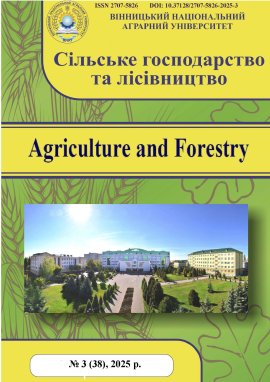
Issue №: 3 (38)
Publications contains the results of researches on optimization of technological methods of cultivation of crops, preservation of soil fertility, greening of agricultural production, modern directions of selection, reproduction of forest resources.
FORMATION OF THE YIELD OF AFILA PEA USING ORGANIC FARMING TECHNOLOGY IN FOREST-STEPPE CONDITIONS
Moisiienko Vira Vasylivna – Doctor of Agricultural Sciences, Professor of the Department of Plant Growing Technologies, Faculty of Agronomy, Polissia National University (10008, Zhytomyr, Stary Boulevard, 7. email: veraprof@ukr.net).
Karpyshyn Oleksandr Volodymyrovych – Doctor of Philosophy, agronomist at Galex Agro (11777, Zhytomyr region, Zviahel district, Stryeva village).
Bolshoi Oleksandr Olehovich – Master of the Faculty of Agronomy, Polissia National University (10008, Zhytomyr, Stary Boulevard, 7).
The results of research and analysis of scientific materials allow us to conclude that afila pea is an important crop in organic farming, as it has significant agronomic, ecological, and economic advantages. The research was conducted under organic production conditions at Galex Agro in the Zviahel district of Zhytomyr region during 2022–2024 on light gray podzolized light loamy soils with a humus content of 1.94%. The greatest increase in the height of Stabil pea plants was obtained with double pre-sowing treatment of seeds with dry and liquid Azotix biological preparations – 6.3–6.5 cm. The weight of 1,000 seeds of the Lump variety was 223–237 g. The dry inoculant Azotix, 1.5 kg/t, increased the weight of 1,000 seeds by 7 g, and the combined treatment of seeds with dry and liquid preparations (2.0 l/ha) increased it by 14–15 g, respectively. The weight of 1,000 seeds in the Stabil variety with a row spacing of 15 cm was 241–264 g, and with a row spacing of 30 cm, it was 240–261 g. The highest indicator was found in the variant with combined treatment of pea seeds with dry and liquid biological preparations, which was 778 g (row spacing 15 cm) and 772 g (row spacing 30 cm). The protein content in Lump seeds in inoculated areas was 25.2–28.2% (15 cm row spacing) and 25.1–27.9% (30 cm row spacing) compared to 23.7–23.9% in the control. The grain of the Stabil variety contained 22.7–26.1% protein. The highest conditional protein yield in the Stabil variety was obtained with combined treatment of afila pea seeds with dry and liquid biological products – 0.62 t/ha. The yield increase depending on the treatment of seeds with different inoculants was 0.2–0.91 t/ha for sowing the Lump pea variety with a row spacing of 15 cm and 0.09–0.74 t/ha for a row spacing of 30 cm. The maximum grain yield of the Stabil pea variety under organic cultivation was 2.38 t/ha in the variant with double inoculation of seeds with dry and liquid Azotix biological preparations and sowing with a row spacing of 15 cm. The yield of the Lump variety was 2.15 t/ha, respectively.
1. Didur I.M., Zakharchuk V.V. (2016). Vplyv elementiv tekhnolohii vyroshchuvannia na vrozhaini pokaznyky zerna horokhu [The influence of cultivation technology elements on pea grain yield indicators]. Silske hospodarstvo ta lisivnytstvo − Agriculture and forestry. № 4. 55–61. [in Ukrainian].
2. Hutianskyi R.A., Ilchenko N.K., Sheliakina T.A., Posylaieva O.O. (2018). [Urozhainist i yakist nasinnia horokhu, nutu, soi za vplyvu zaburianenosti, inokuliatsii ta herbitsydu (Yield and quality of peas, chickpeas, and soybeans under the influence of weed infestation, inoculation, and herbicide]. Selektsiia i nasinnytstvo − Breeding and seed production. № 113. 179–188. DOI: https://doi.org/10.30835/2413-7510.2018.134375. [in Ukrainian].
3. Bakhmat M.I., Nebaba K.S. (2018). Strukturni elementy vrozhaiu horokhu posivnoho zalezhno vid udobrennia ta rehuliatoriv rostu v umovakh Lisostepu Zakhidnoho [Structural elements of sowing pea yield depending on fertilization and growth regulators in the conditions of the Western Forest-Steppe]. Naukovyi visnyk NUBiP Ukrainy. Seriia Ahronomiia − Scientific Bulletin of the National University of Biology and Chemistry of Ukraine. Agronomy Series. № 294. 24–31. http://nbuv.gov.ua/UJRN/nvnau_agr_2018_294_5. [in Ukrainian].
4. Honchar L.M., Pylypenko V.S. (2017). Polova skhozhist nasinnia ta hustota stoiannia roslyn horokhu posivnoho zalezhno vid udobrennia ta inokuliatsii. [Field germination of seeds and plant density of sowing peas depending on fertilization and inoculation]. Naukovyi visnyk Natsionalnoho universytetu bioresursiv i pryrodokorystuvannia Ukrainy − Scientific Bulletin of the National University of Life Resources and Environmental Sciences of Ukraine. Issue. 269. 46–57. [in Ukrainian].
5. Kaminskyi V.F., Sokyrko D.P., Hanhur V.V. (2021). Vplyv tekhnolohichnykh pryiomiv na formuvannia produktyvnosti horokhu v umovakh Livoberezhnoho Lisostepu Ukrainy [Influence of technological methods on the formation of pea productivity in the conditions of the Left-Bank Forest-Steppe of Ukraine]. Tavriiskyi naukovyi visnyk. Seriia: Silskohospodarski nauky − Tavria Scientific Bulletin. Series: Agricultural Sciences. Issue. 117. 73–79. DOI: https://doi.org/10.32851/2226–0099.2021.117.10 [in Ukrainian].
6. Nidzelskyi V. A. (2015). Dynamika rostu horokhu zalezhno vid pohodnykh umov roku [Dynamics of pea growth depending on weather conditions of the year]. Naukovyi visnyk NUBiP Ukrainy. Seriia Ahronomiia − Scientific Bulletin of the National University of Biology and Chemistry of Ukraine. Agronomy Series. № 210. 67–74. [in Ukrainian].
7. Berezovska-Bryhas V.V., Vlasova O.H. (2018). Tekhnolohiia zastosuvannia biopreparativ proty fitofahiv ta zbudnykiv khvorob na posivakh horokhu [Technology for the use of biological products against phytophages and disease pathogens in pea crops]. Karantyn i zakhyst roslyn − Quarantine and plant protection. № 1–2. 5–8. [in Ukrainian].
8. Hlubokyi O.M., Avramenko S.V., Popov S.I. (2021). Formuvannia produktyvnosti sortiv horokhu zalezhno vid umov vyroshchuvannia v skhidnomu Lisostepu Ukrainy [Formation of pea variety productivity depending on growing conditions in the eastern forest-steppe zone of Ukraine]. Henetychni resursy roslyn − Plant genetic resources. № 29. 113–122. DOI:10.36814/pgr.2021.29.11. [in Ukrainian].
9. Lykhochvor V.V., Andrushko M.O. (2020). Produktyvnist horokhu zalezhno vid sortu ta norm vysivu (Pea productivity depending on variety and sowing rates). Visnyk ahrarnoi nauky Prychornomoria − Bulletin of Agricultural Science of the Black Sea Region. Issue. 2. 54–62. DOI: 10.31521/2313-092X/2020-2(106). [in Ukrainian].
10. Ieremenko O. A., Kapinos M. V. (2020). Vplyv peredposivnoi obrobky nasinnia na produktyvnist sortiv horokhu posivnoho v umovakh pivdennoho stepu Ukrainy [The effect of pre-sowing seed treatment on the productivity of sowing pea varieties in the southern steppe of Ukraine]. Tavriiskyi naukovyi visnyk. Silskohospodarski nauky. − Tavria Scientific Bulletin. Series: Agricultural Sciences. Issue. 113. 41–48. DOI:https://doi.org/10.32851/2226-0099.2020.113.6. [in Ukrainian].
11. Kalytka V.V., Kapinos M.V. (2015). Vplyv rehuliatoriv rostu roslyn i biopreparativ na produktyvnist horokhu posivnoho (Pisum sativum L.) v umovakh pivdennoho Stepu Ukrainy (The influence of plant growth regulators and biological products on the productivity of field peas (Pisum sativum L.) in the southern steppe of Ukraine). Naukovyi visnyk NUBiP Ukrainy. Seriia Ahronomiia − Scientific Bulletin of the National University of Biology and Chemistry of Ukraine. Agronomy Series. № 210. 38–46. [in Ukrainian].
12. Kolesnikov M., Tymoshchuk T., Moisiienko V., Vyshnivskyi P. & Rudenkо Yu. (2024). Formation of the photoassimilation apparatus of pea (Pisum sativum L.) crops under biostimulants in arid conditions of the Southern Steppe of Ukraine. Scientific Horizons. 27(4), 76-85. DOI: https://doi.org/10.48077/ scihor4.2024.76 [in English].
13. Petrychenko V. F., Antypin R. A. (2006). Fotosyntetychna produktyvnist horokhu zalezhno vid vplyvu tekhnolohichnykh pryiomiv vyroshchuvannia v umovakh Lisostepu Ukrainy [Photosynthetic productivity of peas depending on the influence of technological cultivation methods in the forest-steppe zone of Ukraine]. Kormy i kormovyrobnytstvo−Feed and feed production. Issue. 57. [in Ukrainian].
14. Chynchyk O.S. (2015). Vplyv obrobky nasinnia biopreparatamy na tryvalist vehetatsiinoho periodu ta urozhainist sortiv horokhu [The effect of seed treatment with biological products on the duration of the growing season and the yield of pea varieties]. Kormy i kormovyrobnytstvo − Feed and feed production. Issue. 81. 74–77. [in Ukrainian].
15. Murach O.M., Volkohon V.V. (2014). Formuvannia symbiotychnoho aparatu horokhu za vplyvu bakterialnykh preparativ, mikroelementiv i stymuliatora rostu [Formation of the symbiotic apparatus of peas under the influence of bacterial preparations, microelements, and growth stimulants]. Ahroekolohichnyi zhurnal − Agroecological Journal. № 4. 55–59. [in Ukrainian].
16. Ieshchenko V.O., Kopytko P.H., Opryshko V.P., Kostohryz P.V. (2005). Osnovy naukovykh doslidzhen v ahronomii [Fundamentals of Scientific Research in Agronomy]. Kyiv: Diia. [in Ukrainian].
17. Ushkarenko V. O., Nikishenko V. L., Holoborodko S. P., Kokovikhin S.V. (2009). Dyspersiinyi i koreliatsiinyi analiz rezultativ polovykh doslidiv [Dispersion and correlation analysis of field experiment results]: monohrafiia. Kherson : Ailant, 372 s. [in Ukrainian].
18. Chekryhin P.M. (2003). Rezultaty i perspektyvy selektsii bezlystochkovykh (vusatykh) sortiv v Instytuti roslynnytstva im. V. Ya. Yurieva [Results and prospects of breeding leafless varieties at the V. Ya. Yuryev Institute of Plant Growing]. Selektsiia i nasinnytstvo − Breeding and seed production. Issue. 87. 42–48. [in Ukrainian].
About the journal
Cluster Agricultural and veterinary sciences (H1 Agronomy, H4 Forestry)
Name of the publication «AGRICULTURE AND FORESTRY»
The aim of the journal "Agriculture and Forestry" is to highlight the results of fundamental and applied research in the fields of agriculture and forestry, aimed at improving the efficiency of agricultural production and introducing modern technologies into farming practice.
This goal defines the main objectives:
– to ensure the creation of open information access regarding the dissemination of relevant scientific research results to: lecturers of agricultural higher education institutions, postgraduate students, doctoral candidates, research staff, and agricultural production specialists;
– to promote the development of young scientists in agricultural sciences;
– to enhance communication between experienced researchers and young scientists in agronomy and forestry;
– to facilitate the expansion of ties between Vinnytsia National Agrarian University and domestic and foreign educational institutions, scientific establishments, and their academic communities.
The scientific, production, and educational journal "Agriculture and Forestry" is a peer-reviewed open-access publication that publishes original experimental research, theoretical and practice-oriented articles within the cluster of "Agricultural and Veterinary Sciences".
The journal's subject matter covers such areas as agronomy and forestry. Publications of scientific and practical significance address the experimental foundations of agricultural and forestry sector development, innovative production technologies, and the results of fundamental and applied research aimed at increasing productivity, product quality, and the sustainable development of natural and production systems.
Publisher: Vinnytsia National Agrarian University
EDRPOU code: 00497236
Publisher's ROR:05m3ysc06
Prefix DOI: 10.37128/
Frequency is quarterly
Publication languages: (Ukrainian, English)
Media ID R30-05174.
Editor in Chief Ihor Didur
According to the order of the Ministry of Education and Science of Ukraine dated 17.03.2020 № 409. The journal Agriculture and Forestry is included in the List of scientific professional publications of Ukraine Category "B" in agricultural sciences (specialties) - 101, 201, 202, 203, 205, 206.
State registration: Decision of the National Council of Ukraine on Television and Radio Broadcasting No. 1337 and No. 1181. Media identifier – R30-05174.
Scientific journal "AGRICULTURE AND FORESTRY" was founded in 1995; it was entitled as Bulletin of Vinnytsya State Agricultural Institute.
In 2010-2014 was enritled as Collection of scientific works of Vinnytsia National Agrarian University.
It has been named as Agriculture and Forestry since 2015.
Listed in the updated list of scientific professional editions of Ukraine on agricultural sciences under the name Agriculture and Forestry (Order of the Ministry of Education and Science of Ukraine of May 16, 2016; No. 515).
Since 2015, "Agriculture and Forestry". (archive of previous issues for 2015-2019) at http://forestry.vsau.edu.ua/.
The journal “Agriculture and Forestry (ISSN: 2707-5826)” passed the evaluation process of Index Copernicus positively and is indexed in the database of ICI Journals Master List ICV for 2018, 2019, 2020, 2021, 2022, 2023, 2024 is presented in the full list of indexed journals in the Master List International List
ICI Journals Master List Value
