

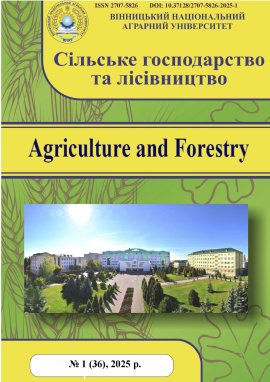
Issue №: 1 (36)
The research results on technological methods of cultivation of crops, energy-saving technologies, production of environmentally friendly agricultural products using foliar nutrition, biologically active preparations, reproduction of forest resources
FORMATION OF SOYBEAN PRODUCTIVITY DEPENDING ON THE USE OF INOCULATION AND MICROBIOLOGICAL PREPARATIONS IN THE CONDITIONS OF THE RIGHT-BANK FOREST-STEPPE
Shcatula Yurii – Candidate of Agricultural Sciences, Associate of Professor of the department of agriculture, soil science and agrochemistry of Vinnytsia National Agrarian University (21008, Vinnytsia, Sonaychna St. 3, e-mail: shkatula@vsau.vin.ua).
Tatiana Zabarna − Candidate of Agricultural Sciences (PhD), Senior Lecturer of the Department of Soil Management, Soil Science and Agrochemistry, Vinnytsia National Agrarian University (21008, Vinnytsia, Soniachna Str.3, е-mail : zabarna-tanja@ukr.net ).
Volodymyr Chereshnyuk – postgraduate student of the Department of Agriculture, Soil Science and Agrochemistry of Vinnytsia National Agrarian University (21008, Vinnytsia, Sonaychna St. 3, e-mail: chereshnyk_vova@ukr.net).
The publication highlights the influence of inoculants Bioinoculant BTU-p, BioMag, Atuva + Protector Premax and microfertilizers for foliar feeding Yarylo Soya and Helprost Soya, which were used in the 3rd leaf and budding phases on the formation of soybean productivity of Pallada variety in the conditions of the Right-Bank Forest-Steppe. According to the results of the research, treatment of soybean seeds with inoculants Bioinoculant BTU (3.0 l/t), BioMag-soybean (7.0 l/t) and Atuva + Protector Premax (2.0 l/t + 0.5 l/t) provided an increase in field germination of soybean seeds to 85.8-86.6%, which is 0.2-1.0% more than the control (without inoculation). The highest number of soybean plants before harvesting 535.6 thousand. /ha was observed in the areas where soybean seeds were treated with Atuva inoculant + Premax protector (2.0 l/t + 0.5 l/t), and during the growing season, foliar feeding of soybean plants with Yarylo Soya microfertilizers (2, 0 l/ha) in the phase of the 3rd leaf, and Helprost Soya (3.0 l/ha) in the budding phase, which is more than the control (without inoculation and foliar fertilisation) by 39.8 thousand. /ha. The highest yields, namely 2.6 t/ha of soybean seeds of Pallada variety in 2023, were provided by the variant where seeds were inoculated with Atuva + Premax protector, 2.0 l/t + 0.5 l/t, and with two fertilisations in the corresponding phases of growth and development (Yarylo Soya + Helprost Soya (3.0 + 3.0 l/ha)). Under similar growing conditions, in 2024, 2.81 t/ha of soybean seed yield was obtained. Thus, on average, over the years of research, this figure was 2.71 t/ha, which is 0.92 t/ha more than in the control variant. The use of inoculants as a pre-sowing treatment of soybean seeds had a positive effect on the formation of the crop. The use of foliar fertilisation with complex fertiliser with a balanced content of nutrients Yarylo Soya in the 3rd leaf stage of soybean ensured its need for nutrients in the initial period. The use of Helprost Soya organo-mineral fertiliser in the budding phase met the soybean's need for biologically active substances, including micro- and macroelements, during the formation of generative organs. While the combination of all these measures allowed to obtain the highest seed productivity of soybeans. The publication highlights the influence of inoculants Bioinoculant BTU-r, BioMag, Atuva + Protector Premax and microfertilisers for foliar feeding Yarylo Soya and Helprost Soya, which were used in the phases of the 3rd leaf and budding on the formation of soybean productivity of Pallada variety in the conditions of the Right-Bank Forest-Steppe. According to the results of the research, treatment of soybean seeds with inoculants Bioinoculant BTU (3.0 l/t), BioMag-soybean (7.0 l/t) and Atuva + Protector Premax (2.0 l/t + 0.5 l/t) provided an increase in field germination of soybean seeds to 85.8-86.6%, which is 0.2-1.0% more than the control (without inoculation). The highest number of soybean plants before harvesting 535.6 thousand. /ha was observed in the areas where soybean seeds were treated with Atuva inoculant + Premax protector (2.0 l/t + 0.5 l/t), and during the growing season, foliar feeding of soybean plants with Yarylo Soya microfertilizers (2, 0 l/ha) in the phase of the 3rd leaf, and Helprost Soya (3.0 l/ha) in the budding phase, which is more than the control (without inoculation and foliar fertilisation) by 39.8 thousand. /ha. The highest yields, namely 2.6 t/ha of soybean seeds of Pallada variety in 2023, were provided by the variant where seeds were inoculated with Atuva + Premax protector, 2.0 l/t + 0.5 l/t, and with two fertilisations in the corresponding phases of growth and development (Yarylo Soya + Helprost Soya (3.0 + 3.0 l/ha)). Under similar growing conditions, in 2024, 2.81 t/ha of soybean seed yield was obtained. Thus, on average, over the years of research, this figure was 2.71 t/ha, which is 0.92 t/ha more than in the control variant. The use of inoculants as a pre-sowing treatment of soybean seeds had a positive effect on the formation of the crop. The use of foliar fertilisation with complex fertiliser with a balanced content of nutrients Yarylo Soya in the 3rd leaf stage of soybean ensured its need for nutrients in the initial period. The use of Helprost Soya organo-mineral fertiliser in the budding phase met the soybean's need for biologically active substances, including micro- and macroelements, during the formation of generative organs. The combination of all these measures resulted in the highest seed productivity of soybeans.
1. Zabolotnyi H.M., Mazur V.A., Tsyhanska O.I., Didur I.M., Tsyhanskyi V.I., Pantsyreva H.V. (2020). Ahrobiolohichni osnovy vyroshchuvannia soi ta shliakhy maksymalnoi realizatsii yii produktyvnosti: monohrafiia [Agribiological bases of soybean cultivation and ways of maximising its productivity: monograph]. Vinnytsia VNAU. [in Ukrainian].
2. Kravchenko V.S., Kononenko L.M., Vyshnevska L.V. Chynchyk O.S., Oliforovych V.O. (2019). Biolohizatsiia vyroshchuvannia zernobobovykh kultur v Ukraini, analiz ta perspektyva [Biologisation of leguminous crops cultivation in Ukraine, analysis and prospects]. Ahrarnyi visnyk Prychornomoria − Agrarian Herald of the Black Sea Region. 92. [in Ukrainian].
3. Urozhainist soi v 2023 r., yii eksport ta tsina [Soybean yields in 2023, exports and prices]. URL: https://superagronom.com/multimedia/infographics/82-urojaynsit-soyi-v-2023-r-yiyi-eksport-ta-tsina (data zvernennia 17.08.2024). [in Ukrainian].
4. Mukhanov V.M. (2019). Stan ta perspektyvy podalshoho rozvytku haluzi promyslovoho vyroshchuvannia ta pererobky soi v Ukraini v KhKhI st. Ekonomika. Finansy. [State and prospects for further development of the industry of industrial cultivation and processing of soybeans in Ukraine in the XXI century]. Menedzhment: aktualni pytannia nauky i praktyky − Management: topical issues of science and practice. 10. 118–125. DOI: 10.37128/2411-4413-2019-10-15. [in Ukrainian].
5. Peretiatko S.H., Rudik O.P. (2021). Suchasnyi stan ta prykladni aspekty perspektyv rozvytku vyrobnytstva soi v Ukraini. [Current state and applied aspects of the prospects for the development of soybean production in Ukraine]. Mizhnarodnyj tematychnyj naukovyj zbirnyk. Zroshuvane zemlerobstvo. − International thematic scientific collection. Irrigated agriculture. 76. 49−53. DOI: https://doi.org/10.32848/0135-2369.2021.76.10. [in Ukrainian].
6. Cherniavskyi I.Iu. (2019). Prohnozuvannia eksportnoho potentsialu pidpryiemstv zernovoi haluzi Ukrainy z urakhuvanniam rivnia rozvytku vitchyznianoi selektsii [Forecasting the export potential of grain enterprises in Ukraine, taking into account the level of development of domestic selection]. Ukrainskyi zhurnal prykladnoi ekonomiky − Ukrainian Journal of Applied Economics. Issue 4. № 4. DOI: https://doi.org/10.36887/2415-8453-2019-4-23. [in Ukrainian].
7. Romanko A.Yu. (2021). Formuvannia produktyvnosti soi zalezhno vid elementiv tekhnolohii vyroshchuvannia v umovakh pivnichno-skhidnoho Lisostepu Ukrainyna zdobuttia naukovoho stupenia doktora filosofii za spetsialnistiu 201 «Ahronomiia» [Formation of soybean productivity depending on the elements of cultivation technology in the conditions of the northeastern Forest-Steppe of Ukraine for the degree of Doctor of Philosophy in speciality 201 ‘Agronomy]. SNAU, Sumy, 260. [in Ukrainian].
8. Hryhorieva O.M. (2014). Produktyvnist soi zalezhno vid ahrotekhnichnykh zakhodiv yii vyroshchuvannia v umovakh pivnichnoho stepu Ukrainy.[Soybean productivity depending on agronomic measures of its cultivation in the northern steppe of Ukraine]. Naukovi pratsi Instytutu bioenerhetychnykh kultur i tsukrovykh buriakiv NAAN Ukrainy − Scientific papers of the Institute of Bioenergy Crops and Sugar Beet of the National Academy of Agrarian Sciences of Ukraine. 21. 115–121. [in Ukrainian].
9. Vid khoroshoho do krashchoho. Inokulianty kompanii BASF. [From good to better. BASF inoculants]. Ahrobiznes sohodni - Agribusiness today. 2015. 06 berez. 20-22. URL : http://agro-business.com.ua/2017-09-29- 05-56-43/item/2231-vid-khoroshoho-do-krashchoho-inokulianty-kompaniibasf.html [in Ukrainian].
10. Ivasyk M.V. (2023). Formuvannia produktyvnosti novykh sortiv soi v umovakh Lisostepu [Formation of productivity of new soybean varieties in the conditions of the Forest-Steppe]. Tavriiskyi naukovyi visnyk Seriia: Silskohospodarski nauky − Tavrian Scientific Bulletin. Series: Agricultural Sciences. 133. 19-24. DOI:https://doi.org/10.32782/2226-0099.2023.133.3. [in Ukrainian].
11. Moisiienko V.V., Didora V.H. (2010). Ahroekonomichne obgruntuvannia roli soi u vyrishenni problemy roslynnoho bilka v Ukraini [Agroeconomic substantiation of the role of soybeans in solving the problem of vegetable protein in Ukraine]. Visnyk ZhNAEU − Journal of ZhNAEU. 1. 1–14. [in Ukrainian].
12. Shkatula Yu.M., Vuiko O.M. (2024). Vplyv biopreparativ ta mikrodobryv na strukturni elementy vrozhaiu horokhu posivnoho v umovakh Lisostepu Pravoberezhnoho. [Influence of biological products and microfertilisers on the structural elements of the crop of sowing peas in the conditions of the Right-Bank Forest-Steppe]. Silske hospodarstvo ta lisivnytstvo − Agriculture and forestry. 35. 29-37. [in Ukrainian].
13. Yeshchenko V.O., Kopytko P.H., Opryshko V.P., Kostohryz P.V. (2005). Osnovy naukovykh doslidzhen v ahronomii [Fundamentals of scientific research in agronomy]. Za red. V.O. Yeshchenka. Uman: Diia. [in Ukrainian].
14. Ermantraut E.R., Malynovskyi A.S., Didora V.H. (2010). Metodyka naukovykh doslidzhen v ahronomii: navch. posib. [Methods of scientific research in agronomy: a textbook]. Zhytomyr: ZhNAEU. [in Ukrainian].
15. Ohurtsov Ye.M., Belinskyi Yu.V. Produktyvnist fotosyntezu soi zalezhno vid pohodnykh umov i tekhnolohichnykh pryiomiv vyroshchuvannia v skhidnii chastyni livoberezhnoho Lisostepu Ukrainy. [Productivity of soybean photosynthesis depending on weather conditions and technological methods of cultivation in the eastern part of the left-bank forest-steppe of Ukraine]. URL :http://ua.z- pdf.ru/7biologiya/768110-1-6-udk-635655-63251-6329311-632934-produktivnist- fotosintezu-soi-zalezhno-vid-pogodnih-umov-tehnologichnih-priyomiv.php. (data zvernennia 27.12.2024). [in Ukrainian].
16. Palamarchuk V.D., Polishchuk I.S., Mazur O.V., Palamarchuk O.D. (2017). Novitni ahrotekhnolohii u roslynnytstvi. [The latest agrotechnologies in crop production]. Vinnytsia : VNAU. [in Ukrainian].
17. Liubchych Oleksandr Hryhorovych. Osoblyvosti sivby soi v Polissi ta Lisostepu v umovakh 2020 r. [Features of soybean sowing in Polissia and Forest-Steppe in 2020]. URL: https://zemlerobstvo.com/news/osoblivosti-sivbi-soyi-v-polissi-ta-lisostepu-v-umovah-2020-r/ (data zvernennia 14.02.2025). [in Ukrainian].
About the journal
Cluster Agricultural and veterinary sciences (H1 Agronomy, H4 Forestry)
Name of the publication «AGRICULTURE AND FORESTRY»
The aim of the journal "Agriculture and Forestry" is to highlight the results of fundamental and applied research in the fields of agriculture and forestry, aimed at improving the efficiency of agricultural production and introducing modern technologies into farming practice.
This goal defines the main objectives:
– to ensure the creation of open information access regarding the dissemination of relevant scientific research results to: lecturers of agricultural higher education institutions, postgraduate students, doctoral candidates, research staff, and agricultural production specialists;
– to promote the development of young scientists in agricultural sciences;
– to enhance communication between experienced researchers and young scientists in agronomy and forestry;
– to facilitate the expansion of ties between Vinnytsia National Agrarian University and domestic and foreign educational institutions, scientific establishments, and their academic communities.
The scientific, production, and educational journal "Agriculture and Forestry" is a peer-reviewed open-access publication that publishes original experimental research, theoretical and practice-oriented articles within the cluster of "Agricultural and Veterinary Sciences".
The journal's subject matter covers such areas as agronomy and forestry. Publications of scientific and practical significance address the experimental foundations of agricultural and forestry sector development, innovative production technologies, and the results of fundamental and applied research aimed at increasing productivity, product quality, and the sustainable development of natural and production systems.
Publisher: Vinnytsia National Agrarian University
EDRPOU code: 00497236
Publisher's ROR:05m3ysc06
Prefix DOI: 10.37128/
Frequency is quarterly
Publication languages: (Ukrainian, English)
Media ID R30-05174.
Editor in Chief Ihor Didur
According to the order of the Ministry of Education and Science of Ukraine dated 17.03.2020 № 409. The journal Agriculture and Forestry is included in the List of scientific professional publications of Ukraine Category "B" in agricultural sciences (specialties) - 101, 201, 202, 203, 205, 206.
State registration: Decision of the National Council of Ukraine on Television and Radio Broadcasting No. 1337 and No. 1181. Media identifier – R30-05174.
Scientific journal "AGRICULTURE AND FORESTRY" was founded in 1995; it was entitled as Bulletin of Vinnytsya State Agricultural Institute.
In 2010-2014 was enritled as Collection of scientific works of Vinnytsia National Agrarian University.
It has been named as Agriculture and Forestry since 2015.
Listed in the updated list of scientific professional editions of Ukraine on agricultural sciences under the name Agriculture and Forestry (Order of the Ministry of Education and Science of Ukraine of May 16, 2016; No. 515).
Since 2015, "Agriculture and Forestry". (archive of previous issues for 2015-2019) at http://forestry.vsau.edu.ua/.
The journal “Agriculture and Forestry (ISSN: 2707-5826)” passed the evaluation process of Index Copernicus positively and is indexed in the database of ICI Journals Master List ICV for 2018, 2019, 2020, 2021, 2022, 2023, 2024 is presented in the full list of indexed journals in the Master List International List
ICI Journals Master List Value
