

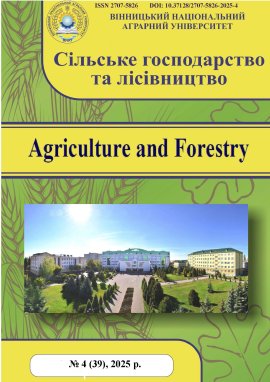
Issue №: 4 (39)
The issue of the magazine is dedicated to the study of the optimization of technological methods of growing agricultural crops. The impact of leguminous crops on improving soil fertility, methods of combating pests, greening territories, and adaptive selection of leguminous crops are considered.
FORMATION OF GRAIN QUALITY INDICATORS OF SOFT WINTER WHEAT DEPENDING ON CULTIVAR CHARACTERISTICS AND THE EFFECT OF RHIZOBACTERIAL-BASED BIOSTIMULANTS
Palazyuk Bohdan Oleksandrovych, PhD candidate, head of the educational and scientific laboratory of protected soil technologies, (Poltava State Agrarian University, 1/3 Skovorody St., Poltava, 36003, Ukraine, e-mail: bohdan.palaziuk@pdau.edu.ua, https://orcid.org/0009-0006-4525-5826).
Yurchenko Svitlana Oleksandrivna, Candidate of Agricultural Sciences, Associate Professor, Head of the Department of Breeding, Seed Production and Genetics, (Poltava State Agrarian University, 1/3 Skovorody St., Poltava, 36003, Ukraine, e-mail: svitlana.iurchenko@pdau.edu.ua, https://orcid.org/0000-0002-5812-3877).
The article presents the results of a three-year study aimed at determining the effect of rhizobacteria-based biostimulants on the formation of grain quality indicators in soft winter wheat. The research was carried out on three cultivars: Manzhelia, Bohdana and Altigo, under the conditions of the Left-Bank Forest-Steppe of Ukraine. The agroclimatic conditions of the study period and the agrochemical characteristics of the soil are described. The effectiveness of four biopreparations differing in their composition is evaluated. It was established that the application of bacterial preparations at the spring tillering stage (BBCH 22) contributed to an increase in test weight, grain protein content and wet gluten content compared with the control within the studied cultivars. Satisfactory results were obtained in increasing test weight by 5–9 g/L, protein content by 0.2–0.4%, and wet gluten content by 0.4–0.7%. According to the results of multifactor ANOVA, the important role of the cultivar factor was determined, and an interaction between the climatic conditions of the year and the cultivar was established, indicating the genotypic response to weather conditions. Correlation and regression models were constructed, confirming the presence of an inverse relationship between key quality parameters and yield. At the same time, partial mitigation of this relationship due to the action of the biopreparations was recorded. The generalization of the data made it possible to identify several stable trends that confirm the consistency of the crop response to the applied biopreparations. The identified effect indicates their potential to increase crop adaptability to variable weather conditions, which is important under current climatic fluctuations. The obtained results confirm the feasibility of using rhizobacteria-based biopreparations as a means of maintaining key grain quality indicators of wheat under variable agroclimatic conditions and cultivar characteristics. The research data may serve as a basis for improving adaptive cultivation technologies and as a component of biologized fertilization systems.
1.DSTU 3768:2019. (2019). Pshenytsia. Tekhnichni umovy [Wheat. Technical conditions]. Kyiv: DP “UkrNDNTs”. [in Ukrainian].
2.Demydov O. A., Los R.M., Dubovyk N.S. (2023). Formuvannia pokaznykiv yakosti zerna sortiv pshenytsi ozymoi (Triticum L.) zalezhno vid ahrotekhnichnykh i ekolohichnykh chynnykiv [Formation of quality indicators of winter wheat grain (Triticum L.) depending on agrotechnical and environmental factors]. Agroekologichnyi Zhurnal − Agroecological journal, № 2. 141–149. DOI: https://doi.org/10.33730/2077-4893.2.2023.283706. [in Ukrainian].
3.Havryliuk I., Kovalyshyna H. (2024). Characteristics of soft winter wheat varieties by crop structure and grain quality indicators. Ukrainian Black Sea Region Agrarian Science, Vol. 28 (4), 68–84. DOI: https://doi.org/10.56407/ bs.agrarian/4.2024.68 [in English].
4.Zaima O.A., Derhachov O.L., Siroshtan A.A. (2024). Urozhainist ta yakist zerna ozymoi pshenytsi za riznykh tekhnolohii vyroshchuvannia − Yield and grain quality of winter wheat under different cultivation technologies. Plant Varieties Studying and Protection, Vol. 20 (1). P. 51–57. DOI:https://doi.org/10.21498/2518-1017.20.1.2024.300136 [in Ukrainian].
5.Augšpole I., Putniece G., Bundžēna G., Sanžarevska R. (2024). WinFOLIA flag leaf analysis of winter wheat (Triticum aestivum L.) and evaluation of grain quality indicators. Engineering for Rural Development, Vol. 23. P. 7955–7962. DOI: https://doi.org/10.17770/etr2024vol1.7955. [in English].
6.Lisovyi M.V., Nikonenko V.M., Karatsiuba O.V. (2021). Vplyv mineralnykh dobryv na yakist zerna ozymoi pshenytsi na typovomu chornozemi Livoberezhnoho Lisostepu [Influence of mineral fertilizers on winter wheat grain quality in typical chernozem of the Left-Bank Forest-Steppe]. Agrochemistry and Soil Science, № 91. 59–63. DOI: https://doi.org/10.31073/acss91-07.
7.Shevchuk M.Y., Lukashchuk L.Y., Zlotenko O.Y. (2024). Vplyv spivvidnoshennia azotu ta kaliiu u systemakh udobrennia na yakist zerna ozymoi pshenytsi [Influence of nitrogen-to-potassium ratio in fertilization systems on the quality of winter wheat grain]. Ahrarni innovatsii − Agrarian Innovations. № 25. DOI: https://doi.org/10.32848/agrar.innov.2024.25.16
8.Lachutta K., Bobrecka-Jamro D., & Dziadowiec M. (2024). Effect of sowing strategies and spring nitrogen rates on winter wheat grain technological quality. Agriculture, Vol. 14. № 4, P. 552. DOI: https://doi.org/10.3390/agriculture14040552 [in English].
9.Klipakova N.V., Bilousova Z.V., Keneva V.A. (2021). Effect of nitrogen fertilization timing on the formation of winter wheat grain quality indicators [Vplyv strokiv vnesennia azotnykh dobryv na formuvannia yakisnykh pokaznykiv zerna pshenytsi ozymoi]. Ahrarni Innovatsii − Agrarian Innovations], Issue 8. 36–41. DOI: https://doi.org/10.32848/ agrar. innov. 2021.8.6 [in Ukrainian].
10.Dehodiuk S., Muliarchuk A. (2023). Urozhainist i yakist zerna pshenytsi ozymoi za tradytsiinykh ta novitnikh system udobrennia [Yield and quality of winter wheat grain under traditional and innovative fertilization systems]. Zemlerobstvo ta Roslynnytstvo: Teoriia i Praktyka − Agriculture and Crop Production: Theory and Practice], Issue 3 (9), 37–42. DOI: https://doi.org/10.54651/agri.2023.03.05.
11.Kotkova T.M., Dovbysh L.L. (2023). Vplyv pozakorenevoho (foliarnoho) pidzhyvlennia roslyn pshenytsi ozymoi na urozhai i yakist zerna [Effect of foliar feeding of winter wheat plants on yield and grain quality]. Ukrainskyi Zhurnal Pryrodnychykh Nauk − Ukrainian Journal of Natural Sciences, № 3. 176–185. DOI: https://doi.org/10.32782/naturaljournal.3.2023.176-185.
12.Dubytska A., Kachmar O., Dubytskyi O. (2024). Vplyv system dobryv z biostymuliatsiieiu ta humusovymy dobryvamy na vrozhainist i yakist zerna ozymoi pshenytsi [Effect of fertilizer systems with biostimulation and humic fertilizers on yield and quality of winter wheat grain]. Foothill and Mountain Agriculture and Stockbreeding, Vol. 76, № 1. 16–25. DOI: https://doi.org/10.32636/01308521.2024-(76)-1-2. [in Ukrainian].
13.Artyszak A., Gozdowski D. (2021). Is it possible to maintain the quantity and quality of winter wheat grain by replacing part of the mineral nitrogen dose by growth activators and plant growth-promoting rhizobacteria (PGPR)? Sustainability, Vol. 13, № 11. 5834. DOI: https://doi.org/10.3390/su13115834. [in English].
14.Zaiets S.O., Onufran L.I., Yuziuk S.M. (2024). Influence of different biological plant protection systems on yield and quality of winter wheat grain under organic farming conditions [Vplyv riznykh system biolohichnoho zakhystu roslyn na vrozhainist ta yakist zerna pshenytsi ozymoi v orhanichnomu zemlerobstvi]. Ahrarni Innovatsii − Agrarian Innovations]. № 23. 75–82. DOI: https://doi.org/10.32848/agrar.innov.2024.23.11. [in Ukrainian].
15.Szpunar-Krok, E., Depciuch J., Drygaś B., Kula-Maximenko M., Baran M., Hermanowicz J. (2022). The effect of biostimulants with antifungal activity on the chemical composition of winter wheat grain. International Journal of Environmental Research and Public Health, Vol. 19. № 20, P. 12998. DOI: https://doi.org/10.3390/ijerph192012998 [in English].
16.Maignan V., Clement C., Barka E.A., Beligni M.V., Deleu C., Farcy E. (2020). Biostimulant effects of Glutacetine® and its derived formulations mixed with N fertilizer on post-heading N uptake and remobilization, seed yield, and grain quality in winter wheat. Frontiers in Plant Science, Vol. 11. P. 607−615. DOI: https://doi.org/10.3389/fpls.2020.607615 [in English].
17.Rouphael Y., Colla G. (2020). Biostimulants in agriculture (editorial article). Frontiers in Plant Science, 11. DOI: https://doi.org/10.3389/fpls.2020.00040 [in English].
18.Kanatas P., Travlos I., Gazoulis I., Antonopoulos N., Papastylianou P., Bilalis D. (2022). Biostimulants and herbicides: A promising approach. Agronomy, Vol. 12, № 12. P. 3205. DOI: https://doi.org/10.3390/agronomy12123205. [in English].
19.Stępień A., Wojtkowiak K., Kolankowska E. (2022). Effect of commercial microbial preparations containing Paenibacillus azotofixans, Bacillus megaterium and Bacillus subtilis on the yield and photosynthesis of winter wheat and the nitrogen and phosphorus content in the soil. Applied Sciences, Vol. 12, № 24. P. 12541. DOI:https://doi.org/10.3390/app122412541. [in English].
20.Abbas M., Abdel-Lattif H., Badawy R., Abd El-Wahab M., Shahba M. (2022). Compost and biostimulants versus mineral nitrogen on productivity and grain quality of two wheat cultivars. Agriculture, Vol. 12, № 5. P. 699. DOI: https://doi.org/10.3390/agriculture12050699 [in English].
About the journal
Cluster Agricultural and veterinary sciences (H1 Agronomy, H4 Forestry)
Name of the publication «AGRICULTURE AND FORESTRY»
The aim of the journal "Agriculture and Forestry" is to highlight the results of fundamental and applied research in the fields of agriculture and forestry, aimed at improving the efficiency of agricultural production and introducing modern technologies into farming practice.
This goal defines the main objectives:
– to ensure the creation of open information access regarding the dissemination of relevant scientific research results to: lecturers of agricultural higher education institutions, postgraduate students, doctoral candidates, research staff, and agricultural production specialists;
– to promote the development of young scientists in agricultural sciences;
– to enhance communication between experienced researchers and young scientists in agronomy and forestry;
– to facilitate the expansion of ties between Vinnytsia National Agrarian University and domestic and foreign educational institutions, scientific establishments, and their academic communities.
The scientific, production, and educational journal "Agriculture and Forestry" is a peer-reviewed open-access publication that publishes original experimental research, theoretical and practice-oriented articles within the cluster of "Agricultural and Veterinary Sciences".
The journal's subject matter covers such areas as agronomy and forestry. Publications of scientific and practical significance address the experimental foundations of agricultural and forestry sector development, innovative production technologies, and the results of fundamental and applied research aimed at increasing productivity, product quality, and the sustainable development of natural and production systems.
Publisher: Vinnytsia National Agrarian University
EDRPOU code: 00497236
Publisher's ROR:05m3ysc06
Prefix DOI: 10.37128/
Frequency is quarterly
Publication languages: (Ukrainian, English)
Media ID R30-05174.
Editor in Chief Ihor Didur
According to the order of the Ministry of Education and Science of Ukraine dated 17.03.2020 № 409. The journal Agriculture and Forestry is included in the List of scientific professional publications of Ukraine Category "B" in agricultural sciences (specialties) - 101, 201, 202, 203, 205, 206.
State registration: Decision of the National Council of Ukraine on Television and Radio Broadcasting No. 1337 and No. 1181. Media identifier – R30-05174.
Scientific journal "AGRICULTURE AND FORESTRY" was founded in 1995; it was entitled as Bulletin of Vinnytsya State Agricultural Institute.
In 2010-2014 was enritled as Collection of scientific works of Vinnytsia National Agrarian University.
It has been named as Agriculture and Forestry since 2015.
Listed in the updated list of scientific professional editions of Ukraine on agricultural sciences under the name Agriculture and Forestry (Order of the Ministry of Education and Science of Ukraine of May 16, 2016; No. 515).
Since 2015, "Agriculture and Forestry". (archive of previous issues for 2015-2019) at http://forestry.vsau.edu.ua/.
The journal “Agriculture and Forestry (ISSN: 2707-5826)” passed the evaluation process of Index Copernicus positively and is indexed in the database of ICI Journals Master List ICV for 2018, 2019, 2020, 2021, 2022, 2023, 2024 is presented in the full list of indexed journals in the Master List International List
ICI Journals Master List Value
