

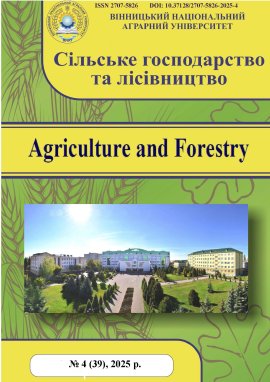
Issue №: 4 (39)
The issue of the magazine is dedicated to the study of the optimization of technological methods of growing agricultural crops. The impact of leguminous crops on improving soil fertility, methods of combating pests, greening territories, and adaptive selection of leguminous crops are considered.
FEATURES OF THE FORMATION OF PHYSICAL PROPERTIES OF CARPINUS BETULA L. WOOD
Ivan Mykolayovych Sopushynskyi, Doctor of Agricultural Sciences, Professor of the Department of Forestry and Sustainable Nature Management of Cherkasy State University of Technology (18006, Cherkasy, Shevchenko Boulevard, 460. e-mail: i.sopushynskyi@chdtu.edu.ua, https://orcid.org/0000-0002-7392-93-85).
Ruslan Tarasovych Maksymchuk, Doctor of Philosophy in Forestry, Associate Professor of the Department of Forestry and Sustainable Nature Management of the Cherkasy State University of Technology (18006, Cherkasy, Shevchenko Boulevard, 460. e-mail: maksymchuktaras@gmail.com, https://orcid.org/0000-0001-5297-4542).
Yaroslav Mykhailovych Kopolovets, Doctor of Philosophy in Forestry, Associate Professor of the Forestry Department of the Uzhgorod National University (88000, Uzhgorod, Pidhirna St., 46. e-mail: yaroslav.kopolovets@uzhnu.edu.ua, https://orcid.org/0009-0006-4008-4052).
The paper presents the results of a comprehensive study of the physical properties of the trunk wood of common hornbeam (Carpinus betula L.) in hornbeam-beech stands of the Ukrainian Carpathians. Structural and qualitative differences in wood between dominant and suppressed trees growing within the same type of forest-vegetation conditions were determined. The relevance of the study is due to the need to optimize the use of hornbeam wood raw materials, which is an important component of the forests of the Forest-Steppe and the Carpathian region and is characterized by valuable, dense and high-calorific wood. The study analysed the change in wood density, wood porosity and indicators of wood shrinkage anisotropy by stem height and tree categories in the stand. It was established that the average density of wood in a completely dry state in dominant trees is 728±3.33 kg•m-3, which is 4.0% higher than in suppressed trees (702±2.69 kg•m-3). A similar pattern is observed for the basic and green wood density. The results obtained indicate that the wood of dominant trees has a denser structure, lower porosity (П₀ = 51±0.23 %), but higher humidity and a slightly greater tendency to deformation during drying. For suppressed trees, on the contrary, increased porosity (Пo = 53±0.17 %) and lower anisotropy of drying are characteristic, which makes their wood more stable during technological processing. The tangential (βt) and radial (βr) shrinkage rates are 10.3±0.04 % and 7.0±0.05% for dominant trees and 9.6±0.03 % and 6.7±0.05 % for suppressed trees, respectively. Volumetric shrinkage (βV) in dominant trees is 18.6 %, while in suppressed trees it is 17.4 %. The anisotropy coefficient (kβt/βr) is on average 1.49 and 1.43, respectively, which indicates a moderate difference in the directions of shrinkage. Linear relationships were found between the basic density of wood and its tangential shrinkage, as well as between the basic wood density and absolute wood porosity. For dominant trees, the dependence equation has the form βt = 0.01ρб + 1.10, and for suppressed trees - βt = 0.01ρб + 4.70, which confirms the different intensity of changes in the dimensions of wood during shrinkage. The results of the study indicate that dominant trees form denser, less porous, but anisotropic wood, while suppressed trees form less dense, with higher porosity and more uniform drying. The established patterns are the basis for further differentiation of hornbeam wood according to technological purposes, requiring dimensional stability or for energy purposes. The results obtained are of important practical importance for optimizing technological processes of drying and processing hornbeam wood, as well as for assessing its quality, structure and deposited carbon in different types of stands.
1.Vintoniv I.S., Sopushynskyi I.M., Teischinger A. (2007). Derevynoznavstvo [Wood Science]: navch. posib. Vyd. 2-he, pererobl. i dopov. Lviv : Apriori. [in Ukrainian].
2.Cziczer M., Báder M., (2024). Comparitive study of different hornbeams (Carpinus betulus L). Gradus. Vol 11, № 3. P. 1−9. DOI: https://doi.org/10.47833/ 2024.3.ENG.014 [in English].
3.Kiaei M., Abadian Z. (2018). Physical and Mechanical Properties of Hornbeam Wood from Dominant and Suppressed Trees. Drvna Ind 69:63–69. DOI: https://doi.org/10.5552/drind.2018.1705 [in English].
4.Meier E. (2024). European Hornbeam. In: Wood Database. Accessed 22.05.2024. DOI: https://www.wooddatabase.com/european-hornbeam. [in English].
5.Meusel H., Jager E., eds. (1998). Vergleichende Chorologie der Zentraleuropäischen Flora - Band I, II, III (Gustav Fischer Verlag, Jena, 1998). [in English].
6.Normen für Holz (2009): DIN-Taschenbuch 31: 8te Aufl. Berlin : Beuth. 604 s. [in English].
7.Paridari C.I., Jalali S.G., Sonboli A., Zarafshar M., Bruschi P. (2013). Carpinus betulus in Europe: distribution, habitat, usage and threats. Journal of Forestry Research 24, 301 [in English].
8.Sikkema R., Caudullo G., de Rigo D. (2016). Carpinus betulus in Europe: distribution, habitat, usage and threats. In: San-MiguelAyanz J., de Rigo D., Caudullo G., Houston Durrant T., Mauri A. (Eds.), European Atlas of Forest Tree Species. Publ. Off. EU, Luxembourg, 2 p. [in English].
About the journal
Cluster Agricultural and veterinary sciences (H1 Agronomy, H4 Forestry)
Name of the publication «AGRICULTURE AND FORESTRY»
The aim of the journal "Agriculture and Forestry" is to highlight the results of fundamental and applied research in the fields of agriculture and forestry, aimed at improving the efficiency of agricultural production and introducing modern technologies into farming practice.
This goal defines the main objectives:
– to ensure the creation of open information access regarding the dissemination of relevant scientific research results to: lecturers of agricultural higher education institutions, postgraduate students, doctoral candidates, research staff, and agricultural production specialists;
– to promote the development of young scientists in agricultural sciences;
– to enhance communication between experienced researchers and young scientists in agronomy and forestry;
– to facilitate the expansion of ties between Vinnytsia National Agrarian University and domestic and foreign educational institutions, scientific establishments, and their academic communities.
The scientific, production, and educational journal "Agriculture and Forestry" is a peer-reviewed open-access publication that publishes original experimental research, theoretical and practice-oriented articles within the cluster of "Agricultural and Veterinary Sciences".
The journal's subject matter covers such areas as agronomy and forestry. Publications of scientific and practical significance address the experimental foundations of agricultural and forestry sector development, innovative production technologies, and the results of fundamental and applied research aimed at increasing productivity, product quality, and the sustainable development of natural and production systems.
Publisher: Vinnytsia National Agrarian University
EDRPOU code: 00497236
Publisher's ROR:05m3ysc06
Prefix DOI: 10.37128/
Frequency is quarterly
Publication languages: (Ukrainian, English)
Media ID R30-05174.
Editor in Chief Ihor Didur
According to the order of the Ministry of Education and Science of Ukraine dated 17.03.2020 № 409. The journal Agriculture and Forestry is included in the List of scientific professional publications of Ukraine Category "B" in agricultural sciences (specialties) - 101, 201, 202, 203, 205, 206.
State registration: Decision of the National Council of Ukraine on Television and Radio Broadcasting No. 1337 and No. 1181. Media identifier – R30-05174.
Scientific journal "AGRICULTURE AND FORESTRY" was founded in 1995; it was entitled as Bulletin of Vinnytsya State Agricultural Institute.
In 2010-2014 was enritled as Collection of scientific works of Vinnytsia National Agrarian University.
It has been named as Agriculture and Forestry since 2015.
Listed in the updated list of scientific professional editions of Ukraine on agricultural sciences under the name Agriculture and Forestry (Order of the Ministry of Education and Science of Ukraine of May 16, 2016; No. 515).
Since 2015, "Agriculture and Forestry". (archive of previous issues for 2015-2019) at http://forestry.vsau.edu.ua/.
The journal “Agriculture and Forestry (ISSN: 2707-5826)” passed the evaluation process of Index Copernicus positively and is indexed in the database of ICI Journals Master List ICV for 2018, 2019, 2020, 2021, 2022, 2023, 2024 is presented in the full list of indexed journals in the Master List International List
ICI Journals Master List Value
