

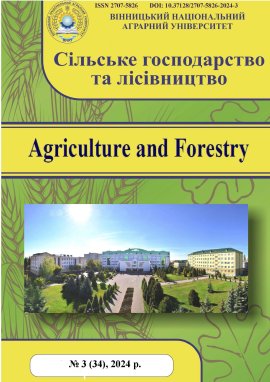
Issue №: 3 (34)
The issue of the journal is dedicated to the study of optimization of elements of crop cultivation technology. An important role is given to the influence of legumes on improving soil fertility, adaptive selection, mineral and foliar fertilization of crops, ecology and environmental protection, in particular, the influence of chemicalization on soil and grain pollution by pesticides, and methods of combating harmful objects.
FACTORS OF PEPPER YIELD FORMATION
Alekseev Oleksiy Oleksandrovich − candidate of agricultural sciences, associate professor department of ecology and environmental protection of Vinnytsia National Agrarian University. (Sonyachna 3, Vinnytsia, 21008. tel. 0685150631. e-mail: alekseev_oleksiy@ukr.net).
Petriyanchuk Lilia Hryhorivna − graduate student of the Department of Ecology and Environmental Protection of Vinnytsia National Agrarian University. (Sonyachna 3, Vinnytsia, 21008. tel. 0681615271. e-mail: liliapetrianchuk999@ukr.net).
In production conditions, the average yield of pepper varieties is lower and is 25-30 t/ha, but it can be 40-45 t/ha with proper care. The average yield of bitter pepper with proper care is 20-25 t/ha. In modern greenhouses, it can be much higher and amount to 100-200 t/ha. Sweet pepper responds well to mineral and organic fertilizers, but the most effective is the complex application of these types of fertilizers. Sweet pepper should be fed for the first time 10-12 days after planting. In the period before flowering, it is better to divide the application of nitrogen fertilizers into several feedings, so as not to apply a large dose at once. An overdose of nitrogen causes an intensive growth of ground green mass and delays the ripening of fruits. Magnesium is very important for salad peppers. Its lack in the soil can lead to the death of leaves, a decrease in yield and product quality. The purpose of the research is to establish the determining factors of formation of high productivity of pepper. The research was conducted on the basis of processing literary sources on the topic of the article.There are 5 classifications of pepper varieties: according to the method of creation; according to taste; by the content of alkaloid capsaicin; by the color of the fruits; by the nature of stem branching. Pepper is grown using the following technologies: in field conditions without irrigation (in regions with sufficient moisture); in field conditions with irrigation; in field conditions with drip irrigation; in field conditions with drip irrigation and covering the soil with polymeric materials; in field conditions with drip irrigation and covering the soil with straw or other plant mulch; in tunnels made of film; in spunbond tunnels; in film greenhouses; in spunbond greenhouses (agrofibre); in glass greenhouses; in high-tech greenhouses with hydroponics and fully controlled climate and automation of all processes. The pepper fertilization system can be organo-mineral, which involves the use of organic and mineral fertilizers, or biological, which includes the use of biostimulants, foliar feeding, including trace elements and anti-stressors.
1. Kuts O.V., Onyshchenko O.I., Semenenko I.I., Ilyinova E.M., Panova I.M., Pylypenko L.V., Chayuk O.O., Konovalenko K.M., Yakovchenko A.V. (2020). Efektyvnist rehulyatoriv rostu v ovochivnytstvi. [Effectiveness of growth regulators in vegetable production]. Ovochivnytstvo i bashtannytstvo – Vegetable and melon growing. Issue 68. 63–75. URL : https://doi.org/10.32717/0131-0062-2020-68-63-75. [in Ukrainian].
2. Kravchenko V.A., Prylipka O.V. (2009). Perets solodkyy. Baklazhan: selektsiya, nasinnytstvo, tekhnolohiyi. [Sweet pepper. Eggplant: selection, seed production, technologies]. K.: Zadruga. [in Ukrainian].
3. Kuraksa N.P., Pylypenko L.V. (2014). Parametry adaptyvnosti pertsyu solodkoho. [Adaptability parameters of sweet pepper]. Ovochivnytstvo i bashtannytstvo – Vegetable and melon growing. Issue 60. 155–166. [in Ukrainian].
4. Yavorska V. K., Dragovoz I. V., Kryuchkova L. O. (2006). Rehulyatory rostu na osnovi pryrodnoyi syrovyny ta yikh zastosuvannya v roslynnytstvi. [Growth regulators based on natural raw materials and teir application in crop production]. K.: Logos. [in Ukrainian].
5. Shevchenko A.O., Tarasenko V.O. (1998). Rehulyatory rostu v roslynnytstvi – efektyvnyy element silʹsʹkohospodarsʹkykh tekhnolohiy. Stan ta perspektyvy. [Growth regulators in crop production are an effective element of agricultural technologies. Status and prospects]. Rehulyatory rostu roslyn u zemlerobstvi – Plant growth regulators in agriculture. 8–14. [in Ukrainian].
6. Zakalyk G., Verbenets D., Baranov V., Shuvar N. (2008). Vplyv Emystymu S i Ahrostymulinu na vrozhaynist roslyn pertsyu solodkoho. [Effect of Emystimum C and Agrostimulin on the yield of sweet pepper plants]. Visnyk Lvivskoho universytetu – Bulletin of Lviv University. Issue 48. 195–200. [in Ukrainian].
7. Gordienko I.M., Ilyushenko G.Ya. (2002). [Effect of local application of fertilizers on sweet pepper seed productivity]. Ahrokhimiya i gruntoznavstvo – Agrochemistry and soil science. Kharkiv. Issue 63. P. 83-85. [in Ukrainian].
8. Gordienko I.M., Honcharenko V.Yu., Tkach L.O. (2002). Vynos azotu, fosforu i kaliyu pertsem solodkym zalezhno vid dobryv i tekhnolohiyi vyroshchuvannya. [Removal of nitrogen, phosphorus and potassium by sweet pepper depending on fertilizers and growing technology]. Ovochivnytstvo i bashtannytstvo – Vegetable and melon growing. Issue 47. P. 359-365. [in Ukrainian].
9. Bosland P.W., Votana E.J. (2000). Peppers: Vegetable and spice Capsicum. CABI Publishing: Wallingford. 89 р. [in English].
10. Aliyu L. The effects of organic and mineral fertilizer on growth, yield and composition of pepper. Biological Agriculture and Horticulture. 2000. Vol. 18. Р. 29–36. DOI:10.1080/01448765.2000.9754862 [in English].
About the journal
Cluster Agricultural and veterinary sciences (H1 Agronomy, H4 Forestry)
Name of the publication «AGRICULTURE AND FORESTRY»
The aim of the journal "Agriculture and Forestry" is to highlight the results of fundamental and applied research in the fields of agriculture and forestry, aimed at improving the efficiency of agricultural production and introducing modern technologies into farming practice.
This goal defines the main objectives:
– to ensure the creation of open information access regarding the dissemination of relevant scientific research results to: lecturers of agricultural higher education institutions, postgraduate students, doctoral candidates, research staff, and agricultural production specialists;
– to promote the development of young scientists in agricultural sciences;
– to enhance communication between experienced researchers and young scientists in agronomy and forestry;
– to facilitate the expansion of ties between Vinnytsia National Agrarian University and domestic and foreign educational institutions, scientific establishments, and their academic communities.
The scientific, production, and educational journal "Agriculture and Forestry" is a peer-reviewed open-access publication that publishes original experimental research, theoretical and practice-oriented articles within the cluster of "Agricultural and Veterinary Sciences".
The journal's subject matter covers such areas as agronomy and forestry. Publications of scientific and practical significance address the experimental foundations of agricultural and forestry sector development, innovative production technologies, and the results of fundamental and applied research aimed at increasing productivity, product quality, and the sustainable development of natural and production systems.
Publisher: Vinnytsia National Agrarian University
EDRPOU code: 00497236
Publisher's ROR:05m3ysc06
Prefix DOI: 10.37128/
Frequency is quarterly
Publication languages: (Ukrainian, English)
Media ID R30-05174.
Editor in Chief Ihor Didur
According to the order of the Ministry of Education and Science of Ukraine dated 17.03.2020 № 409. The journal Agriculture and Forestry is included in the List of scientific professional publications of Ukraine Category "B" in agricultural sciences (specialties) - 101, 201, 202, 203, 205, 206.
State registration: Decision of the National Council of Ukraine on Television and Radio Broadcasting No. 1337 and No. 1181. Media identifier – R30-05174.
Scientific journal "AGRICULTURE AND FORESTRY" was founded in 1995; it was entitled as Bulletin of Vinnytsya State Agricultural Institute.
In 2010-2014 was enritled as Collection of scientific works of Vinnytsia National Agrarian University.
It has been named as Agriculture and Forestry since 2015.
Listed in the updated list of scientific professional editions of Ukraine on agricultural sciences under the name Agriculture and Forestry (Order of the Ministry of Education and Science of Ukraine of May 16, 2016; No. 515).
Since 2015, "Agriculture and Forestry". (archive of previous issues for 2015-2019) at http://forestry.vsau.edu.ua/.
The journal “Agriculture and Forestry (ISSN: 2707-5826)” passed the evaluation process of Index Copernicus positively and is indexed in the database of ICI Journals Master List ICV for 2018, 2019, 2020, 2021, 2022, 2023, 2024 is presented in the full list of indexed journals in the Master List International List
ICI Journals Master List Value
