

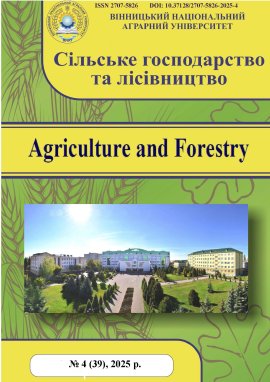
Issue №: 4 (39)
The issue of the magazine is dedicated to the study of the optimization of technological methods of growing agricultural crops. The impact of leguminous crops on improving soil fertility, methods of combating pests, greening territories, and adaptive selection of leguminous crops are considered.
EVALUATION OF MAIZE HYBRIDS BASED ON ECOLOGICAL PLASTICITY AND STABILITY INDICES
Steshenko Borys – Postgraduate Student, Department of Genetics, Breeding and Seed Production prof. M. O. Zelensky, National University of Life and Environmental Sciences of Ukraine (37600, Myrhorod, Shyshatska Street 31, apt. 14, e-mail: b.steshenko@nubip.edu.ua, https://orcid.org/0009-0007-7159-2102).
Makarchuk Oleksandr – candidate of Agricultural Sciences, Head of Genetics, Breeding and Seed Production prof. M. O. Zelensky department, National University of Life and Environmental Sciences of Ukraine (03041, Kyiv, Generala Rodimtceva str. 1a, e-mail: mcar2010@ukr.net, https://orcid.org/0000-0002-3348-676X).
Maize (Zea mays L.) is a strategic crop within global food, feed, and bioenergy systems, and increasing climate variability highlights the need to develop high-yielding and adaptive hybrids. This study aimed to assess the ecological plasticity, stability, and productivity of early- and mid-season maize hybrids developed by LLC “RAZT Semens-Ukraine” in order to identify the most environmentally plastic genotypes suitable for large-scale cultivation. Ecological trials were conducted in 2024 across three contrasting soil–climatic zones of Ukraine: Kyiv, Ivano-Frankivsk, and Vinnytsia regions. Grain yield was measured according to standard methodologies, while environmental index, ecological plasticity, and stability parameters were calculated using the Eberhart–Russell model. The results revealed considerable variation in yield depending on location. Among early-maturing hybrids, the highest yield was obtained from RZT Motorikks – 14.29 t/ha, while among mid-season hybrids, RZT Tekksiia demonstrated the highest productivity – 14.77 t/ha, both recorded under conditions of the Kyiv region, which exhibited the most favorable environmental index (Ij > 1). The greatest ecological plasticity was observed in RZT Motorikks (bi = 1.4), RZT Lipekks and RZT Attrakksion (bi = 1.1), as well as RZT Tekksiia (bi = 1.3) and RZT Inedikkks (bi = 1.1), indicating their suitability for intensive agricultural technologies. Meanwhile, the highest ecological stability (σd2 = 0.02) was recorded for RZT Alikks, RZT Attrakksion, and RZT Inedikkks, reflecting minimal yield response to fluctuating growing conditions.
All evaluated hybrids demonstrated high adaptive potential. However, RZT Motorikks and RZT Tekksiia are recommended for high-input production systems, whereas more stable hybrids may be advantageous in regions with variable environmental conditions. Future research should focus on multi-year testing and the integration of biotic and abiotic stress factors.
1.Erenstein O., Jaleta M., Sonder K., Mottaleb K., Prasanna B.M. (2022). Global maize production, consumption and trade: trends and R&D implications. Food Security. 14 (5). P. 1295–1319. DOI: 10.1007/s12571-022-01288-7. [in English].
2.Liu H., Wang X., Warburton-Marilyn L., Wen W., Jin M., Deng M., Liu J., Tong H., Pan Q., Yang X. (2015). Genomic, transcriptomic, and phephenomic variation reveals the complex adaptation of modern maize breeding. Molecular Plant. 8 (6). P. 871–884. [in English].
3.Haidash O., Nehoda T., Olkhovyk M. (2024). Metody ta pryntsypy stvorennia vykhidnoho materialu dlia selektsii kukurudzy [Methods and principles of creating initial material for maize breeding]. International Science Journal of Engineering & Agriculture, 3 (4), 60–69. DOI:https://doi.org/10.46299/ j.isjea. 20240304.06. [in Ukrainian].
4.Tollenaar M., Lee E.A. (2006). Maydica. 51. P. 399–498. [in English].
5.Munsch M.A., Stamp P., Christov N.K., Foueillassar X.M., Hüsken A., Camp K.H., Weider C. (2010). Grain yield increase and pollen containment by Plus-Hybrids could improve acceptance of transgenic maize. Crop Science. 50 (3) P. 909–919. [in English].
6.Nelimor C., Badu-Apraku B., Tetteh A.Y., N’guetta A.S.P. (2019). Assessment of genetic diversity for drought, heat and combined drought and heat stress tolerance in early maturing maize landraces. Plants. 8. 518 p. [in English].
7.Nuzhna M.V., Bodenko N.A. (2018). Models of corn hybrids of different maturity groups FAO 150–490 for irrigated conditions. Plant Varieties Studying and Protection. 14 (1). P. 58–64. [in English].
8.Gong F., Yang L., Tai F., Hu X., Wang W. (2014). “Omics” of maize stress response for sustainable food production: opportunities and challenges. OMICS.. Vol. 18 (12). P. 714–732. [in English].
9.Tkachyk S.O., Prysiazhniuk O.I., Leshchuk N.V. (2016). Metodyka provedennia kvalifikatsiinoi ekspertyzy sortiv roslyn na prydatnist do poshyrennia v Ukraini. Zahalna chastyna [Methodology for qualifying examination of plant varieties for suitability for dissemination in Ukraine. General part]. Vinnytsia. 119 p. [in Ukrainian].
10.Eberhart S. A., Russell W. A. (1966). Stability parameters for comparing varieties. Crop Science. Vol. 6. №1. P. 36–40. DOI: https://doi.org/10.2135/cropsci1966.0011183X000600010011x. [in English].
11.Spriazhka R.O., Zhemoida V.L. (2022). Екологічна пластичність та стабільність гібридів кукурудзи при селекції на якість зерна. Наукові доповіді НУБіП України. № 5 (99). 13 с. DOI: https://doi.org/10.31548/ dopovidi 2022.05.007. [in English].
About the journal
Cluster Agricultural and veterinary sciences (H1 Agronomy, H4 Forestry)
Name of the publication «AGRICULTURE AND FORESTRY»
The aim of the journal "Agriculture and Forestry" is to highlight the results of fundamental and applied research in the fields of agriculture and forestry, aimed at improving the efficiency of agricultural production and introducing modern technologies into farming practice.
This goal defines the main objectives:
– to ensure the creation of open information access regarding the dissemination of relevant scientific research results to: lecturers of agricultural higher education institutions, postgraduate students, doctoral candidates, research staff, and agricultural production specialists;
– to promote the development of young scientists in agricultural sciences;
– to enhance communication between experienced researchers and young scientists in agronomy and forestry;
– to facilitate the expansion of ties between Vinnytsia National Agrarian University and domestic and foreign educational institutions, scientific establishments, and their academic communities.
The scientific, production, and educational journal "Agriculture and Forestry" is a peer-reviewed open-access publication that publishes original experimental research, theoretical and practice-oriented articles within the cluster of "Agricultural and Veterinary Sciences".
The journal's subject matter covers such areas as agronomy and forestry. Publications of scientific and practical significance address the experimental foundations of agricultural and forestry sector development, innovative production technologies, and the results of fundamental and applied research aimed at increasing productivity, product quality, and the sustainable development of natural and production systems.
Publisher: Vinnytsia National Agrarian University
EDRPOU code: 00497236
Publisher's ROR:05m3ysc06
Prefix DOI: 10.37128/
Frequency is quarterly
Publication languages: (Ukrainian, English)
Media ID R30-05174.
Editor in Chief Ihor Didur
According to the order of the Ministry of Education and Science of Ukraine dated 17.03.2020 № 409. The journal Agriculture and Forestry is included in the List of scientific professional publications of Ukraine Category "B" in agricultural sciences (specialties) - 101, 201, 202, 203, 205, 206.
State registration: Decision of the National Council of Ukraine on Television and Radio Broadcasting No. 1337 and No. 1181. Media identifier – R30-05174.
Scientific journal "AGRICULTURE AND FORESTRY" was founded in 1995; it was entitled as Bulletin of Vinnytsya State Agricultural Institute.
In 2010-2014 was enritled as Collection of scientific works of Vinnytsia National Agrarian University.
It has been named as Agriculture and Forestry since 2015.
Listed in the updated list of scientific professional editions of Ukraine on agricultural sciences under the name Agriculture and Forestry (Order of the Ministry of Education and Science of Ukraine of May 16, 2016; No. 515).
Since 2015, "Agriculture and Forestry". (archive of previous issues for 2015-2019) at http://forestry.vsau.edu.ua/.
The journal “Agriculture and Forestry (ISSN: 2707-5826)” passed the evaluation process of Index Copernicus positively and is indexed in the database of ICI Journals Master List ICV for 2018, 2019, 2020, 2021, 2022, 2023, 2024 is presented in the full list of indexed journals in the Master List International List
ICI Journals Master List Value
