

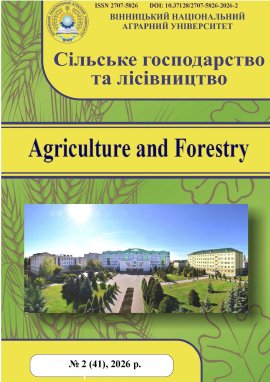
Issue №: 2 (41)
This issue of the journal is dedicated to current issues in improving technological methods for crop cultivation. Significant attention is given to the specifics of growing vegetable, grain and leguminous crops, which play a vital role in ensuring the state's food security. The scientific publications present the results of experimental research on the production of organic leguminous products, the importance of adaptive breeding to increase the resilience of agrocenoses, plant protection against harmful objects and the application of fertilizers to increase crop yields. Certain papers are devoted to the implementation of innovative methods for stimulating the seed productivity of forest seed plantations.
EFFICIENCY OF MICRONUTRIENT FERTILIZER APPLICATION IN THE BIOFORTIFICATION OF TOMATO FRUIT QUALITY UNDER CULTIVATION IN PLASTIC GREENHOUSES
Tetiana Aralova, PhD in Agricultural Sciences, Senior Lecturer Department of Botany, Genetics and Plant Protection, Faculty of Agronomy, Horticulture and Plant Protection, Educational and Scientific Institute of Agrotechnology and Environmental Management, Vinnytsia National Agrarian University (21008, 1 Soniachna Str., Vinnytsia, Ukraine; e-mail: aralova.t@ukr.net, ORCID: https://orcid.org/0000-0002 9013-3979).
Pavel Verheles, Candidate of Agricultural Sciences, Associate Professor Department of Botany, Genetics and Plant Protection, Faculty of Agronomy, Horticulture and Plant Protection, Educational and Scientific Institute of Agrotechnology and Environmental Management, Vinnytsia National Agrarian University (21008, Vinnytsia, 1 Soniachna Str., e-mail: pasha425@gmail.com, ORCID: https://orcid.org/0000-0002-4101-1465).
Systemic biofortification in tomato cultivation under plastic greenhouses has been substantiated as significant both in terms of ensuring high nutritional quality of the harvested crop and as a corrective strategy for applying this innovative technology within general vegetable quality management processes. It has been determined that the main biofortification technologies in vegetable production are based on the use of selected micronutrients, which, due to their specific action, ensure a stable positive effect both on improving the micronutrient composition of tomato fruits and on enhancing other quality indicators important for direct consumption or further technological processing of the harvested crop. It has been determined that studying the effectiveness of applying a комплекс of chelated micronutrient fertilizers, considered as potential biofortifying agents in tomato cultivation technologies, is a relevant objective in vegetable production, with the ultimate goal not only of significantly stabilizing and increasing crop yield, but also of developing adaptive cultivation technologies. The study presents the results of applying micronutrient fertilizers in the form of foliar feeding at different phenological stages during the cultivation of an indeterminate tomato hybrid of the Porpora type, and their influence on yield formation and nutritional characteristics of greenhouse-grown products. The research was conducted using the greenhouse facilities of the Educational and Scientific Institute of Agrotechnologies and Environmental Management of Vinnytsia National Agrarian University, employing standard methods accepted in protected vegetable production, as well as the capacities of a certified and accredited laboratory in the Vinnytsia region to ensure reliable assessment of the quality and biochemical structure of the harvested crop depending on the experimental treatments. The influence of micronutrient fertilizers applied at different timings on the formation and realization of the yield potential of the tomato hybrid was determined. The marketability of the harvested crop was evaluated, and conclusions were drawn regarding the technological feasibility of the studied nutritional optimization measures for tomatoes grown in commonly used plastic greenhouses in Ukraine. Based on laboratory protocols for determining the chemical composition of tomato fruits – such as dry matter content, ascorbic acid, carotenoids, flavonoids, mono- and disaccharides, and total micronutrient content – the effectiveness of the biofortification approach using foliar application of specific micronutrient fertilizers was analyzed. The most optimal technological options for foliar nutrition of indeterminate tomato hybrids were identified to achieve the best combination of high yield and quality of the produced crop.
1. Meenakshi J.V., Johnson N.L., Manyong V.M., De Groote H., Javelosa J., Yanggen D.R. (2010). How cost-effective is biofortification in combating micronutrient malnutrition? An ex ante assessment. World Development. Vol. 38. P. 64–75. DOI: 10.1016/j.worlddev.2009.03.014 [in English].
2. Genc Y., Humphries J.M., Lyons G.H., Graham R.D. (2005). Exploiting genotypic variation in plant nutrient accumulation to alleviate micronutri ent deficiency in populations. Journal of Trace Elements in Medicine and Biology. Vol. 18. (4). P. 319–24. DOI: 10.1016/j.jtemb.2005.02.005 [in English].
3. Mrština T., Praus L., Száková J., Kaplan L., Tlustoš P. (2024). Foliar selenium biofortification of soybean: the potential for transformation of mineral selenium into organic forms. Frontiers in Plant Science. Vol. 15. 1379877. DOI: 10.3389/fpls.2024.379877 [in English].
4. Hossain A., Skalicky M., Brestic M., Maitra S., Sarkar S., Ahmad Z. (2021). Selenium biofortification: roles, mechanisms, responses and prospects. Molecules. Vol. 26 (4). P. 881. DOI: 10.3390/molecules26040881 [in English].
5. Rai S., Singh P.K., Mankotia S., Swain J., Satbhai S.B. (2021). Iron homeostasis in plants and its crosstalk with copper, zinc, and manganese. Plant Stress. Vol. 1. 100008. DOI: 10.1016/j.stress.2021.100008 [in English].
6. Bouis H.E., Welch R.M. (2010). Biofortification – A sustainable agricultural strategy for reducing micronutrient malnutrition in the global south. Crop Science. Vol. 50. P. 20–32. DOI: 10.2135/cropsci2009.09.0531 [in English].
7. Hansch R., Mendel R.R. (2009). Physiological functions of mineral micronutrients (Cu, Zn, Mn, Fe, Ni, Mo, B, Cl). Current Opinion in Plant Biology. Vol. 12 (3). P. 259–266. DOI: 10.1016/j.pbi.2009.05.006 [in English].
8. Xu X., Wang J., Wu H., Yuan Q., Wang J., Cui J., Lin A. (2022). Effects of selenium fertilizer application and tomato varieties on tomato fruit quality: A meta-analysis. Scientia Horticulturae. Vol. 304 (2). Article № 111242. DOI: 10.1016/j.scienta.2022.111242 [in English].
9. Lahoz I., Leiva-Brondo M., Martí R., Macua J.I., Campillo C., Roselló S., Cebolla-Cornejo J. (2016). Influence of high lycopene varieties and organic farming on the production and quality of processing tomato. Sciencia Horticulturae. 204. Р. 128–137. DOI: 10.1016/j.scienta.2016.03.042 [in English].
10. Traoré A. (2022). Optimizing tomato (Solanum lycopersicum L.) growth with different combinations of organo-mineral fertilizers. Frontiers in Sustainable Food Systems. Vol. 5. Р. 1–7. DOI: 10.3389/fsufs.2021.694628 [in English].
11. Peres L. A. С., Terra N. F., Rezende C. F. A. (2020). Productivity of industrial tomato submitted to organo-mineral fertilization in cover. Brazilian Journal of Development. Vol. 6. (3). Р. 10586–10599. DOI: 10.34117/bjdv6n3-075 [in English].
12. Wang P., Lombi E., Zhao F.J., Kopittke P.M. (2016). Nanotechnology: A new opportunity in plant sciences. Trends Plant Science. Vol. 21. P. 699–712. DOI: 10.1016/j.tplants.2016.04.005 [in English].
13. Agarwal A., Sharma U., Ranjan R., Nasim M. (2017). Combining ability analysis for yield, quality, earliness, and yieldattributing traits in tomato. International Journal of Vegetable Science. № 23 (6). Р. 605–615. DOI: 10.1080/19315260.2017.1355864 [in English].
14. Carricondo-Martínez I., Berti F., Salas-Sanjuán M. d. C. (2022). Different organic fertilization systems modify tomato quality: an opportunity for circular fertilization in intensive horticulture. Agronomy. 12. Р. 174–183. DOI: 10.3390/agronomy12010174 [in English].
15. Didur I., Vdovenko S., Tkachuk O., Palamarchuk I., Pantsyreva H., Chabaniuk Ya., Shkatula Yu., Zabarna T., Gucol G. (2024). Cultivation of tomatoes using mycorrhizal biological preparations. Modern Phytomorphology. Vol. 18. P. 133–138. DOI: 10.5281/zenodo.200121 [in English].
16. Schwarz D., Thompson A.J., Kläring H.P. (2014). Guidelines to use tomato in experiments with a controlled environment. Frontiers in Plant Science. Vol. 18. P. 625. DOI: 10.3389/fpls.2014.00625 [in English].
17. Christodoulou P., Kritsi E., Ladika G., Tsafou P., Tsiantas K., Tsiaka T., Zoumpoulakis P., Cavouras D., Sinanoglou V. J. (2025). Estimation of Tomato Quality During Storage by Means of Image Analysis, Instrumental Analytical Methods, and Statistical Approaches. Applied Sciences. Vol. 15, Issue 14. P. 7936. DOI: 10.3390/app15147936 [in English].
18. Amr A., Raie W. (2022). Tomato Components and Quality Parameters. A Review. Jordan Journal of Agricultural Sciences. Vol. 18 (3). P. 199–220. DOI: 10.35516/jjas.v18i3.444 [in English].
19. Nisbet R., Miner G., Yale K. (2018). Handbook of statistical analysis and data mining applications. Cambridge, Academic Press. 589 p. DOI: 10.1016/C2012-0-06451-4 [in English].
20. Wang X., Xing, Y. (2017). Evaluation of the effects of irrigation and fertilization on tomato fruit yield and quality: A principal component analysis. Scientific reports. Vol. 7, Issue 1. P. 350. DOI: 10.1038/s41598-017-00373-8 [in English].
About the journal
Cluster Agricultural and veterinary sciences (H1 Agronomy, H4 Forestry)
Name of the publication «AGRICULTURE AND FORESTRY»
The aim of the journal "Agriculture and Forestry" is to highlight the results of fundamental and applied research in the fields of agriculture and forestry, aimed at improving the efficiency of agricultural production and introducing modern technologies into farming practice.
This goal defines the main objectives:
– to ensure the creation of open information access regarding the dissemination of relevant scientific research results to: lecturers of agricultural higher education institutions, postgraduate students, doctoral candidates, research staff, and agricultural production specialists;
– to promote the development of young scientists in agricultural sciences;
– to enhance communication between experienced researchers and young scientists in agronomy and forestry;
– to facilitate the expansion of ties between Vinnytsia National Agrarian University and domestic and foreign educational institutions, scientific establishments, and their academic communities.
The scientific, production, and educational journal "Agriculture and Forestry" is a peer-reviewed open-access publication that publishes original experimental research, theoretical and practice-oriented articles within the cluster of "Agricultural and Veterinary Sciences".
The journal's subject matter covers such areas as agronomy and forestry. Publications of scientific and practical significance address the experimental foundations of agricultural and forestry sector development, innovative production technologies, and the results of fundamental and applied research aimed at increasing productivity, product quality, and the sustainable development of natural and production systems.
Publisher: Vinnytsia National Agrarian University
EDRPOU code: 00497236
Publisher's ROR:05m3ysc06
Prefix DOI: 10.37128/
Frequency is quarterly
Publication languages: (Ukrainian, English)
Media ID R30-05174.
Editor in Chief Ihor Didur
According to the order of the Ministry of Education and Science of Ukraine dated 17.03.2020 № 409. The journal Agriculture and Forestry is included in the List of scientific professional publications of Ukraine Category "B" in agricultural sciences (specialties) - 101, 201, 202, 203, 205, 206.
State registration: Decision of the National Council of Ukraine on Television and Radio Broadcasting No. 1337 and No. 1181. Media identifier – R30-05174.
Scientific journal "AGRICULTURE AND FORESTRY" was founded in 1995; it was entitled as Bulletin of Vinnytsya State Agricultural Institute.
In 2010-2014 was enritled as Collection of scientific works of Vinnytsia National Agrarian University.
It has been named as Agriculture and Forestry since 2015.
Listed in the updated list of scientific professional editions of Ukraine on agricultural sciences under the name Agriculture and Forestry (Order of the Ministry of Education and Science of Ukraine of May 16, 2016; No. 515).
Since 2015, "Agriculture and Forestry". (archive of previous issues for 2015-2019) at http://forestry.vsau.edu.ua/.
The journal “Agriculture and Forestry (ISSN: 2707-5826)” passed the evaluation process of Index Copernicus positively and is indexed in the database of ICI Journals Master List ICV for 2018, 2019, 2020, 2021, 2022, 2023, 2024 is presented in the full list of indexed journals in the Master List International List
ICI Journals Master List Value
