

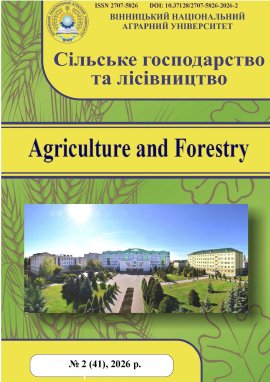
Issue №: 2 (41)
This issue of the journal is dedicated to current issues in improving technological methods for crop cultivation. Significant attention is given to the specifics of growing vegetable, grain and leguminous crops, which play a vital role in ensuring the state's food security. The scientific publications present the results of experimental research on the production of organic leguminous products, the importance of adaptive breeding to increase the resilience of agrocenoses, plant protection against harmful objects and the application of fertilizers to increase crop yields. Certain papers are devoted to the implementation of innovative methods for stimulating the seed productivity of forest seed plantations.
CURRENT YIELD MODELS FOR NEW PROMISING SOYBEAN VARIETIES
Anna Diyanova, PhD candidate, Department of Breeding, Seed Production and Genetics, Poltava State Agrarian University, Poltava, Ukraine, (Poltava State Agrarian University, 1/3, Skovorody str., Poltava, 36003, Ukraine tel: +38050-062-46-47, e-mail: annadi_@ukr.net, ORCID: https://orcid.org/0000-0003-2635-3659).
Liudmyla Biliavska, Dr. Sc. (Agricultural), Associate Professor, Professor at the Department of Breeding, Seed Production and Genetics, Poltava State Agrarian University, Poltava, Ukraine. (Poltava State Agrarian University, 1/3, Skovorody str., Poltava, 36003, Ukraine tel: +38050-948-17-57, e-mail: Bilyavska@ukr.net, ORCID: https://orcid.org/0000-0003-3856-7718).
Objective. To develop a general model for soybean varieties and to determine the value of agronomic traits and the correlations between them. Methods. Field experiments were conducted during 2022–2024 in the breeding rotation of the “Hryga” Farm (Poltava region). The research focused on new Ukrainian soybean varieties developed in Poltava. Results. The developed model and comprehensive analysis of the morphogenetic and generative parameters of soybean varieties allowed us to establish a comprehensive system of patterns determining the formation of their productivity. It was found that the vegetative set of traits-plant height, number of branches, and number of nodes-forms the foundation of productivity. The generative block is characterized by a high degree of correlational order: the number of pods is almost linearly dependent on the number of nodes, and the number of seeds is dependent on the number of pods. It has been determined that, for all varieties, seed formation is determined by the number of seeds. Correlations between the number of seeds and seed weight reach values of r = 0.85–1.00, which underscores the dominance of the extensive production pathway. The yield of varieties is characterized by an extremely high dependence on seed weight per plant (r = 0.87–0.98). This pattern confirms that the internal structure of productivity functions effectively, and individual plant productivity is almost entirely transformed into crop yield. The varieties proved to be less variable in morphogenesis, but at the same time demonstrate uneven correlation clarity and intensity of generative development. Conclusions. The obtained results allow us to characterize promising varieties, predict their adaptability to environmental conditions, and assess the relationship between traits in crop yield formation.
1. Biliavska L.H., Biliavskyi Yu.V., Diianova A.O., Myrnyi M.V. (2021). Corty soi dlia Stepu ta Lisostepu Ukrainy [Soybean varieties for the Steppe and Forest-Steppe of Ukraine]. Visnyk Poltavskoi derzhavnoi ahrarnoi akademii − Bulletin of the Poltava State Agrarian Academy. 1. DOI: 10.31210/visnyk2021.01.16. [in Ukrainian].
2. Sichkar V., Orekhivskyi V., Bilyavskaya L., Kryvenko A., Solomonov R., Diyanova A. (2022). Use of soybean genetic resources to create highly adaptive varieties. International Journal of Ecosystems and Ecology Science (IJEES). Vol. 12, Issue 1. Р. 3-14. DOI: https://doi.org/10.31407/ijees12.1. [in English].
3. Mazur O., Kupchuk I., Biliavska L., Biliavskyi Y., Voloshyna O., Mazur O., Razanov S. (2023). Ecological plasticity and stability of soybean varieties under climate change in Ukraine. Acta Fytotechnica et Zootechnica. Vol. 26, Issue 4. Р. 398–411. DOI: https://doi.org/10.15414/afz.2023.26.04.398-411. [in English].
4. Biliavska L., Biliavskiy Y., Mazur O., Mazur O. (2021). Adaptability and breeding value of soybean varieties of Poltava breeding. Bulgarian Journal of Agricultural Scienc. Vol. 27 (2). Р. 312–322. [in English].
5. Biliavska L.H., Biliavskyi Yu.V., Mazur O.V., Mazur O.V. (2021). Adaptyvnist ta selektsiina tsinnist sortiv soi za vyroshchuvannia v riznykh hruntovo-klimatychnykh umovakh Ukrainy [Adaptyvnist ta selektsiina tsinnist sortiv soi za vyroshchuvannia v riznykh hruntovo-klimatychnykh umovakh Ukrainy]. Silske hospodarstvo ta lisivnytstvo − Agriculture and forestry. 3 (22). DOI:10.37128/2707-5826-2021-3-8 [in Ukrainian].
6. Biliavska L., Diianova A. (2021). Model duzhe skorostyhlykh sortiv soi v umovakh zminy klimatu dlia zon Stepu I Lisostepu Ukrainy [Model of very precocious soybean varieties under climate change conditions for the steppe and forest-steppe zones of Ukraine]. Hraal nauky Grail of science. Grail of science − Grail of science, 4. DOI: https://doi.org/10.36074/grail-of-science.07.05.2021.029. [in Ukrainian].
7. DeJong T.M., Da Silva D., Vos J., Escobar-Gutierrez A.J. (2011). Using functional-structural plant models to study, understand and integrate plant development and ecophysiology. Ann. Bot. Vol. 108, Issue 6. P. 987–989. DOI: 10.1093/aob/mcr257. [in English].
8. Messina C. D., Jones J.W., Boote K.J., Vallejos C. E. (2006). A gene-based model to simulate soybean development and yield responses to environment. Сrop Sci. Vol. 46, Issue. 1. P. 456–466. DOI: 10.2135/cropsci2005.04-0372. [in English].
9. Biliavska L.H. (2024). Hospodarsko-tsinni oznaky, yikh riven ta koreliatsiini zviazky u potomstvakh hibrydnykh populiatsii soi [Economically valuable traits, their level and correlations in the offspring of hybrid soybean populations]. Scientific Progress & Innovations. Issue 27 (2). DOI: https://doi.org/10.31210/ spi2024.27.02.01. [in Ukrainian].
10. Fournier C., Andrieu B., Buck-Sorlin G.H. (2007). Functional-Structural modelling of Gramineae. Functional Structural Plant Modelling in Crop Production. Dordrecht : Springer. P. 175–186. DOI: 10.1007/1-4020-6034 3_15. [in English].
11. Diianova A.O., Kulyk M.I. (2024). Formuvannia nasinnievoi produktyvnosti soi zalezhno vid biometrychnykh pokaznykiv roslyn ta umov roku vyroshchuvannia [Soybean seed productivity as affected by biometric parameters of plants and cultivation conditions]. Naukovi pratsi Instytutu bioenerhetychnykh kultur i tsukrovykh buriakiv − Scientific Papers of the Institute of Bioenergy Crops and Sugar Beet. 32. DOI: https://doi.org/10.47414/np.32.2024.326050 [in Ukrainian].
12. Diianova A.O., Kulyk M.I. (2025). Formuvannia urozhainosti soi zalezhno vid sortovoho skladu ta umov vyroshchuvannia [The formation of soybean productivity depending on the varietal composition and growing conditions]. Ahrarni innovatsii − Agrarian innovations. 30. DOI: https://doi.org/10.32848/ agrar.innov. 2025.30.28 [in Ukrainian].
13. Mazur O., Kupchuk I., Voloshyna O., Mazur O., Biliavska L., Poltoretskiy S. (2024). Adaptive Value of Soybean Varieties by the Seed Quality Parameters. Acta fytotechn zootechn. Vol. 27, Issue 2. P. 157–171. DOI: https://doi.org/10.15414/afz.2024.27.02.157-171. [in English].
14. Mazur O., Mazur O., Zayka K., Didur I., Biliavska L., Tsyhanskyi V., Verheles P. (2025). Variability of soybean varieties in terms of yield components and yield in the conditions of the Forest-Steppe of Right-Bank Ukraine. Ecological Engineering & Environmental Technology, Vol. 26, Issue 7. P. 186–195. DOI: https://doi.org/10.12912/ 27197050/205208. [in English].
15. Karpuk L., Prysiazhniuk O. (2014). Construction of multiple regressive models of sugar beet growth and development. Visnyk Kharkivskoho natsionalnoho ahrarnoho universytetu. Seriia: Roslynnytstvo, selektsiia i nasinnytstvo, plodoovochivnytstvo − Bulletin of Kharkiv National Agrarian University. Series: Crop production, selection and seed production, fruit and vegetable production. Issue. 2. [in Ukrainian].
16. Kobyzieva L.N., Riabchun V.K., Bezuhla O.M., Drepina T.O., Driepin I.M., Potomkina L.M., Biliavska L. H. (2004). Shyrokyi unifikovanyi klasyfikator rodu Glycine max (L.) Merr. [Complete unified classifier of genus Glycine max (L.) Merr.]. Kharkiv. [in Ukrainian].
17. Mohanty M., Probert M.E., Sammi Reddy K., Dalal R.C., Mishra A.K., Subba Rao A., Singh M., Menzies N.W. (2012). Simulating soybean-wheat cropping system: APSIM model parameterization and validation. Agric. Ecosyst. Environ. Vol. 152. P. 68–78. DOI: 10.1016/j.agee.2012.02.013. [in English].
18. Tkachyk S.O. (Ed.). (2016). Metodyka provedennia kvalifikatsiinoi ekspertyzy sortiv roslyn na prydatnist do poshyrennia v Ukraini. Zahalna chastyna [Methods of conducting qualification tests of plant varieties for suitability for distribution in Ukraine. General part]. (4th ed., rev.). Vinnytsya: FOP Korzun D. Yu. [in Ukrainian].
19. Bazylenko Ye.O., Marchenko T.Yu., Lavrynenko Yu.O. (2022). Proiav i minlyvist oznaky «kilkist bobiv na produktyvnykh vuzlakh roslyny» u hibrydiv ta sortiv soi riznykh hrup styhlosti [Manifestation and variability of the trait "the number of beans on the productive nodes of the plant" in hybrids and soybean varieties of different maturity groups]. Ahrarni innovatsii − Agrarian innovations. 15. DOI: https://doi.org/10.32848/agrar.innov.2022.15.19 [in Ukrainian].
20. Ermantraut E.R., Prysiazhniuk O.I., Shevchenko I.L. (2007). Statystychnyi analiz ahronomichnykh doslidzhen danykh v paketi Statistica 6.0: metodychni vkazivky [Statistical analysis of agronomic research data in the Statistica 6.0 package: methodological instructions].: Poltava: Polihraf Konsaltynh, [in Ukrainian].
About the journal
Cluster Agricultural and veterinary sciences (H1 Agronomy, H4 Forestry)
Name of the publication «AGRICULTURE AND FORESTRY»
The aim of the journal "Agriculture and Forestry" is to highlight the results of fundamental and applied research in the fields of agriculture and forestry, aimed at improving the efficiency of agricultural production and introducing modern technologies into farming practice.
This goal defines the main objectives:
– to ensure the creation of open information access regarding the dissemination of relevant scientific research results to: lecturers of agricultural higher education institutions, postgraduate students, doctoral candidates, research staff, and agricultural production specialists;
– to promote the development of young scientists in agricultural sciences;
– to enhance communication between experienced researchers and young scientists in agronomy and forestry;
– to facilitate the expansion of ties between Vinnytsia National Agrarian University and domestic and foreign educational institutions, scientific establishments, and their academic communities.
The scientific, production, and educational journal "Agriculture and Forestry" is a peer-reviewed open-access publication that publishes original experimental research, theoretical and practice-oriented articles within the cluster of "Agricultural and Veterinary Sciences".
The journal's subject matter covers such areas as agronomy and forestry. Publications of scientific and practical significance address the experimental foundations of agricultural and forestry sector development, innovative production technologies, and the results of fundamental and applied research aimed at increasing productivity, product quality, and the sustainable development of natural and production systems.
Publisher: Vinnytsia National Agrarian University
EDRPOU code: 00497236
Publisher's ROR:05m3ysc06
Prefix DOI: 10.37128/
Frequency is quarterly
Publication languages: (Ukrainian, English)
Media ID R30-05174.
Editor in Chief Ihor Didur
According to the order of the Ministry of Education and Science of Ukraine dated 17.03.2020 № 409. The journal Agriculture and Forestry is included in the List of scientific professional publications of Ukraine Category "B" in agricultural sciences (specialties) - 101, 201, 202, 203, 205, 206.
State registration: Decision of the National Council of Ukraine on Television and Radio Broadcasting No. 1337 and No. 1181. Media identifier – R30-05174.
Scientific journal "AGRICULTURE AND FORESTRY" was founded in 1995; it was entitled as Bulletin of Vinnytsya State Agricultural Institute.
In 2010-2014 was enritled as Collection of scientific works of Vinnytsia National Agrarian University.
It has been named as Agriculture and Forestry since 2015.
Listed in the updated list of scientific professional editions of Ukraine on agricultural sciences under the name Agriculture and Forestry (Order of the Ministry of Education and Science of Ukraine of May 16, 2016; No. 515).
Since 2015, "Agriculture and Forestry". (archive of previous issues for 2015-2019) at http://forestry.vsau.edu.ua/.
The journal “Agriculture and Forestry (ISSN: 2707-5826)” passed the evaluation process of Index Copernicus positively and is indexed in the database of ICI Journals Master List ICV for 2018, 2019, 2020, 2021, 2022, 2023, 2024 is presented in the full list of indexed journals in the Master List International List
ICI Journals Master List Value
