

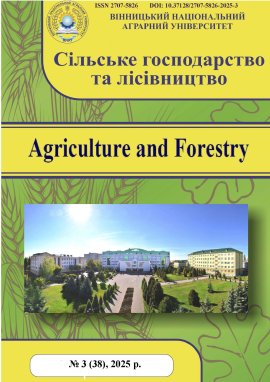
Issue №: 3 (38)
Publications contains the results of researches on optimization of technological methods of cultivation of crops, preservation of soil fertility, greening of agricultural production, modern directions of selection, reproduction of forest resources.
CURRENT STATE AND COMPARATIVE CHARACTERISTICS OF THE PRODUCTIVITY OF SUGAR CORN HYBRIDS IN THE CONDITIONS OF UKRAINE
Palamarchuk Inna Ivanivna – Candidate of Agricultural Sciences, Associate Professor of the Department of Crop Production and Horticulture, Vinnytsia National Agrarian University (21008, Vinnytsia, Soniachna Str.3, e-mail: pal_inna@vsau.vin.ua).
Manzhos Maksym Mykhailovych – postgraduate student of Vinnytsia National Agrarian University (21008, Vinnytsia, Soniachna Str. 3, е-mail: metal19981230@gmail.com).
The current state of sugar corn production in the conditions of Ukraine was studied, and a comparative description of sugar corn hybrids was also made. A comparative assessment of the yield of sugar corn hybrids in different soil and climatic zones of Ukraine was carried out. An analysis of weather conditions depending on the growing zone was made. Average long-term meteorological data indicate significant differences in climatic conditions in the three main zones of Ukraine – Forest Steppe, Steppe and Polissia. In terms of temperature, the warmest is the steppe zone, where the average annual temperature is +11.9 °C, while in the Forest Steppe this indicator is +10.1 °C, and in Polissia – is only +8.7 °C. The highest values of average monthly temperature are recorded in July (24.6 °C in Steppe, 22.9 °C in Forest Steppe and 21.1 °C in Polissia), and the lowest – in January (from –2.6 °C in Steppe to – 4.9 °C in Polissia). As for the provision of precipitation, the wettest region is Polissia with an annual amount of 691.0 mm. In the Forest Steppe, this figure is 587.7 mm, while in the Steppe it is only 380.2 mm. The most precipitation occurs in the summer months (June – July), and the least – in the winter period, especially in the steppe zone (18.6 mm in January – lutom). Thus, the Steppe is characterized by the highest average annual temperatures, but also by the lowest level of moisture, which creates conditions for risky agriculture. Polissia is distinguished by a cool and humid climate, and the forest-steppe occupies an intermediate position. According to the statistics of sweet corn production in Ukraine, since 2021 there has been a tendency to decrease the area of crops. In 2024, they decreased by 1,721.9 thousand hectares, which is due primarily to the war events in the country. Gross collection directly depended on areas and yields: the highest figure was recorded in 2021 – 42109.8 thousand tons, which exceeded the level of the following years by 11079.4–17949.3 thousand tons. The highest average crop yield was in 2023 – 7.81 t/ha, which is 0.14–1.46 t/ha more than in 2021, 2022 and 2024. The productivity of sweet corn hybrids also varied significantly depending on the climate zone. In the Steppe, the Jubili F1 hybrid (12.5–13.8 t/ha) provided the largest harvest, which is 2.8–3.8 t/ha more than in Polissia. Similar dynamics were demonstrated by the hybrid Spirit F1 – in the Steppe, it gave 12.0–13.5 t/ha, which is 3.0–3.5 t/ha higher than in Polissia. In the Forest Steppe, their yield was stable at 10.5–11.5 t/ha in Spirit F1 and 11.0–12.0 t/ha in Jubilee F1, only 1.0–1.5 t/ha below the Steppe. The Delicia F1 hybrid in the Steppe provided 11.5–12.5 t/ha, which exceeded Polissia's performance by 2.7–3.5 t/ha; in the Forest Steppe, its yield was 10.0–11.2 t/ha, that is, 1.3–1.5 t/ha lower than in the Steppe. The Lacomque F1 hybrid formed 10.8–12.0 t/ha in the Steppe, 9.5–10.8 t/ha in the Forest Steppe and 8.0–8.5 t/ha in Polissia. The F1 Trophy had a similar picture: in Steppe – 11.0–12.2 t/ha, in Forest Steppe – 9.8–10.5 t/ha, in Polissia – 8.2–9.0 t/ha. The hybrid Early Gold F1 showed the lowest results: 10.0–11.5 t/ha in Steppe, 9.0–10.0 t/ha in Forest Steppe and only 7.5–8.0 t/ha in Polissia. On average, the yield of hybrids in the Steppe exceeded that of Polissia by 2.5–3.5 t/ha. The forest-steppe occupied an intermediate position with a lag behind the Steppe of only 1.0–1.5 t/ha, which once again confirms its transitional nature between the warm and arid Steppe and the cool and wet Polissia.
1. Lykhovyd P.V. (2015). Urozhainist tovarnykh kachaniv kukurudzy tsukrovoi zalezhno vid ahrotekhniky v zroshuvanykh umovakh sukhoho Stepu Ukrainy [Yield of commercial sweet corn cobs depending on agricultural techniques in irrigated conditions of the dry steppe of Ukraine]. Tavriyskyy naukovyy visnyk. Seriya: Silskohospodarski nauky − Tavria Scientific Bulletin. Series: Agricultural Sciences. № 94. 42-48. [in Ukrainian].
2. Masliiov S.V., Masliiov Ye.S., Tsyhankova N.A., Rudakov V.S. (2020). Rist, rozvytok i vrozhainist tsukrovoi kukurudzy zalezhno vid vydiv osnovnoho obrobitku ѓruntu [Growth, development, and yield of sweet corn depending on the type of primary soil cultivation]. Visnyk Poltavskoi derzhavnoi ahrarnoi akademii – Bulletin of the Poltava State Agrarian Academy. № 4. 53-60. DOI: 10.31210/visnyk2020.04.06. [in Ukrainian].
3. Masliiov S.V. (2013). Urozhainist hibrydiv kukurudzy tsukrovoi za riznykh strokiv sivby [Yield of sweet corn hybrids at different sowing dates]. Biuleten Instytutu silskoho hospodarstva stepovoi zony NAAN Ukrainy – Bulletin of the Institute of Agriculture of the Steppe Zone of the National Academy of Agrarian Sciences of Ukraine. № 5. 111-113. [in Ukrainian].
4. Palamarchuk I.I. (2025). Urozhainist hibrydiv kukurudzy tsukrovoi v umovakh Lisostepu pravoberezhnoho Ukrainy [Yield of sweet corn hybrids in the forest-steppe conditions of the right-bank Ukraine]. Ukrainskyi zhurnal pryrodnychykh nauk – Ukrainian Journal of Natural Sciences. № 11. 178-184. DOI: https://doi.org/10.32782/naturaljournal.11.2025.19. [in Ukrainian].
5. Palamarchuk I.I., Manzhos M.M. (2025). Otsinka sortovykh resursiv kukurudzy tsukrovoi v Ukraini [Assessment of sweet corn varietal resources in Ukraine]. Silske hospodarstvo ta lisivnytstvo – Agriculture and forestry. № 1 (36). 207-217. DOI: 10.37128/2707-5826-2025-1-15. [in Ukrainian].
6. Sokolovska I.M., Demianova H.V. (2011). Urozhainist ta yakist osnovnoi y dodatkovoi produktsii kharchovykh pidvydiv kukurudzy [Yield and quality of main and additional products of food corn subspecies]. Visnyk Poltavskoi derzhavnoi ahrarnoi akademii – Bulletin of the Poltava State Agrarian Academy. № 1. 59-62. [in Ukrainian].
7. Ushkarenko V.O., Lykhovyd P.V. (2016). Rehresiina model urozhainosti kukurudzy tsukrovoi zalezhno vid ahrotekhnolohii v zroshuvanykh umovakh sukhoho stepu Ukrainy [Regression model of sweet corn yield depending on agricultural technology in irrigated conditions of the dry steppe of Ukraine]. Visnyk umanskoho natsionalnoho universytetu sadivnytstva – Bulletin of Uman National University of Horticulture. № 1. 31-34. [in Ukrainian].
8. Hajer Sidahmed, Attila Vad and Janos Nagy (2025). Advances in sweet corn (Zea mays L. saccharata) research from 2010 to 2025: A comprehensive review. Agronomy. 15 (5), r. 1260. DOI: https://doi.org/10.3390/agronomy15051260. [in English].
9. Chouhan D., Dubey R.B., Choudhary P., Singh D. (2021). Studies on general and specific combining ability effects in sweet corn (Zea mays L . ssp. saccharata) hybrids for green cob yield and TSS content. Pharma Innov. 10 (12): 886-888. [in English].
10. Farid N., Siadat S.A., Ghalamboran, M.R. (2020). Effect of deficit irrigation and nitrogen fertilizer source on earyield, nitrogen use efficiency and water productivity in sweet corn (Zea mays L. cv. Saccharata). Iranian Society of Crops and Plant Breeding Sciences. 21 (4). P. 386-398. DOI:10.29252/abj.21.4.386. [in English].
11. Heryanto FSS, Wirnas D, Ritonga A.W. (2022). Diversity of twenty-three sweet corn (Zea mays L. saccharata) varieties in Indonesia. Biodiversitas. 23(11). P. 6075-6081. DOI:10.13057/biodiv/d231164. [in English].
12. Hryhoriv Y., Butenko A., Masyk I., Onychko T., Davydenko G., Bondarieva L., Hotvianska A., Horbunova K., Yevtushenko Y., Mykola V. (2023). Growth and Development of Sweet Corn Plants in the Agro-Ecological Conditions of the Western Region of Ukraine. Ecological Engineering & Environmental Technology. 24(4), R. 216–222. DOI: https://doi.org/10.12912/27197050/162699. [in English].
13. Paranhos J., Foshee Wh., Coolong T., Torres-Quezada E., Luiz Biscaia A., R. da Silva (2025). Impacts of nitrogen fertilizer application timing and rate on sweet corn production under subtropical environmental conditions. Nitrogen. 6 (2), R. 20; DOI: https://doi.org/10.3390/nitrogen6020020. [in English].
14. Jessica Paranhos, Wheeler Foshee, Timothy Coolong, Emmanuel Torres-Quezada and Andre Luiz Biscaia Ribeiro da Silva. (2025). Impacts of nitrogen fertilizer application timing and rate on sweet corn production under subtropical environmental conditions. Nitrogen. 6 (2). P. 20. DOI: https://doi.org/10.3390/nitrogen6020020. [in English].
15. Seshu G, Rao MVB, Sudarshan MR. (2015) Genetic divergence in sweet corn (Zea mays L. saccharata). Green Farm. 6 (1). P. 44-46. DOI: 10.1016/j.jfca.2015.06.001. [in English].
16. Sidahmed H., Vad A., Nagy J. (2025) Advances in Sweet Corn (Zea mays L. saccharata) Research from 2010 to 2025: Genetics, Agronomy, and Sustainable Production. Agronomy. 15 (5), P. 1260. DOI: https://doi.org/10.3390/ agronomy 15051260. [in English].
17. Simic M., Srdic J., Videnovic Z., DoliJanovic Z., Uludag A. and Kovacevic D. (2012) Sweet maize (Zea mays L. saccharata) weeds infestation, yield and yield quality affected by different crop densities. Bulgarian Journal of Agricultural Science. 18 (No 5). P. 668-674. DOI: https://www.agrojournal.org/18/05-04-12.pdf. [in English].
18. Vdovenko S. A., Palamarchuk I. I. (2020) Climate change and its effect on the formation of vegetable plant yield in the conditions of Ukraine. The scientific heritage. Vol 3. № 56 (56). P. 12-16. DOI: 10.24412/9215-0365-2020-56-3-12-16. [in English].
19. Martin M. Williams II (2008) Sweet corn growth and yield responses to planting dates in the northern Corn Belt. HortScience. 43(6), P. 1775–1779. DOI:10.21273/HORTSCI.43.6.1775. [in English].
20. Wong A. D., Juvik, J. A., Breeden, D. C., & Swiader, J. M. Shrunken (1994) Sweet corn yield and the chemical components of quality. Journal of the American Society for Horticultural Science. 119 (4), P. 747–755. [in English].
About the journal
Cluster Agricultural and veterinary sciences (H1 Agronomy, H4 Forestry)
Name of the publication «AGRICULTURE AND FORESTRY»
The aim of the journal "Agriculture and Forestry" is to highlight the results of fundamental and applied research in the fields of agriculture and forestry, aimed at improving the efficiency of agricultural production and introducing modern technologies into farming practice.
This goal defines the main objectives:
– to ensure the creation of open information access regarding the dissemination of relevant scientific research results to: lecturers of agricultural higher education institutions, postgraduate students, doctoral candidates, research staff, and agricultural production specialists;
– to promote the development of young scientists in agricultural sciences;
– to enhance communication between experienced researchers and young scientists in agronomy and forestry;
– to facilitate the expansion of ties between Vinnytsia National Agrarian University and domestic and foreign educational institutions, scientific establishments, and their academic communities.
The scientific, production, and educational journal "Agriculture and Forestry" is a peer-reviewed open-access publication that publishes original experimental research, theoretical and practice-oriented articles within the cluster of "Agricultural and Veterinary Sciences".
The journal's subject matter covers such areas as agronomy and forestry. Publications of scientific and practical significance address the experimental foundations of agricultural and forestry sector development, innovative production technologies, and the results of fundamental and applied research aimed at increasing productivity, product quality, and the sustainable development of natural and production systems.
Publisher: Vinnytsia National Agrarian University
EDRPOU code: 00497236
Publisher's ROR:05m3ysc06
Prefix DOI: 10.37128/
Frequency is quarterly
Publication languages: (Ukrainian, English)
Media ID R30-05174.
Editor in Chief Ihor Didur
According to the order of the Ministry of Education and Science of Ukraine dated 17.03.2020 № 409. The journal Agriculture and Forestry is included in the List of scientific professional publications of Ukraine Category "B" in agricultural sciences (specialties) - 101, 201, 202, 203, 205, 206.
State registration: Decision of the National Council of Ukraine on Television and Radio Broadcasting No. 1337 and No. 1181. Media identifier – R30-05174.
Scientific journal "AGRICULTURE AND FORESTRY" was founded in 1995; it was entitled as Bulletin of Vinnytsya State Agricultural Institute.
In 2010-2014 was enritled as Collection of scientific works of Vinnytsia National Agrarian University.
It has been named as Agriculture and Forestry since 2015.
Listed in the updated list of scientific professional editions of Ukraine on agricultural sciences under the name Agriculture and Forestry (Order of the Ministry of Education and Science of Ukraine of May 16, 2016; No. 515).
Since 2015, "Agriculture and Forestry". (archive of previous issues for 2015-2019) at http://forestry.vsau.edu.ua/.
The journal “Agriculture and Forestry (ISSN: 2707-5826)” passed the evaluation process of Index Copernicus positively and is indexed in the database of ICI Journals Master List ICV for 2018, 2019, 2020, 2021, 2022, 2023, 2024 is presented in the full list of indexed journals in the Master List International List
ICI Journals Master List Value
