

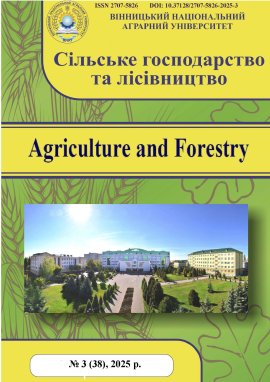
Issue №: 3 (38)
Publications contains the results of researches on optimization of technological methods of cultivation of crops, preservation of soil fertility, greening of agricultural production, modern directions of selection, reproduction of forest resources.
COMMON SPIDER MITE IN SOYBEAN SEED CROPS OF THE FOREST-STEPPE OF UKRAINE
Bilyavska L.G., Doctor of Agricultural Sciences, Professor of the Department of Breeding, Seed Production and Genetics of the Poltava State Agrarian University
Logvinenko V.V., holder of the degree of Doctor of Philosophy in specialty 201 Agronomy of the Poltava State Agrarian University.
Prohvatilo M.M., graduate of Master's degree from Poltava State Agrarian University.
Bilyavskyi Yu.V., candidate of biological sciences, senior researcher of the Poltava State Agrarian University.
The relevance of the research is due to the widespread distribution of the common spider mite in soybean seed crops in the Forest-Steppe zone of Ukraine. About 60% of all soybean agrocenoses are concentrated in the forest-steppe zone of the country. The use of high-quality seeds makes it possible to more fully realize the potential of a variety with the appropriate varietal and sowing qualities. During the reproduction of varieties, they may lose their varietal qualities due to damage to plants by spider mites (10–50%). It was established that mass colonization of crops by insects was observed in 2024, a dry year: the Adamos variety – 16-18 specimens/leaf and the Mentor variety – 15-19 specimens/leaf. The mid-season Mentor variety was more heavily infested. A study of promising acaricides on seed soybean crops showed that on the 7th day after treatment, the most effective acaricides were Aktarofit K and Blaster, with 70% mite mortality, respectively. On day 14, the maximum mite mortality was observed with the use of Vertimec 018 EC, k.e. and Sintak, with 94% and 91% mortality, respectively. On average, the percentage of mite mortality (on the 14th day) ranged from 81% to 94%. The average yield of Adamos soybean seeds over the years of research was 3.56 t/ha, and that of Mentor seeds was 3.6 t/ha. Conclusions. It has been proven that the yield of cultivated soybean seed crops is influenced by the combined effect of two factors: drought during the growing season and active colonization of crops by common spider mites. The colonization of plants by spider mites was at its highest in 2024. A comparison of the effectiveness of insectoacaricides revealed the following: on day 7, the mortality of mites from the preparations Aktarofit K and Blaster, z.p., was 70%. On day 14, the maximum mite mortality was observed with the use of Vertimek 018 EC, k.e. and Sintak, 94% and 91%, respectively. Thus, in modern climatic conditions, it is necessary to constantly monitor the spread of common spider mites, control their density, and make timely decisions on the protection of seed crops and the effective use of selected insectoacaricides.
1. Kyrychenko V.V., Kobyzieva L.N., Petrenkova V.P., Riabchun V.K., Bezuhla O.M., Markova T.Yu. (2009). Identyfikatsiia oznak zernobobovykh kultur (horokh, soia) (navchalnyi posibnyk). za red. akademika UAAN V.V. Kyrychenko. Kharkiv : IR im. V. Ya. Yurieva UAAN. [Іn Ukrainian].
2. Korobka A.A. (2021). Dynamika vyrobnytstva soi v Ukraini ta sviti. Zbalansovane pryrodokorystuvannia, 4, 125–134. DOI: https://doi.org/ 10.33730/ 2310- 4678.4.2021.253098 [Іn Ukrainian].
3. Shemavnev V.I., Kovalevska N.I., Moroz V.V. (2004). Nasinnytstvo polovykh kultur. Navchalnyi posibnyk. Dnipropetrovsk: DDAU. [Іn Ukrainian].
4. Kindruk M.O., Sokolov V.M., Vyshnevskyi V.V. (2012). Nasinnytstvo z osnovamy nasinnieznavstva. K.: Ahrar. nauka. [Іn Ukrainian].
5. Zvychainyi pavutynnyi klishch - zahroza soievym posivam (2017). Propozytsiia. № 1. https://propozitsiya.com/ua/zvichayniy-pavutinniy-klishch-zagroza-soievim-posivam [Іn Ukrainian].
6. Prohnoz fitosanitarnoho stanu ahrotsenoziv Ukrainy ta rekomendatsii shchodo zakhystu roslyn u 2024 r. (2024). Naukovo-vyrobnyche vydannia. Kyiv. 79-90. https://edorada.org/articles/227 [Іn Ukrainian].
7. Emery S. E., Jonsson M., Silva H., Ribeiro A., Mills N. J. (2021). High agricultural intensity at the landscape scale benefits pests, but low intensity practices at the local scale can mitigate these effects. Agriculture, Ecosystems & Environment. Vol. 306, art.107199. DOI: https://doi.org/10.1016/j.agee. 2020.107199. [in English].
8. Marinosci C., Magalhães S., Macke E., Navajas M., Carbonell D., Devaux C., Olivieri I. (2015). Effects of host plant on life-history traits in the polyphagous spider mite Tetranychus urticae. Ecology and Evolution. Vol. 5. P.3151-3158. DOI: https://doi.org/10.1002/ece3.1554. [in English].
9. Padilha G., Fiorin R.A., Cargnelutti Filho A., Pozebon H., Rogers J., Marques R.P., Castilhos L.B., Donatti A., Stefanelo L., Burtet L.M., Stacke R.F., Guedes J.V.C., Arnemann J.A. (2020) Damage assessment and economic injury level of the two-spotted spider mite Tetranychus urticae in soybean. Pesquisa Agropecuária Brasileira. Vol. 55. P. 1678-3921. DOI: https://doi.org/10.1590/S1678-3921.pab2020.v55.01836. [in English].
10. Biliavskyi Yu.V., Biliavska L.H. (2021). Poshyrennia zvychainoho pavutynnoho klishcha (Tetranychus urticae Koch.) v suchasnykh ahrotsenozakh. Selektsiia, henetyka ta tekhnolohii vyroshchuvannia silskohospodarskykh kultur : mater. IX Mizhnar. nauk.-prakt. konf. molod. vchen. i spets. (s. Tsentralne, 23 kvit. 2021 r.) / NAAN, MIP im. V. M. Remesla, MRETtaSH Ukrainy, UIESR. 16-17. Rezhym dostupu : http://confer.uiesr.sops.gov.ua [Іn Ukrainian].
11. Derzhavnyi reiestr sortiv roslyn, prydatnykh dlia poshyrennia v Ukraini na 2024 rik. URL: https://minagro.gov.ua/file-storage/reyestr-sortiv-roslin [Іn Ukrainian].
12. Metodyka provedennia kvalifikatsiinoi ekspertyzy sortiv roslyn na prydatnist do poshyrennia v Ukraini. (2016). Zahalna chastyna. za red. S. O. Tkachyk. 4-te vyd., vypr. i dop. Vinnytsia : Nilan-LTD, 120 s. [Іn Ukrainian].
13. Ermantraut E.R., Prysiazhniuk O. I., Shevchenko I. L. (2007). Statystychnyi analiz ahronomichnykh doslidzhen danykh v paketi Statistica 6.0: metodychni vkazivky / uklad.: Poltava: Polihraf Konsaltynh. 55. [Іn Ukrainian].
14. Arnemann J. A., Fiorin R. A., Guedes J.V. C., Pozebon H., Marques R. P., Perini C.R., Storck L. (2018). Assessment of damage caused by the spider mite Mononychellus planki (McGregor) on soybean cultivars in South America. Australian Journal of Crop Science. Vol. 12. P. 1989-1996, DOI: https://doi.org/10.21475/ajcs.18.12.12.p1434 [in English].
15. Suekane R., Degrande P.E., Melo E.P. de, Bertoncello T.F., Lima Junior L. dos S. De, Kodama C. (2012). Damage level of the twos-potted spider mite Tetranychus urticae Koch (Acari: Tetranychidae) in soybeans. Revista Ceres. Vol. 59, P. 77-81, DOI: https://doi.org/10.1590/S0034-737X2012000100011. [in English].
16. Ezequiel G. Souza, Antonio J. Steidle-Neto, Daniela C. Lopes, Priscilla T. N. Maia, Marcos A. M. Fadini. (2024). Development and validation of mathematical model for population estimation of the two-spotted spider mite in soybeans. Entomological Communications, Vol. 6. P.6031. DOI: 10.37486/2675-1305.ec06031 [in English].
17. De Araújo C. R. N., Do Amaral F. H. F., Brandão I. R. S., Pereira T. E. R., Santos V.C. (2022). The Transversality of the environmental theme: The use of pesticides in the planting of soybeans and the impacts on biodiversity. International Journal Semiarid. Vol. 5 (5). P. 77-91. DOI:10.56346/ journal_ semiarid_ijsa.v5i5.116. [in English].
18. Jakubowska M., Dobosz R., Zawada D., Kowalska J. (2022). A Review of crop protection methods against the twospotted spider mite- Tetranychus urticae Koch (Acari: Tetranychidae) with special reference to alternative methods. Agriculture. Vol. 12 (7). P. 898. DOI: 10.3390/agriculture12070898. [in English].
About the journal
Cluster Agricultural and veterinary sciences (H1 Agronomy, H4 Forestry)
Name of the publication «AGRICULTURE AND FORESTRY»
The aim of the journal "Agriculture and Forestry" is to highlight the results of fundamental and applied research in the fields of agriculture and forestry, aimed at improving the efficiency of agricultural production and introducing modern technologies into farming practice.
This goal defines the main objectives:
– to ensure the creation of open information access regarding the dissemination of relevant scientific research results to: lecturers of agricultural higher education institutions, postgraduate students, doctoral candidates, research staff, and agricultural production specialists;
– to promote the development of young scientists in agricultural sciences;
– to enhance communication between experienced researchers and young scientists in agronomy and forestry;
– to facilitate the expansion of ties between Vinnytsia National Agrarian University and domestic and foreign educational institutions, scientific establishments, and their academic communities.
The scientific, production, and educational journal "Agriculture and Forestry" is a peer-reviewed open-access publication that publishes original experimental research, theoretical and practice-oriented articles within the cluster of "Agricultural and Veterinary Sciences".
The journal's subject matter covers such areas as agronomy and forestry. Publications of scientific and practical significance address the experimental foundations of agricultural and forestry sector development, innovative production technologies, and the results of fundamental and applied research aimed at increasing productivity, product quality, and the sustainable development of natural and production systems.
Publisher: Vinnytsia National Agrarian University
EDRPOU code: 00497236
Publisher's ROR:05m3ysc06
Prefix DOI: 10.37128/
Frequency is quarterly
Publication languages: (Ukrainian, English)
Media ID R30-05174.
Editor in Chief Ihor Didur
According to the order of the Ministry of Education and Science of Ukraine dated 17.03.2020 № 409. The journal Agriculture and Forestry is included in the List of scientific professional publications of Ukraine Category "B" in agricultural sciences (specialties) - 101, 201, 202, 203, 205, 206.
State registration: Decision of the National Council of Ukraine on Television and Radio Broadcasting No. 1337 and No. 1181. Media identifier – R30-05174.
Scientific journal "AGRICULTURE AND FORESTRY" was founded in 1995; it was entitled as Bulletin of Vinnytsya State Agricultural Institute.
In 2010-2014 was enritled as Collection of scientific works of Vinnytsia National Agrarian University.
It has been named as Agriculture and Forestry since 2015.
Listed in the updated list of scientific professional editions of Ukraine on agricultural sciences under the name Agriculture and Forestry (Order of the Ministry of Education and Science of Ukraine of May 16, 2016; No. 515).
Since 2015, "Agriculture and Forestry". (archive of previous issues for 2015-2019) at http://forestry.vsau.edu.ua/.
The journal “Agriculture and Forestry (ISSN: 2707-5826)” passed the evaluation process of Index Copernicus positively and is indexed in the database of ICI Journals Master List ICV for 2018, 2019, 2020, 2021, 2022, 2023, 2024 is presented in the full list of indexed journals in the Master List International List
ICI Journals Master List Value
