

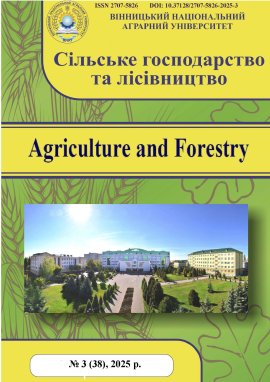
Issue №: 3 (38)
Publications contains the results of researches on optimization of technological methods of cultivation of crops, preservation of soil fertility, greening of agricultural production, modern directions of selection, reproduction of forest resources.
BREEDING FOR DROUGHT TOLERANCE OF COMMON BEAN IN THE CONDITIONS OF THE NNVK "ALL-UKRAINIAN SCIENTIFIC AND EDUCATIONAL CONSORTIUM" (ULADOVO-LULINETSKA RESEARCH AND SELECTION STATION)
Branitskyi Yurii Yuriyovych – Candidate of Agricultural Sciences, Director of the Uladovo-Lyulinetsky Experimental Breeding Station of the Institute of Bioenergetic Cultures and Sugar Beet NAAS (Vinnytia region, Kalynivka, district, Uladivske, Samolevska Str., 15).
Mazur Oleksandr Vasyliovych – Candidate of Agricultural Sciences, Associate Professor of the Department of Crop Production and Horticulture, Vinnytsia National Agrarian University (21008, Vinnytsia, Soniachna Str., 3 е-mail: selection@vsau.vin.ua).
The article differentiation of varieties of beans of conventional yields in different hydrothermal years by a number of indexes, which characterize the stability of samples to drought, and also identified the different and low levels of genotypes with high and low levels of drought resistance. The main advantages of the drought resistance assessment method for the use of indices include the availability of the necessary data, the ability to study a considerable amount of varieties of varieties, the simplicity of calculations and the determination in units of the most important agronomic characteristics - yields. The best tolerance indexes (tol) were the varieties of beans common local white - 0.31, local green - 0.37, libra - 0.38, Cossacks - 0.48 t/ha. As a result of experimental studies, a number of best varieties of common beans with high levels of drought resistant are highlighted: local green and libra by indexes - YS, YP, MP, MP, Tol, Yrr, SSI, SSPI, YSI, DI, RDI, ISR; Gigantella and marble - ys, yp, mp, yi, gmp, hmp, sti, di, RDI, with high yield formation, both under favorable and adverse conditions;The use in the breeding practice of the selected best varieties of common beans with the help of breeding indexes will allow the starting material for synthetic breeding when creating new yields and drought resistant varieties. In addition, for breeding practice, we recommend using the indexes we have studied to identify the breeding material for drought resistance and yield for growing it in different hydrothermal conditions. The use of selected breeding material will serve as the formation of soybean working collection by resistance to drought and increased yield under favorable and adverse hydrothermal growing conditions.
1.Iermolenko N.S., Khokhlov V.M. (2012). Porivniannia prostorovo-chasovykhkharakterystyk posukh v Ukraini na pochatku ta naprykintsi KhKh storichchia [Comparison of spatial-temporal characteristics of droughts in Ukraine at the beginning and at the end of the twentieth century]. Ukrainskyi hidrometeorolohichnyi zhurnal − Ukrainian Hydrometeorological Journal. №10. 65–72.[in Ukrainian].
2.Chеrnobaі L.N., Ponurenko S.G., Sikalova O.V. (2016). Evaluation ofstability for maize genotype characteristics by drought tolerance indices under different hydrothermal conditions. Wschodnioeuropejskie Czasopismo Naukowe (East European Scientific Journal). Vol. 8. № 6. P. 69–75. [in English].
3.Beltrano J., Marta G.R. (2008). Improved tolerance of wheat plants(Triticum aestivum L.) to drought stress and rewatering by the arbuscularmycorrhizal fungus Glomusclaroideum: Effect on growth and cell membrane stability. Brazilian Journal of Plant Physiology. Vol. 20. № 1. Р. 29–37. https://doi.org/10.1590/S1677-04202008000100004[in English].
4.Ribaut J.M., Poland D. (1999). Molecular approaches for the geneticimprovement of cereals for stable production in water-limited environments. A Strategic Planning Workshop held at CIMMYT. 180 p. [in English].
5.Vasylkivskyi S.P., Hudzenko V.M., Kochmarskyi V.S., Kyrylenko V.V.(2017). Realizatsiia potentsialu sortiv zernovykh kultur – shliakh vyrishennia prodovolchoi problemy [The realization of the potential of grain varieties is a way to solve the food problem]. Faktory eksperymentalnoi evoliutsii orhanizmiv − Factors of experimental evolution of organisms. Vol. 21. 47–51. [in Ukrainian].
6.Talebi R., Fayaz F., Naji A.M. (2009). Effective selection criteria forassessing drought stress tolerance in durum wheat (Triticum durum Desf.). General and Applied Plant Physiology. Vol. 35. № ½. Р. 64–74. [in English].
7.Mehraban A., Tobe A., Gholipouri A., Amiri E., Ghafari A., Rostaii M.(2018). Evaluation of drought tolerance indices and yield stability of wheat cultivars to drought stress in different growth stage. World Journal of Environmental Biosciences. Vol. 7. Issue 1. P. 8–14. [in English].
8.Fernandez G.C.J. (1992). Effective selection criteria for assessing plantstress tolerance. Proceeding of the International Symposium on Adaptation of Vegetables and other Food Crops in Temperature and Water Stress. Aug. 13–16, Shanhua, Taiwan, Р. 257–270. [in English].
9.Rosielle A.A., Hamblin J. (1981). Theoretical aspects of selection for yieldin stress and non-stress environments. Crop Science. Vol. 21. № 6. Р. 943–946. DOI : http://dx.doi.org/10.2135/cropsci1981.0011183X002100060033x. [in English].
10.Golestani-Araghi S., Assad M.T. (1998). Evaluation of four screeningtechniques for drought resistance and their relationship to yield reduction ratio in wheat. Euphytica. Vol. 103. № 3. Р. 293–299. DOI:10.1023/A:1018307111569[in English].
11.Fisher R. A., Maurer R. (1978). Drought resistance in spring wheat cultivars.Grain yield responses. Australian Journal of Agricultural Research. Vol. 29. № 5. Р. 897–912. DOI: http://dx.doi.org/10.1071/AR9780897. [in English].
12.Moosavi S.S., Yazdi Samadi B., Naghavi M.R, Zali A.A, Dashti H.,Pourshahbazi A. (2008). Introduction of new indices to identify relative drought tolerance and resistance in wheat genotypes. Desert (Biaban). Vol. 12. № 2. Р. 165–178. [in English]
13.Bouslama M., Schapaugh W.T. (1984). Stress tolerance in soybean. Part 1:evaluation of three screening techniques for heat and drought tolerance. Crop Science. Vol. 24. № 5. C. 933–937. DOI:https://doi.org/10.2135/cropsci 1984.0011183X002400050026x. [in English].
14.Gavuzzi P., Rizza F., Palumbo M., Campanile R. G., Ricciardi G. L., BorghB. (1997). Evaluation of field and laboratory predictors of drought and heat tolerance in winter cereals. Canadian Journals of Plant Science. Vol. 77. № 4. Р. 523–531. DOI:10.4141/P96-130. [in English].
15.Kristin A.S., Serna R.R., Perez F.I., Enriquez B.C., Gallegos J.A.A., VallegoP.R., Wassimi N., Kelly J.D. (1997). Improving common Bean performance under drought stress. Crop Science. Vol. 37. № 1. P. 43–50. DOI:10.2135/cropsci1997.0011183X003700010007x. [in English].
16.Lan J. (1998). Comparison of evaluating methods for agronomic droughtresistance in crops. Acta Agriculturae Boreali-occidentalis Sinica. Vol. 7. P. 85–87. [in English].
17.Tyshchenko A.V., Tyshchenko O.D., Liuta Yu.O. (2021). Otsinka henotypivliutserny za nasinnievoiu produktyvnistiu na posukhostiikist [Assessment of alfalfa genotypes by seed productivity for drought resistance]. Tavriiskyi naukovyi visnyk. Ceriia: Silskohospodarski nauk − Tavriysk Scientific Bulletin. CERIA: Agricultural Sciences. № 120. 157-164. DOI: https://doi.org/10.32851/2226-0099.2021.120.21. [in Ukrainian].
18.Moghaddam A., Hadizadeh M.H. (2002). Response of corn (Zea mays L.).Hybrids and their parental lines to drought using different stress tolerance indices. J. Seed and plant improvement. Vol. 18, Issue 3. P. 255–275. DOI: 10.22092/SPIJ.2017.110741. [in English].
19.Pykalo S.V., Demydov O.A., Yurchenko T.V., Khomenko S.O., HumeniukO.V., Kharchenko M.V. (2020). Indeksnyi pidkhid dlia doboru posukhostiikykh sortiv pshenytsi v umovakh nestiikoho klimatu [Index approach for the selection of drought -resistant wheat varieties in unstable climates]. Ekolohichni nauky − Environmental Sciences № 2 (29). Vol. 2. 157-164. DOI: https://doi.org/10.32846/2306- 9716/2020.eco.2-29.2.24. [in Ukrainian].
20.Saba J., Moghaddam M., Ghassemi K. and Nishabouri M.R. (2001). Geneticproperties of drought resistance indices. J. Agric. Sci. Technol. 2001. Vol. 3. P. 43–49.[in English].
About the journal
Cluster Agricultural and veterinary sciences (H1 Agronomy, H4 Forestry)
Name of the publication «AGRICULTURE AND FORESTRY»
The aim of the journal "Agriculture and Forestry" is to highlight the results of fundamental and applied research in the fields of agriculture and forestry, aimed at improving the efficiency of agricultural production and introducing modern technologies into farming practice.
This goal defines the main objectives:
– to ensure the creation of open information access regarding the dissemination of relevant scientific research results to: lecturers of agricultural higher education institutions, postgraduate students, doctoral candidates, research staff, and agricultural production specialists;
– to promote the development of young scientists in agricultural sciences;
– to enhance communication between experienced researchers and young scientists in agronomy and forestry;
– to facilitate the expansion of ties between Vinnytsia National Agrarian University and domestic and foreign educational institutions, scientific establishments, and their academic communities.
The scientific, production, and educational journal "Agriculture and Forestry" is a peer-reviewed open-access publication that publishes original experimental research, theoretical and practice-oriented articles within the cluster of "Agricultural and Veterinary Sciences".
The journal's subject matter covers such areas as agronomy and forestry. Publications of scientific and practical significance address the experimental foundations of agricultural and forestry sector development, innovative production technologies, and the results of fundamental and applied research aimed at increasing productivity, product quality, and the sustainable development of natural and production systems.
Publisher: Vinnytsia National Agrarian University
EDRPOU code: 00497236
Publisher's ROR:05m3ysc06
Prefix DOI: 10.37128/
Frequency is quarterly
Publication languages: (Ukrainian, English)
Media ID R30-05174.
Editor in Chief Ihor Didur
According to the order of the Ministry of Education and Science of Ukraine dated 17.03.2020 № 409. The journal Agriculture and Forestry is included in the List of scientific professional publications of Ukraine Category "B" in agricultural sciences (specialties) - 101, 201, 202, 203, 205, 206.
State registration: Decision of the National Council of Ukraine on Television and Radio Broadcasting No. 1337 and No. 1181. Media identifier – R30-05174.
Scientific journal "AGRICULTURE AND FORESTRY" was founded in 1995; it was entitled as Bulletin of Vinnytsya State Agricultural Institute.
In 2010-2014 was enritled as Collection of scientific works of Vinnytsia National Agrarian University.
It has been named as Agriculture and Forestry since 2015.
Listed in the updated list of scientific professional editions of Ukraine on agricultural sciences under the name Agriculture and Forestry (Order of the Ministry of Education and Science of Ukraine of May 16, 2016; No. 515).
Since 2015, "Agriculture and Forestry". (archive of previous issues for 2015-2019) at http://forestry.vsau.edu.ua/.
The journal “Agriculture and Forestry (ISSN: 2707-5826)” passed the evaluation process of Index Copernicus positively and is indexed in the database of ICI Journals Master List ICV for 2018, 2019, 2020, 2021, 2022, 2023, 2024 is presented in the full list of indexed journals in the Master List International List
ICI Journals Master List Value
