

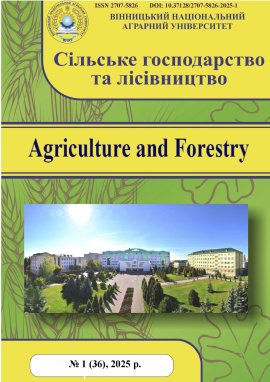
Issue №: 1 (36)
The research results on technological methods of cultivation of crops, energy-saving technologies, production of environmentally friendly agricultural products using foliar nutrition, biologically active preparations, reproduction of forest resources
ASSESSMENT OF THE SUCCESS OF THE INTRODUCTION AND PERSPECTIVES OF THE USE OF AESCULUS PAVIA IN THE CONDITIONS OF VINNITSA
Matusyak Mikhailo – Сandidate of Agricultural Sciences, Associate Professor, Head of the Department of Forestry and Horticulture, Faculty of Ecology, Forestry and Horticulture, Educational and Scientific Institute of Agricultural Technologies and Nature Management of Vinnytsia National Agrarian University (21008, Vinnytsya, Soniachna st. 3. e-mail: mikhailo1988@gmail.com).
Vradii Oksana – Candidate of Agricultural Sciences, Associate Professor of the Department of Ecology and Environmental Protection, Faculty of Ecology, Forestry and Horticulture, Educational and Scientific Institute of Agricultural Technologies and Nature Management of Vinnytsia National Agrarian University (21008, Vinnytsia, 3, Soniachna St., e-mail: oksanavradii@gmail.com).
The study considered the issue of inventory and assessment of the state of Aesculus pavia plantations in urban conditions using the example of the city of Vinnytsia, which is an important stage for the development of recommendations for improving the phytosanitary condition of green areas and the selection of sustainable species for landscaping. The inventory of plantations was carried out during the growing season of 2024, with the recording of 18 instances of Aesculus pavia, mostly concentrated in the Vyshensky District. The majority of trees are located along transport routes and are under 25 years old (56.5%), while trees aged 41–50 years account for only 8.9%. The assessment of the state of life using the visual analysis method, taking into account the condition of the leaves, the presence of mechanical damage, dry branches and pests, showed that a significant proportion of the trees are in good condition (64.5%). At the same time, trees near roads suffer from “burns" of leaves due to overheating of the soil, insufficient watering and technogenic stress. Special attention in the study is devoted to frost resistance and drought resistance of the Aesculus pavia, which are key to the survival and effective use of the species in the urban environment. Research conducted in the agrochemical laboratory proved that the Aesculus pavia is able to withstand frosts up to -25 °C, while the greatest damage is observed in the buds. Studies of drought resistance based on water retention coefficients in different areas of the city have shown that the man-made load leads to an increase in water deficit. In the most polluted areas, the coefficient of water retention and drought resistance decreases, which impairs the viability and decorativeness of trees. The results of the study indicate a high perspective of the introduction of Aesculus pavia in urban conditions, in particular in Vinnytsia. This species retains decorativeness, and is also resistant to frost and partially resistant to man-made stress, which makes it a valuable element of landscaping, able to integrate into the cultural landscape of the city and contribute to the creation of natural fragments in the urban environment.
1. Calic D., Stevovic S., Zdravkovic-Korac S. (2010) Impact of Genotype, Age of Tree and Environmental Temperature on Androgenesis Induction of Aesculus hippocastanum. African Journal of Biotechnology. Vol. 9. № 26. P. 4042−4049 [in English].
2. Gilman E., Watson G., Watson D. (1993). Aesculus x carnea: Red Horse Chestnut. Gainesville: University of Florida, 3 p. [in English].
3. Marincovic N., Radojevic Lj. (1992). The Influence of Bud Length, Age of the Tree and Culture Media on Androgenesis in Aesculus carnea Hayne. Anther Culture Plant Cell, Tiss. Org. Cult. Vol. 31. P. 51−59 [in English].
4. Matusyak M.V., Pantsyreva H.V., Prokopchuk V.M. (2021). Assessment of decorative value and prospects of the genus Magnolia compositional use on the territory of Vinnytsia. Silske hospodarstvo ta lisivnytstvo – Agriculture and forestry. № 4 (23). 137−147. DOI: 10.37128/2707-5826-2021-4-11 [in Ukrainian].
5. Neyko I., Yurkiv Z., Matusiak M., Kolchanova O. (2019). The current state and efficiency use of in situ and ex situ conservation units for seed harvesting in the central part of Ukraine. Folia Forestalia Polonica, Series A. 2019. Vol. 61 (2). Р. 146−155. DOI: https://doi.org/10.2478/ffp-2019-0014 [in English].
6. Prokopchuk V., Pantsyreva H., Tsyhanska O. (2020). Biostationary and exposition plot of Vinnytsia national agrarian university as an educational, scientific and manufacturing base in preparation of the landscape gardening specialist. The scientific heritage. Vol. 1. № 51. P. 8−17 [in English].
7. Roth A.S. (2001). Taylor’s Guide to Trees: The Definitive, Easy – to use guide to 200 of the garden’s most important plants. New York: Houghton Mifflin Company. [in English].
8. Doroshenko O. K., Didenko T. V. (2001). Dekoratyvna perspektyvnist vydiv Aesculus L. za aspektyvnymy fenofazamy [Ornamental prospects of Aesculus L. species by aspectual phenophases]. Introduktsiia roslyn – Introduction of plants. № 1−2. 225−228 [in Ukrainian].
9. Ievtushenko Yu.V. (2015). Diahnostyka zharo- ta posukhostiikosti hirkokashtanu miaso-chervonoho (Aesculus carnea Hayne) v umovakh mista Kyieva [Diagnostics of heat and drought resistance of meat-red bitter chestnut (Aesculus carnea Hayne) in Kyiv city conditions]. Naukovyi visnyk Natsionalnoho universytetu bioresursiv i pryrodokorystuvannia Ukrainy. Seriia «Lisivnytstvo ta dekoratyvne sadivnytstvo» – Scientific Bulletin of the National University of Life and Environmental Sciences of Ukraine. Series “Forestry and Ornamental Horticulture. Ch. 1. Issue. 219. 218−226 [in Ukrainian].
10. Ievtushenko Yu.V. (2016). Aesculus carnea Hayne v nasadzhenniakh mista Kyieva [Aesculus carnea Hayne in the plantations of Kyiv]. Naukovyi visnyk NLTU – Scientific Bulletin of the NLTU. Issue. 25.3. [in Ukrainian].
11. Kuznetsov S.I., Levon F.M., Klymenko Yu.O. (2000). Suchasnyi stan ta shliakhy optymizatsii zelenykh nasadzhen v Kyievi [Current state and ways to optimize green spaces in Kyiv]. Introduktsiia i zelene budivnytstvo: zb. nauk. prats – Introduction and green building: a collection of scientific works. 90−104 [in Ukrainian].
12. Laptiev O.O. (2001). Introduktsiia ta aklimatyzatsiia roslyn z osnovamy ozelenennia [Introduction and acclimatization of plants with the basics of landscaping]. Kyiv: Fitosotsiotsentr. [in Ukrainian].
13. Matusyak M.V. (2019). [Research and analysis of the composition of the grass cover of phytocenoses in Vinnytsia using the example of individual sections of the forest park and botanical garden of VNAU]. Molodyi vchenyi – A young scientist. № 3 (67). 224−228 [in Ukrainian].
14. Matusyak M.V. (2020). Otsinka zymostiikosti vydiv rodu Magnolia L. v umovakh biostatsionaru Vinnytskoho natsionalnoho ahrarnoho universytetu [Evaluation of winter hardiness of species of the genus Magnolia L. in the biostationary conditions of Vinnytsia National Agrarian University]. Naukovi horyzonty – Scientific horizons. № 03 (88). 74−80. DOI: 10.33249/2663-2144-2020-88-3-74-80 [in Ukrainian].
15. Matusyak M.V. (2019). Suchasnyi stan rozvytku khvorob ta shkidnykiv zelenykh nasadzhen m. Vinnytsi ta otsinka yikhnoho vplyvu na zhyttiezdatnist derevnykh roslyn [The current state of development of diseases and pests of green spaces in Vinnytsia and assessment of their impact on the viability of woody plants]. Silske hospodarstvo i Lisivnytstvo – Agriculture and forestry. № 2 (13). 218−226. DOI: 10.37128/2707-5826-2019-2-18 [in Ukrainian].
16. Pro zatverdzhennia Instruktsii z inventaryzatsii zelenykh nasadzhen u naselenykh punktakh Ukrainy: nakaz Derzhavnoho komitetu budivnytstva, arkhitektury ta zhytlovoi polityky Ukrainy [On Approval of the Instruction on Inventory of Green Areas in Settlements of Ukraine: Order of the State Committee for Construction, Architecture and Housing Policy of Ukraine]. № 226 vid 24.12.2001 р. URL: http://zakon3.rada.gov.ua/laws/show/z0182-02 [in Ukrainian].
17. Prokopchuk V.M., Pantsyreva H.V., Matusyak M.V., Kovalchuk Ya.D. (2021). Suchasnyi stan ta perspektyvy stvorennia rozariiu na bazi parkovoi zony Vinnytskoho natsionalnoho ahrarnoho universytetu [The current state and prospects of creating a rose garden on the basis of the park area of Vinnytsia National Agrarian University]. Silske hospodarstvo i Lisivnytstvo – Agriculture and forestry. № 4 (23). 124−136. DOI 10.37128/2707-5826-2021-4-10 [in Ukrainian].
18. Saranenko I.I. (2018). Analiz stiikosti predstavnykiv rodu Aesculus L. do zabrudnennia dovkillia v umovakh mista Khersona [Analysis of the resistance of representatives of the genus Aesculus L. to environmental pollution in the city of Kherson]. Ekolohichni nauky – Ecological sciences. № 22. 53−56 [in Ukrainian].
19. Khoroshykh O. H., Khoroshykh O.V. (1999). Shkala kompleksnoi otsinky dekoratyvnykh oznak derevnykh roslyn [Scale of complex evaluation of decorative traits of woody plants]. Doslidzhennia, okhorona ta zbahachennia bioriznomanittia – Research, protection and enrichment of biodiversity. Issue. 9.9. [in Ukrainian].
20. Tsyhanska O.I., Prokopchuk V.M. Matusiak M.V. (2019). Perspektyva vykorystannia rodu Dahlia CAV. v umovakh Podillia [The prospect of using the genus Dahlia CAV. in Podillya]. Silske hospodarstvo i Lisivnytstvo – Agriculture and forestry. № 1 (12). 154−162. DOI: 10.37128/2707-5826-2019-1-12 [in Ukrainian].
21. Shavanova K.Ye., Taran M.V., Starodub M.F., Marchenko O.A. (2014). Ekspresna otsinka stiikosti hirkokashtaniv zvychainoho i chervonoho proty kompleksu chynnykiv dovkillia za dopomohoiu metodu induktsii fluorestsentsii khlorofilu [Rapid assessment of the resistance of common and red bitter chestnuts against a complex of environmental factors using the method of chlorophyll fluorescence induction]. Naukovyi visnyk NUBiP Ukrainy. Seriia: Biolohiia, biotekhnolohiia, ekolohiia – Scientific Bulletin of the NUBiP of Ukraine. Series: Biology, biotechnology, ecology. Issue. 204. 36−44. [in Ukrainian].
About the journal
Cluster Agricultural and veterinary sciences (H1 Agronomy, H4 Forestry)
Name of the publication «AGRICULTURE AND FORESTRY»
The aim of the journal "Agriculture and Forestry" is to highlight the results of fundamental and applied research in the fields of agriculture and forestry, aimed at improving the efficiency of agricultural production and introducing modern technologies into farming practice.
This goal defines the main objectives:
– to ensure the creation of open information access regarding the dissemination of relevant scientific research results to: lecturers of agricultural higher education institutions, postgraduate students, doctoral candidates, research staff, and agricultural production specialists;
– to promote the development of young scientists in agricultural sciences;
– to enhance communication between experienced researchers and young scientists in agronomy and forestry;
– to facilitate the expansion of ties between Vinnytsia National Agrarian University and domestic and foreign educational institutions, scientific establishments, and their academic communities.
The scientific, production, and educational journal "Agriculture and Forestry" is a peer-reviewed open-access publication that publishes original experimental research, theoretical and practice-oriented articles within the cluster of "Agricultural and Veterinary Sciences".
The journal's subject matter covers such areas as agronomy and forestry. Publications of scientific and practical significance address the experimental foundations of agricultural and forestry sector development, innovative production technologies, and the results of fundamental and applied research aimed at increasing productivity, product quality, and the sustainable development of natural and production systems.
Publisher: Vinnytsia National Agrarian University
EDRPOU code: 00497236
Publisher's ROR:05m3ysc06
Prefix DOI: 10.37128/
Frequency is quarterly
Publication languages: (Ukrainian, English)
Media ID R30-05174.
Editor in Chief Ihor Didur
According to the order of the Ministry of Education and Science of Ukraine dated 17.03.2020 № 409. The journal Agriculture and Forestry is included in the List of scientific professional publications of Ukraine Category "B" in agricultural sciences (specialties) - 101, 201, 202, 203, 205, 206.
State registration: Decision of the National Council of Ukraine on Television and Radio Broadcasting No. 1337 and No. 1181. Media identifier – R30-05174.
Scientific journal "AGRICULTURE AND FORESTRY" was founded in 1995; it was entitled as Bulletin of Vinnytsya State Agricultural Institute.
In 2010-2014 was enritled as Collection of scientific works of Vinnytsia National Agrarian University.
It has been named as Agriculture and Forestry since 2015.
Listed in the updated list of scientific professional editions of Ukraine on agricultural sciences under the name Agriculture and Forestry (Order of the Ministry of Education and Science of Ukraine of May 16, 2016; No. 515).
Since 2015, "Agriculture and Forestry". (archive of previous issues for 2015-2019) at http://forestry.vsau.edu.ua/.
The journal “Agriculture and Forestry (ISSN: 2707-5826)” passed the evaluation process of Index Copernicus positively and is indexed in the database of ICI Journals Master List ICV for 2018, 2019, 2020, 2021, 2022, 2023, 2024 is presented in the full list of indexed journals in the Master List International List
ICI Journals Master List Value
