

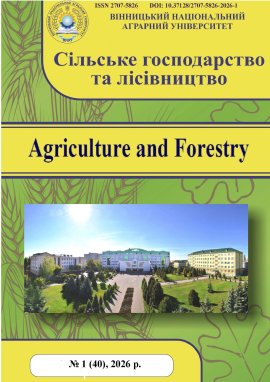
Issue №: 1 (40)
This issue of the journal is devoted to current issues related to the optimization of technological elements in the cultivation of agricultural crops. Considerable attention is paid to the specific features of growing vegetable and cereal crops, which play an important role in ensuring the state’s food security. The scientific publications present research results on the role of leguminous crops in improving soil fertility, the development of domestic and international adaptive breeding, as well as the application of mineral and foliar fertilization to increase the productivity of agroecosystems. Separate studies are devoted to improving the efficiency of forest management and to issues related to landscape greening.
AGROECOLOGICAL ASPECTS OF ORGANIC SOYBEAN PRODUCTION IN EU COUNTRIES
Jolanta Puczel, dr inż. International Academy of Applied Sciences in Łomża, Poland, jolanta.puczel@wp.pl; ORCID: https://orcid.org/0009-0009-1713-7058.
This article examines a range of agroecological factors influencing the efficiency of organic soybean cultivation within the European Union. The significance of the topic stems from the EU’s strategic focus on achieving protein self-sufficiency and meeting the objectives of the "Farm to Fork" strategy, which aims to expand organic farmland to 25% by 2030. At the same time, increasing climate instability presents new obstacles for pesticide-free agricultural practices. The study aims to provide a systematic analysis of the current state of the EU organic soybean sector, identify key abiotic risks, and propose adaptation strategies to enhance crop yields. The research methodology combines statistical analysis of data from Eurostat and FiBL, a comparative review of regional practices in France, Austria, Romania, and Germany, as well as a content analysis of recent field experiments conducted by European research institutions. Findings reveal that while organic soybean acreage has grown significantly-by 158% over five years-yields remain inconsistent due to hydrothermal stress. The most critical challenges identified include flower abortion under temperatures above 32°C and reduced nitrogen fixation caused by insufficient moisture levels. The study highlights that effective adaptation in the EU relies on three key strategies: selecting ultra-early soybean varieties (maturity groups 000/00), using heat-resistant inoculants, and adopting water-saving techniques such as cover crops and living mulch. The novelty of this research lies in its comprehensive analysis of the conflict between organic farming standards and climatic constraints. The practical importance of these findings lies in the potential application of European adaptive farming models in Ukraine to strengthen its role as a major exporter of organic protein. Specific recommendations include localizing soybean breeding efforts and introducing precision mechanical methods for weed control to further enhance productivity.
1. Mazur V., Didur І., Tkachuk О., Pantsyreva Н., Ovcharuk V. (2021). Agroecological stability of cultivars of sparsely distributed legumes in the context of climate change. Scientific Horizons. Vol. 24, № 1. Р. 54-60. DOI: https://doi.org/10.48077/scihor.24(1).2021.54-60 [in English].
2. Mazur O., Mazur O., Tymoshchuk T., Didur I., Tsyhanskyi V. (2024). Study of legume-rhizobia symbiosis in soybean for agroecosystem resilience. Scientific Horizons. Vol. 24, № 11. Р. 68-89. DOI: 10.48077/scihor11.2024.68 [in English].
3. Petrychenko V., Lykhochvor V., Didur I., Pantsyreva H. Scientific aspects of organic soy productionin Ukraine. Chemistry-Didactics-Ecology-Metrology. 2024. Vol. 29, Issue 1-2. P. 111-121. DOI: 10.2478/cdem-2024-0008 [in English].
4. The World of Organic Agriculture: Statistics and Emerging Trends 2024. FiBL & IFOAM. Research Institute of Organic Agriculture (FiBL) & IFOAM – Organics International. 2024. 352 p. [in English].
5. Petrychenko V., Didur I., Pantsyreva H., Volynets Ye. (2025). Agroecological assessment of technologies for growing legumes. Ecological Engineering & Environmental Technology. Vol. 26 (3). P. 393–403. DOI: https://doi.org/10.12912/27197050/200442 [in English].
6. Reckling M. (2022). Soybean resilience to drought is supported by partial recovery of photosynthetic traits. Frontiers in Plant Science. Vol. 13. Art. 971893. DOI: 10.3389/fpls.2022.971893 [in English].
7. Westermeier P. (2023). Impact of Microbial Strain on the Nitrogen Fixation of Soybean (Glycine max L.) Plants. Vol. 12, Issue 19. Art. 3097. DOI: 10.3390/plants12193097 [in English].
8. Didur I., Bakhmat M., Сhynchyk O., Pantsyreva H., Telekalo N., Tkachuk O. (2020). Substantiation of agroecological factors on soybean agrophytocenoses by analysis of variance of the Right-Bank Forest-Steppe in Ukraine. Ukrainian Journal of Ecology. Vol. 10, № 5. Р. 54-61. DOI: 10.15421/2020_206. [in English].
9. Nendel C., Reckling M. (2022). Future area expansion outweighs increasing drought risk for soybean in Europe. Global Change Biology. Vol. 29, Issue 3. DOI: 10.1111/gcb.16562 [in English].
10. Zimmer S. (2020). Characterization of Rhizobia for the Improvement of Soybean Cultivation at Cold Conditions in Central Europe. MicrobiologyOpen. Vol. 9, Issue 4. Art. e1002. DOI: 10.1002/mbo3.1002 [in English].
About the journal
Cluster Agricultural and veterinary sciences (H1 Agronomy, H4 Forestry)
Name of the publication «AGRICULTURE AND FORESTRY»
The aim of the journal "Agriculture and Forestry" is to highlight the results of fundamental and applied research in the fields of agriculture and forestry, aimed at improving the efficiency of agricultural production and introducing modern technologies into farming practice.
This goal defines the main objectives:
– to ensure the creation of open information access regarding the dissemination of relevant scientific research results to: lecturers of agricultural higher education institutions, postgraduate students, doctoral candidates, research staff, and agricultural production specialists;
– to promote the development of young scientists in agricultural sciences;
– to enhance communication between experienced researchers and young scientists in agronomy and forestry;
– to facilitate the expansion of ties between Vinnytsia National Agrarian University and domestic and foreign educational institutions, scientific establishments, and their academic communities.
The scientific, production, and educational journal "Agriculture and Forestry" is a peer-reviewed open-access publication that publishes original experimental research, theoretical and practice-oriented articles within the cluster of "Agricultural and Veterinary Sciences".
The journal's subject matter covers such areas as agronomy and forestry. Publications of scientific and practical significance address the experimental foundations of agricultural and forestry sector development, innovative production technologies, and the results of fundamental and applied research aimed at increasing productivity, product quality, and the sustainable development of natural and production systems.
Publisher: Vinnytsia National Agrarian University
EDRPOU code: 00497236
Publisher's ROR:05m3ysc06
Prefix DOI: 10.37128/
Frequency is quarterly
Publication languages: (Ukrainian, English)
Media ID R30-05174.
Editor in Chief Ihor Didur
According to the order of the Ministry of Education and Science of Ukraine dated 17.03.2020 № 409. The journal Agriculture and Forestry is included in the List of scientific professional publications of Ukraine Category "B" in agricultural sciences (specialties) - 101, 201, 202, 203, 205, 206.
State registration: Decision of the National Council of Ukraine on Television and Radio Broadcasting No. 1337 and No. 1181. Media identifier – R30-05174.
Scientific journal "AGRICULTURE AND FORESTRY" was founded in 1995; it was entitled as Bulletin of Vinnytsya State Agricultural Institute.
In 2010-2014 was enritled as Collection of scientific works of Vinnytsia National Agrarian University.
It has been named as Agriculture and Forestry since 2015.
Listed in the updated list of scientific professional editions of Ukraine on agricultural sciences under the name Agriculture and Forestry (Order of the Ministry of Education and Science of Ukraine of May 16, 2016; No. 515).
Since 2015, "Agriculture and Forestry". (archive of previous issues for 2015-2019) at http://forestry.vsau.edu.ua/.
The journal “Agriculture and Forestry (ISSN: 2707-5826)” passed the evaluation process of Index Copernicus positively and is indexed in the database of ICI Journals Master List ICV for 2018, 2019, 2020, 2021, 2022, 2023, 2024 is presented in the full list of indexed journals in the Master List International List
ICI Journals Master List Value
