

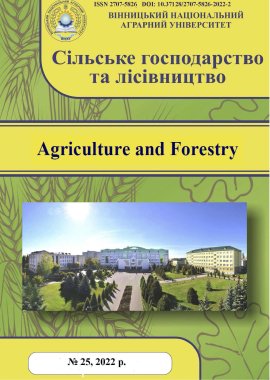
Issue №: 2 (25)
The issue of the magazine is devoted to the study of the optimization of the elements of the technology of growing agricultural crops. An important role is given to the influence of leguminous crops on improving soil fertility, adaptive breeding, mineral and foliar fertilization of agricultural crops, ecology and environmental protection, in particular, the impact of chemical treatment on the contamination of soil and grain products with pesticides, methods of combating harmful objects.
VARIATIONS OF GETEROSIS SIZE OF GREEN MASS AND SEED YIELD IN HYBRID POPULATIONS OF LUCERNE SOWING IN CONDITIONS OF HIGH ACID ACID
Mamaliha Vasyl Stepanovych – Сandidate of Biology Sciences, Professor, Professor of the Department of Botany, Genetics and Plant Protection of Vinnytsia National Agrarian University (21008, Vinnytsia, Soniachna Str., 3. e-mail: stepanovich112@i.ua).
Buhayov Vasyl Dmytrovych – Candidate of Agricultural Sciences, Senior StaffScientist, the Head of the Selection of Green Crops Department of Institute of Forage and Agriculture of Podolia NAAS of Ukraine (21100, Vinnytsia, Prospekt Yunosty, 16. e-mail: bugayovvd@ukr.net).
Horenskyi Vitalii Mihailovich – Сandidate of Agricultural Sciences, Senior Researcher of the Department of Fodder Crop Selection of the Institute of Fodder and Agriculture of Podolia NAAS of Ukraine (21100, Vinnytsia, Prospekt Yunosty, 16. e-mail: e-mail: gorenskij.vitalij@ukr.net).
The article highlights the results of studying the magnitude of heterosis and the nature of inheritance of forage and seed productivity in 37 hybrid populations (F3 and F5) of alfalfa sowing under conditions of high soil acidity (pH 5.2-5.3). It was found that among the hybrid populations of alfalfa F3 (2013-2016) in terms of forage productivity above the standard variety Sinyukha by 0.06-0.23 kg / m² (+ 5-20%) were: Mega / Regina, Vika / Regina, Zhidrune / Regina, Zhidrune / Sinyukha, Mega / Grilys, Yaroslavna / Vika, Yaroslavna / Zhidrune, Zhidrune / Vika, Grilys / Zhidrune, Vika / Mega and 15 more samples and parental forms of Zhidrune, Vika indicator. In the standard variety Sinyukha, the dry matter collection was 1.0-1.25 kg / m². The average interpopulation level was in the range of 0.98-1.25 kg / m2 depending on the year of use. Subsequent studies (2017-2019) among hybrid F5 populations only in Grilys / Mega, Grilys / Vika, Yaroslavna / Vika, Yaroslavna / Zhidrune and Grilys / Zhidrune revealed an increase in feed productivity to the standard by 5-11% or at 0.06-0.13 kg / m2 and 21 other samples and the parental forms of Grilys, Vika were on a par with him in this respect. In the standard variety of cyanosis, the dry matter collection was 1.09-1.41 kg / m². The average interpopulation level (MPC) was in the range of 1.03-1.31 kg / m². Heterosis (positive dominance) was detected in Mega / Regina (F3 hp = 69.37 and in F5 - 4.44) according to the degree of dominance of hybrid populations isolated by forage productivity in both F3 and F5; Vika / Regina (3.66 and 1.08); Gidrune / Regina (4.67 and 24.2); Yaroslavna / Vika (2.7 and 1.71); Yaroslavna / Zhidrune (2.56 and 5.11); Grilys / Gidrune (17,58 and 2.0). It should be noted that the heterosis index in these combinations ranged from 9.6 to 23.6% in F3, while in F5 it decreased to 0.5-19%. In terms of seed productivity in the period 2013-2016, only the combination Sinyukha / Mega was 20% higher than the standard among hybrid F3 populations and 8 more were on a par with it (Regina / Zhidrune, Sinyukha / Yaroslavna), Grilys / Mega, Grilys / Regina, Mega / Yaroslavna, Vika, Mega / Zhidrune). In the standard variety Sinyukha, the seed yield was 26.1-49.8 g / m2. The average interpopulation level was in the range of 16.7-52.5 g / m². During the following studies (2018-2020) among F5 hybrids no significant excess to the standard variety was detected, only the Regina / Mega population was on a par with it. Seed yield at the average interpopulation level was 9.3-22.9 g / m², in the standard - 25.0-37.5 g / m². Based on the results of this work, hybrid alfalfa populations with a combination of fodder and seed productivity against the background of high soil acidity were selected and proposed for use in the selection process: Regina / Zhidrune, Sinyukha / Mega, Sinyukha / Yaroslavna, Grilys / Mega, Grilys / Regina. They can be used separately in the selection process after further research: on forage productivity - samples Mega / Regina, Vika / Regina, Zhidrune / Regina, Zhidrune / Sinyukha, Mega / Grilys, Grilys / Vika Yaroslavna / Vika, Yaroslavna / Zhidrune, Grilys / Zhidrune , Vika / Mega; by seed productivity - Regina / Mega.
1.Kvitko G.P., Polishhuk I.S., Protopish I.G. (2012). Bagatorichni bobovi travy`–osnova staloyi kormovoyi bazy` i biologizaciyi zemlerobstva v umovax Lisostepupravoberezhnogo [Perennial legumes are the basis of a sustainable fodder base and biologization of agriculture in the right-bank forest-steppe]. Collection of scientific worcs of Vin.Nats.agrarn.un-tu. − Zb.nauk.pr. Vin.nacz.agrarn.un-tu. Series: Agricultural Sciences. Issue. 6 (68). P. 89-95. [in Ukrainian].
2.Zharinov V.I., Klyuj V.S. (1990). Lyucerna [Alfalfa]. К. Urozhai. 320 р. [inUkrainian].
3.Molotsky M.Ya. (2010). Special selection of field crops [Special`na selekciyapol`ovy`x kul`tur]. White Church. 368 p. [in Ukrainian].
4.Quiros C.F., Bauchan G.R. (1988). The Genus Medicago and the origin of theMedicago sativa. Soil Science Society of America. Inc.: Madison. WI, USA. Р.93-124. [in English].
5.Riday H., Brummer E.C. (2002). Heterosis of agronomic traits in alfalfa Crop.Sci. № 42(b). Р.1081-1087. [in English].
6.Bolton J.L. (1937). A study of combining ability of alfalfa in relation tocertain methods of selection. Sci. Agr. № 28. Р. 97-126. [in English].
7.Grundler F.M.W. (2000). Chancen und Risiken der Genetik imPflanzenschutz. Schrift en. Agrar. und Ernahrungswisfak. Univ. Kiel. № 90. Р. 37-39. [in English].
8.Bugajov V.D., Gorens`ky`j V.M. (2018). Riven` geterozy`su za kormovoyu tanasinnyevoyu produkty`vnistyu u gibry`div (F3) lyucerny` za umov pidvy`shhenoyi ky`slotnosti gruntu. [The level of heterosis in forage and seed productivity in hybrids (F3) of alfalfa under conditions of high soil acidity]. Kormy` i kormovy`robny`cztvo − Feed and feed production. Issue. 85. P. 3-11. [in Ukrainian].
9.Bober A.F., Povy`dalo M.V. (2011). Transgresiya oznak nasinnyevoyi ikormovoyi produkty`vnosti u mizhvy`dovy`x gibry`div lyucerny` [Transgression of traits of seed and fodder productivity in interspecific hybrids of alfalfa]. Zbirny`k naukovy`x pracz` NNCz «Insty`tutu zemlerobstva NAAN» − Collection of scientific works of NSC "Institute of Agriculture of NAAS". Issue 1-2. P. 211-219. [in English].
10.Pol`ovy`j A.M., Bozhko L.Yu., Vol`vach O.V. (2004) Osnovy`agrometeorologiyi: [Fundamentals of agrometeorology]. Lecture notes. Odessa: TPP. 150 p. [in Ukrainian].
11.Beil G.M., Atkins R.E. (1965). Inheritance of quantitative characters in grainsorgum. Iowa State Journal. № 39. P. 3. [in English].
12.Baby`ch A.O. (1998). Metody`ka provedennya doslidiv z kormovy`robny`cztva ta godivli tvary`n [Methods of conducting experiments on feed production and animal feeding]. Vinnitsa 78 p. [in Ukrainian].
13.Yeshhenko V.O., Kopy`tko P.G., Opry`shkoV.P., Kostogry`z P.V. (2005).Osnovy` naukovy`x doslidzhen` v agronomiyi [Fundamentals of research in agronomy]. K. Diya. [in Ukrainian].
14.Bugajov V.D., Mamaly`ga V.S., Gorens`ky`j V.M., Maksimov A.M. (2014).Ocinka ta stvorennya vy`xidnogo materialu dlya selekciyi lyucerny` v umovax pidvy`shhenoyi ky`slotnosti g`runtiv [Evaluation and creation of source material for alfalfa breeding in conditions of high soil acidity]. Zbirny`k naukovy`x pracz` Faktory` ekspery`mental`noyi evolyuciyi organizmiv − Collection of scientific works Factors of experimental evolution of organisms. K. Vol. 15. P.153-155. [in Ukrainian].
15.Ruds`ka N.O. (2016). Formuvannya vy`dovogo skladu zapy`lyuvachiv ta yixvply`v na nasinnyevu produkty`vnist` rosly`n lyucerny` u Pravoberezhnomu Lisostepu Ukrayiny`. [Formation of species composition of pollinators and their influence on seed productivity of alfalfa plants in the Right-Bank Forest-Steppe of Ukraine]. Zaxy`st i karanty`n rosly`n: mizhvidomchy`j tematy`chny`j naukovy`j zbirny`k − Plant protection and quarantine: interdepartmental thematic scientific collection. Issue. 62. P. 206-215. [in Ukrainian].
About the journal
Cluster Agricultural and veterinary sciences (H1 Agronomy, H4 Forestry)
Name of the publication «AGRICULTURE AND FORESTRY»
The aim of the journal "Agriculture and Forestry" is to highlight the results of fundamental and applied research in the fields of agriculture and forestry, aimed at improving the efficiency of agricultural production and introducing modern technologies into farming practice.
This goal defines the main objectives:
– to ensure the creation of open information access regarding the dissemination of relevant scientific research results to: lecturers of agricultural higher education institutions, postgraduate students, doctoral candidates, research staff, and agricultural production specialists;
– to promote the development of young scientists in agricultural sciences;
– to enhance communication between experienced researchers and young scientists in agronomy and forestry;
– to facilitate the expansion of ties between Vinnytsia National Agrarian University and domestic and foreign educational institutions, scientific establishments, and their academic communities.
The scientific, production, and educational journal "Agriculture and Forestry" is a peer-reviewed open-access publication that publishes original experimental research, theoretical and practice-oriented articles within the cluster of "Agricultural and Veterinary Sciences".
The journal's subject matter covers such areas as agronomy and forestry. Publications of scientific and practical significance address the experimental foundations of agricultural and forestry sector development, innovative production technologies, and the results of fundamental and applied research aimed at increasing productivity, product quality, and the sustainable development of natural and production systems.
Publisher: Vinnytsia National Agrarian University
EDRPOU code: 00497236
Publisher's ROR:05m3ysc06
Prefix DOI: 10.37128/
Frequency is quarterly
Publication languages: (Ukrainian, English)
Media ID R30-05174.
Editor in Chief Ihor Didur
According to the order of the Ministry of Education and Science of Ukraine dated 17.03.2020 № 409. The journal Agriculture and Forestry is included in the List of scientific professional publications of Ukraine Category "B" in agricultural sciences (specialties) - 101, 201, 202, 203, 205, 206.
State registration: Decision of the National Council of Ukraine on Television and Radio Broadcasting No. 1337 and No. 1181. Media identifier – R30-05174.
Scientific journal "AGRICULTURE AND FORESTRY" was founded in 1995; it was entitled as Bulletin of Vinnytsya State Agricultural Institute.
In 2010-2014 was enritled as Collection of scientific works of Vinnytsia National Agrarian University.
It has been named as Agriculture and Forestry since 2015.
Listed in the updated list of scientific professional editions of Ukraine on agricultural sciences under the name Agriculture and Forestry (Order of the Ministry of Education and Science of Ukraine of May 16, 2016; No. 515).
Since 2015, "Agriculture and Forestry". (archive of previous issues for 2015-2019) at http://forestry.vsau.edu.ua/.
The journal “Agriculture and Forestry (ISSN: 2707-5826)” passed the evaluation process of Index Copernicus positively and is indexed in the database of ICI Journals Master List ICV for 2018, 2019, 2020, 2021, 2022, 2023, 2024 is presented in the full list of indexed journals in the Master List International List
ICI Journals Master List Value
