

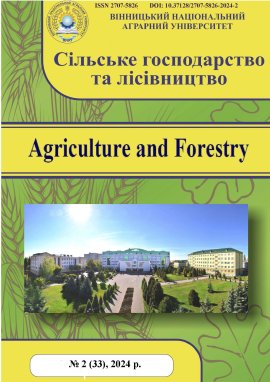
Issue №: 2 (33)
The issue of the magazine is dedicated to the study of the optimization of technological methods of growing agricultural crops. Considered the importance of the influence of leguminous crops on improving soil fertility, ecology and environmental protection, methods of combating pests, greening of territories.
THE PRODUCTIVITY OF AN APPLE ORCHARD DEPENDS ON FERTILIZER
Tkachuk Oleksandr − doctor of agricultural sciences, professor, head of the department of ecology and environmental protection of Vinnytsia National Agrarian University. (Str. Sunny, 3, Vinnitsa city, 21008; tel. 0679546095; e-mail: tkachukop@ukr.net).
Misery Anna − graduate student of the department of ecology and environmental protection of Vinnytsia National Agrarian University. (St. Sonyachna, 3, Vinnytsia city, 21008; tel. 0685429710; e-mail: _anna_m_@ukr.net).
Intensive apple orchards in Ukraine occupy about 70% of their total number and involve the use of high rates of mineral fertilizers and repeated use of pesticides. Despite this, in general, in all categories of farms, the yield of apples remains at a low level. At the same time, the profits of farms are decreasing due to the increase in cultivation costs and a decrease in the sales price. The quality and environmental safety of the obtained products may deteriorate. Therefore, the promising direction of fruit growing in Ukraine is the production of organic products. It limits the use of mineral fertilizers, especially nitrogen and synthetic pesticides. But because of this, the yield in an organic garden can drop sharply compared to an intensive garden: from 30-40 t/ha in intensive horticulture to 10-12 t/ha in an organic one. Therefore, in order to reduce the degradation processes in soils, improve the quality and ecological safety of the obtained products, which will meet the requirements of organic production, it is necessary to switch from the use of traditional mineral fertilizers to their alternatives: organic, biological, microfertilizers and others. Since it is impossible to supply the entire horticultural sector with organic fertilizers in the absence of them, an important emphasis should be placed on biofertilizers. But their effectiveness in horticulture is practically not studied, especially in comparison with traditional mineral fertilizers. The purpose of the research is to establish indicators of individual productivity and fruit yield of an intensive apple orchard using biofertilizers of the Bionorma series. When fertilizing an apple orchard of an intensive type with mineral and biofertilizers of the Bionorma series, the highest fruit yield is ensured by the application of complex mineral fertilizer in the norm N60Ð60Ê60 - 39,617 t/ha. When replacing mineral fertilizers with biological fertilizer Bionorma nitrogen, the yield of fruits decreases by 8.0% and amounts to 36,451 t/ha. This biological fertilizer provides 1.8% more apple yield than N60 mineral nitrogen application and 26.1% more than P60 mineral phosphorus application. The high yield of apples with the application of biofertilizer Bionorma nitrogen is ensured by the largest number of set fruits, the lowest percentage of fruit falling during June-August, the highest percentage of fruit preservation before harvest and the largest number of them before harvest from one tree.
1. Burlyay O.L., Burlyay A.P., Kharenko A.O. (2013). Suchasnyy stan rozvytku sadivnytstva v Ukrayini. [The current state of horticulture development in Ukraine]. Zbirnyk naukovykh prats Umanskoho natsionalnoho universytetu sadivnytstva – Collection of scientific works of the Uman National University of Horticulture. Vol. 82. 249-259. [in Ukrainian].
2. Razanov S., Melnyk V., Symochko L., Dydiv A., Vradii O., Balkovskyi V., Khirivskyi P., Panas N., Lysak H., Koruniak O. (2022). Agroecological assessment of gray forest soils under intensive horticulture. International Journal of Ecosystems and Ecology Science (IJEES). Vol. 12 (4). Р. 459-464. DOI: https://doi.org/10.31407/ijees12.458. [In English].
3. Razanov S.F., Melnyk V.O. (2022). Ahrokhimichna otsinka gruntiv, shcho perebuvaly pid sadivnytstvom, shchodo prydatnosti yikh vykorystannya pid vyroshchuvannya osnovnykh silskohospodarskykh kultur. [Agrochemical assessment of soils that were under horticulture, regarding their suitability for growing the main agricultural crops]. Silske hospodarstvo ta lisivnytstvo – Agriculture and forestry. № 1 (24). 171-181. DOI:10.37128/2707-5826-2022-1-12. [in Ukrainian].
4. Kozina T.V. (2023). Potentsial sadivnytstva ta napryamy yoho efektyvnoho vykorystannya v umovakh Podillya. [The potential of horticulture and directions for its effective use in the conditions of Podillia]. Podilskyy visnyk: silske hospodarstvo, tekhnika, ekonomika – Podilsky Visnyk: agriculture, technology, economy. № 38. DOI: https://doi.org/10.37406/2706-9052- 2023-1.3. [in Ukrainian].
5. Tkachuk O.P., Mizeriy A.T. (2023). Pryntsypy pidboru biopreparativ u plodovykh sadakh orhanichnoho vyrobnytstva [Principles of selection of biological preparations in orchards of organic production]. Ahrarni innovatsiyi – Agrarian innovations. № 17. 150-155. DOI: https://doi.org/10.32848/agrar.innov.2023.17.20. [in Ukrainian].
6. Zhuk V.M., Barabash L.O., Kryvoshapka V.A., Boldyzheva L.D. (2022). Efektyvnist vyroshchuvannya perspektyvnykh sortiv yabluni selektsiyi Instytutu sadivnytstva NAAN v intensyvnykh nasadzhennyakh. [The efficiency of growing promising apple varieties selected by the Institute of Horticulture of the National Academy of Sciences in intensive plantations]. Visnyk ahrarnoyi nauky – Herald of Agrarian Science. Vol. 100. № 2 (827). 34-41. DOI: https://doi.org/10.31073/ agrovisnyk202202-05. [in Ukrainian].
7. Kuyan V.H., Pelekhatyy V.M. (2012). Intensyfikatsiya i kontsentratsiya plodivnytstva ta osnovni shlyakhy yikh vyrishennya v riznykh gruntovo-klimatychnykh zonakh Ukrayiny. [Intensification and concentration of fruit growing and the main ways of solving them in different soil and climatic zones of Ukraine]. Naukovyj visnyk Nacionalnogo universytetu bioresursiv i pryrodokorystuvannya Ukrayiny. Seriya: Agronomiya – Scientific Bulletin of the National University of Bioresources and Nature Management of Ukraine. Series: Agronomy. № 180. 129-138. [in Ukrainian].
8. Kondratenko P.V., Shestopal O.M., Barabash L.O. (2009). Osnovni napryamy rozvytku promyslovoho sadivnytstva Ukrayiny. [The main directions of development of industrial horticulture of Ukraine]. Sadivnytstvo – Gardening. Issue. 62. 5-13. [in Ukrainian].
9. Chumachenko O.M., Kryvovyaz YE.V., Hrehul V.I. (2020). Ekolohichni naslidky intensyfikatsiyi silskohospodarskoho vyrobnytstva. [Ecological consequences of intensification of agricultural production]. Zbalansovane pryrodokorystuvannya – Balanced nature management. № 4. 114-124. DOI: https://doi.org/10.33730/2310- 4678.4.2020.226636. [in Ukrainian].
10. Yeshchenko V.O. (2005). Osnovy naukovykh doslidzhen v ahronomiyi. [Basics of scientific research in agronomy]. K.: Diya. [in Ukrainian].
11. Rudenko S.S., Kostyshyn S.S., Morozova T.V. (2008). Zahalna ekolohiya. Praktychnyy kurs. Chastyna 2. Pryrodni nazemni ekosystemy. [General ecology. Practical course. Part 2. Natural terrestrial ecosystems]. Chernivtsi: Knyhy – KHKHI. [in Ukrainian].
12. Moyseychenko V.F., Yeshchenko V.O. (1994). Osnovy naukovykh doslidzhenʹ v ahronomiyi. [Basics of scientific research in agronomy]. K.: Vyshcha shkola. [in Ukrainian].
13. Bionorma azot. BioNorma. (2018). [Nitrogen bionorm. BioNorma]. URL: https://bionorma.ua/biozhyvlennya/bionorma-azot-1-l/ (access date 5.01.2024). [in Ukrainian].
14. Bionorma fosfor. BioNorma. (2018). [Bionorma phosphorus. BioNorma]. URL: https://bionorma.ua/biozhyvlennya/bionorma-fosfor-1-l/(access date 5.01.2024). [in Ukrainian].
15. Bionorma sad. BioNorma. (2018). [Bionorma garden. BioNorma]. URL: https://bionorma.ua/biozakhyst/bionorma-sad-10-l/ (access date 5.01.2024).
About the journal
Cluster Agricultural and veterinary sciences (H1 Agronomy, H4 Forestry)
Name of the publication «AGRICULTURE AND FORESTRY»
The aim of the journal "Agriculture and Forestry" is to highlight the results of fundamental and applied research in the fields of agriculture and forestry, aimed at improving the efficiency of agricultural production and introducing modern technologies into farming practice.
This goal defines the main objectives:
– to ensure the creation of open information access regarding the dissemination of relevant scientific research results to: lecturers of agricultural higher education institutions, postgraduate students, doctoral candidates, research staff, and agricultural production specialists;
– to promote the development of young scientists in agricultural sciences;
– to enhance communication between experienced researchers and young scientists in agronomy and forestry;
– to facilitate the expansion of ties between Vinnytsia National Agrarian University and domestic and foreign educational institutions, scientific establishments, and their academic communities.
The scientific, production, and educational journal "Agriculture and Forestry" is a peer-reviewed open-access publication that publishes original experimental research, theoretical and practice-oriented articles within the cluster of "Agricultural and Veterinary Sciences".
The journal's subject matter covers such areas as agronomy and forestry. Publications of scientific and practical significance address the experimental foundations of agricultural and forestry sector development, innovative production technologies, and the results of fundamental and applied research aimed at increasing productivity, product quality, and the sustainable development of natural and production systems.
Publisher: Vinnytsia National Agrarian University
EDRPOU code: 00497236
Publisher's ROR:05m3ysc06
Prefix DOI: 10.37128/
Frequency is quarterly
Publication languages: (Ukrainian, English)
Media ID R30-05174.
Editor in Chief Ihor Didur
According to the order of the Ministry of Education and Science of Ukraine dated 17.03.2020 № 409. The journal Agriculture and Forestry is included in the List of scientific professional publications of Ukraine Category "B" in agricultural sciences (specialties) - 101, 201, 202, 203, 205, 206.
State registration: Decision of the National Council of Ukraine on Television and Radio Broadcasting No. 1337 and No. 1181. Media identifier – R30-05174.
Scientific journal "AGRICULTURE AND FORESTRY" was founded in 1995; it was entitled as Bulletin of Vinnytsya State Agricultural Institute.
In 2010-2014 was enritled as Collection of scientific works of Vinnytsia National Agrarian University.
It has been named as Agriculture and Forestry since 2015.
Listed in the updated list of scientific professional editions of Ukraine on agricultural sciences under the name Agriculture and Forestry (Order of the Ministry of Education and Science of Ukraine of May 16, 2016; No. 515).
Since 2015, "Agriculture and Forestry". (archive of previous issues for 2015-2019) at http://forestry.vsau.edu.ua/.
The journal “Agriculture and Forestry (ISSN: 2707-5826)” passed the evaluation process of Index Copernicus positively and is indexed in the database of ICI Journals Master List ICV for 2018, 2019, 2020, 2021, 2022, 2023, 2024 is presented in the full list of indexed journals in the Master List International List
ICI Journals Master List Value
