

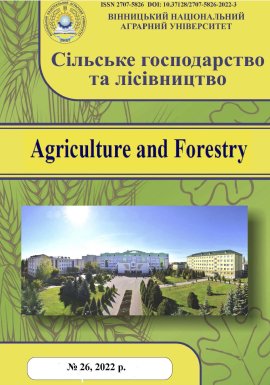
Issue №: 3 (26)
The issue of the magazine is devoted to the study of the optimization of the elements of the technology of growing agricultural crops. An important role is given to the influence of leguminous crops on improving soil fertility, adaptive breeding, mineral and foliar fertilization of agricultural crops, ecology and environmental protection, in particular, the impact of chemical treatment on the contamination of soil and grain products with pesticides, methods of combating harmful objects.
THE INFLUENCE OF EXTRA-ROOT NUTRIENTS ON THE DURATION OF THE INTERPHASE PERIOD OF SPRING BARLEY IN THE CONDITIONS OF THE RIGHT-BANK FOREST STEPPE OF UKRAINE
Tkachuk Oleksandr Petrovich − Doctor of Agricultural Sciences, Associate Professor of the Department of Ecology and Environmental Protection of Vinnitsa National Agrarian University. (str. Sunny, 3, Vinnitsa city, 21008. tel. 0679546095. e-mail: tkachukop@ukr.net).
A sufficient amount of precipitation and a moderate air temperature are necessary for optimal growth and development processes, as well as the formation of reproductive organs of plants. Since their excessive or insufficient amount, as well as elevated or low temperature conditions, delay or accelerate the passage of interphase periods and adversely affect the duration of vegetative and generative growth of spring barley plants. In the course of research, it was established that in order to reduce the negative impact of the weather conditions of individual years on the stability of the gross harvest of barley grain, it is necessary to carry out foliar feeding in the phase of tillering and emergence of plants into the tube with biological preparations, such as Help Rost - 2 l/ha, Organic D2-M - 1 l/ha, Azotophyte - 2 l/ha. The duration of the period of earing-full ripeness turned out to be the most contrasting in response to the application of fertilizers. Thus, in the variant with the introduction of mineral fertilizers in the dose of N15Р15К15 and with one-time treatment with biological preparations Help Rost 2 l/ha, Organic D2-M 1 l/ha, Azotophyt 2 l/ha, the duration of this period was extended by 1 day compared to the control variant and by 2 days for two-time feeding with the indicated preparations in the phase of tillering and emergence of plants into the tube. So, in general, the duration of the growing season in spring barley varieties Armaks and Swagor on the control variant were the lowest and amounted to 83 and 79 days, respectively.By carrying out one-time foliar fertilization in the budding phase with biological preparations Help Rost - 2 l/ha, Organic D2-M - 1 l/ha, Azotophyt 2 l/ha against the background of N15Р15K15 fertilizer, the length of the growing season was extended to 85 and 86 days and 81 and 82 days , it is higher than on the control variant by 2 and 4; 2 and 3 days, respectively. With a two-time foliar feeding in the phase of bushing and emergence of plants in the tube with biological preparations Help Rost - 2 l/ha, Organic D2-M - 1 l/ha and Azotophyt 2 l/ha against the background of N15Р15K15 fertilizer, the duration of the growing season was extended to 86 and 87 days.
1.Kalenska S. (2015). Vplyv mineralnykh dobryv ta retardnoho zakhystu na urozhainist yachmeniu yaroho pyvovarnoho. [The influence of mineral fertilizers and retard protection on the yield of spring malting barley]. Posibnyk Ahrobiolohiia. Issue. 1 (117). 56-58. [in Ukrainian].
2.Lytvynenko M. A. (2007). Stan ta perspektyvy stvorennia novykh sortiv i hibrydiv u naukovykh ustanovakh UAAN [The state and prospects of creating new varieties and hybrids in scientific institutions of UAAS]. Posibnyk. Zernovi kultury. №1. 3–6. [in Ukrainian].
3.Lykhochvor V.V., Petrychenko V.F. (2006). Fazy rostu ta rozvytku yachmeniu yaroho [Specialties of growth and development of spring barley]. Posibnyk. 730-733 [in Ukrainian].
4.Romaniuk V.I. (2017). Yak naidali vid bez hroshivia! Zhnyva rannikh zernovykh: ochikuvani finansovi rezultaty. [How far from without money! Early grain harvest: expected financial results]. Zhurnal «Zerno− Grain magazine». №9 (138). 108-113. [in Ukrainian].
5.Vyslobodska M., Danyliuk V., Bidna L., Vurdyk P. (2013). Formuvannia urozhainosti ta yakosti zerna yaroho yachmeniu zalezhno vid rivnia mineralnoho zhyvlennia. [Formation of yield and quality of spring barley grain depending on the level of mineral nutrition]. Visnyk Lvivskoho nats. ahrar. Universytetu − Visnyk Lviv national newspaper. agrarian university. № 17 (1). S. 166-170. [in Ukrainian].
6.Len O.I. (2010). Zabezpechenist roslyn yachmeniu yaroho osnovnymy elementamy zhyvlennia zalezhno vid variantiv udobrennia. [Provision of spring barley plants with basic nutrients depending on fertilizer options]. Visnyk Poltavskoi derzhavnoi ahrarnoi akademii− Bulletin of the Poltava State Agrarian Academy. № 4. S. 182-185. [in Ukrainian].
7.Romoniuk V.O. (2019). Formuvannia urozhainosti ta yakosti zerna sortiv yachmeniu yaroho zalezhno vid doz mineralnykh dobryv ta rehuliatoriv rostu roslyn v umovakh Lisostepu pravoberezhnoho. [Formation of yield and grain quality of spring barley varieties depending on the doses of mineral fertilizers and plant growth regulators in the right-bank forest-steppe]. Diss. on of science candidate degree s.-g. of science. S.68-69. [in Ukrainian].
8.Petrychenko V.F., Lykhochvor V.V. (2014). Tekhnolohii vyroshchuvannia yachmeniu yaroho. [Technologies for growing spring barley] Roslynnytstvo. Navchalnyi posibnyk dlia studentiv vyshchykh ahrarnykh zakladiv osvity I-IV rivnian akredytatsii. S. 221-254. [in Ukrainian].
9.Polupan M.I., Velychko V.A., Solovei V.B., Bilivets I.I. (2011). Produktyvna zdatnist gruntiv Lisostepu za pryrodnoiu ta efektyvnoiu rodiuchistiu. [Productive ability of Forest-Steppe soils by natural and effective fertility]. Visnyk ahrarnoi nauky − Herald of Agrarian Science. № 7. S. 15-23. [in Ukrainian].
10.Metodyka Derzhavnoho sortovyprobuvannia silskohospodarskykh kultur (zernovi, krupiani ta zernobobovi kultury) (2001). [Methods of State variety testing of agricultural crops (cereals, cereals and legumes)] / za red. V.V. Volkodava. Kyiv. [in Ukrainian].
About the journal
Cluster Agricultural and veterinary sciences (H1 Agronomy, H4 Forestry)
Name of the publication «AGRICULTURE AND FORESTRY»
The aim of the journal "Agriculture and Forestry" is to highlight the results of fundamental and applied research in the fields of agriculture and forestry, aimed at improving the efficiency of agricultural production and introducing modern technologies into farming practice.
This goal defines the main objectives:
– to ensure the creation of open information access regarding the dissemination of relevant scientific research results to: lecturers of agricultural higher education institutions, postgraduate students, doctoral candidates, research staff, and agricultural production specialists;
– to promote the development of young scientists in agricultural sciences;
– to enhance communication between experienced researchers and young scientists in agronomy and forestry;
– to facilitate the expansion of ties between Vinnytsia National Agrarian University and domestic and foreign educational institutions, scientific establishments, and their academic communities.
The scientific, production, and educational journal "Agriculture and Forestry" is a peer-reviewed open-access publication that publishes original experimental research, theoretical and practice-oriented articles within the cluster of "Agricultural and Veterinary Sciences".
The journal's subject matter covers such areas as agronomy and forestry. Publications of scientific and practical significance address the experimental foundations of agricultural and forestry sector development, innovative production technologies, and the results of fundamental and applied research aimed at increasing productivity, product quality, and the sustainable development of natural and production systems.
Publisher: Vinnytsia National Agrarian University
EDRPOU code: 00497236
Publisher's ROR:05m3ysc06
Prefix DOI: 10.37128/
Frequency is quarterly
Publication languages: (Ukrainian, English)
Media ID R30-05174.
Editor in Chief Ihor Didur
According to the order of the Ministry of Education and Science of Ukraine dated 17.03.2020 № 409. The journal Agriculture and Forestry is included in the List of scientific professional publications of Ukraine Category "B" in agricultural sciences (specialties) - 101, 201, 202, 203, 205, 206.
State registration: Decision of the National Council of Ukraine on Television and Radio Broadcasting No. 1337 and No. 1181. Media identifier – R30-05174.
Scientific journal "AGRICULTURE AND FORESTRY" was founded in 1995; it was entitled as Bulletin of Vinnytsya State Agricultural Institute.
In 2010-2014 was enritled as Collection of scientific works of Vinnytsia National Agrarian University.
It has been named as Agriculture and Forestry since 2015.
Listed in the updated list of scientific professional editions of Ukraine on agricultural sciences under the name Agriculture and Forestry (Order of the Ministry of Education and Science of Ukraine of May 16, 2016; No. 515).
Since 2015, "Agriculture and Forestry". (archive of previous issues for 2015-2019) at http://forestry.vsau.edu.ua/.
The journal “Agriculture and Forestry (ISSN: 2707-5826)” passed the evaluation process of Index Copernicus positively and is indexed in the database of ICI Journals Master List ICV for 2018, 2019, 2020, 2021, 2022, 2023, 2024 is presented in the full list of indexed journals in the Master List International List
ICI Journals Master List Value
