

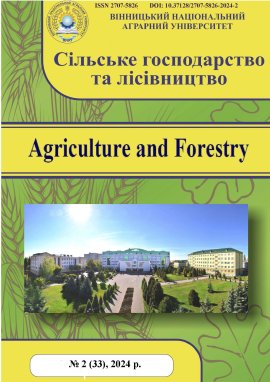
Issue №: 2 (33)
The issue of the magazine is dedicated to the study of the optimization of technological methods of growing agricultural crops. Considered the importance of the influence of leguminous crops on improving soil fertility, ecology and environmental protection, methods of combating pests, greening of territories.
THE IMPACT OF PHOSPHORUS FERTILIZERS ON WINTER RAPESEED GROWTH AND YIELD
Matsera Olha Olehivna – Candidate of Agricultural Sciences (PhD), Associate Professor at the Agriculture, Soil Science and Agrochemistry Department, Vinnytsia National Agrarian University (21008, Vinnytsia, Soniachna Str.3, е-mail: matsera.olga.vnau@gmail.com).
Original article focuses on the peculiarities of the nutrition system of a common marginal crop – winter rapeseed – one of the main macronutrients – phosphorus. The latest literary sources related to the study of the problem of feeding winter rapeseed with phosphorus have been elaborated. Rapid germination and active development of the root system in autumn are very important for winter rape, and the use of starter fertilizers is particularly effective. Rape responds well to starting phosphorus. Winter rape consumes about 25% of all necessary nutrients in autumn. Phosphorus, applied when sowing rapeseed, is a key nutrient, especially important for root development, which contributes to better growth of young plants. Phosphorus is immobile in the soil, so when sowing, fertilizer should be placed as close as possible to the seeds. This ensures that the root system, which is actively developing, will be able to provide an optimal supply of phosphorus at the early stage of growth - the most critical for phosphorus. This is especially important on soils prone to its strong fixation and transformation into forms inaccessible to plants. Reducing the contact of fertilizer with the soil during local application reduces the amount of bound phosphorus. Rapeseed efficiently absorbs phosphorus, despite the fact that Brassicaceae species are not prone to mycorrhizal formation. Studies have shown that winter rapeseed needs more phosphorus than cereals, especially in the early stages of development. Research on the effect of phosphorus fertilizers on the growth, development and yield formation of winter rapeseed plants was conducted at the Department of Agriculture, Soil Science and Agrochemistry within the experimental farm of the Vinnytsia National Agrarian University in the village of Agronomichne. Two hybrids of winter rapeseed were chosen for research: DK Immortal and DK Extract; phosphorus fertilization included five levels: 0; 30; 60; 90; 120 kg/ha. Research results showed a strong positive correlation between fertilizer rates and the growth of biometric indicators of winter rapeseed plants, yield and oil content in seeds.
1.Wang R., Zheng WD., Wu YH., Liu DM., Peng WL. (2023). Effects of a range of phosphorus levels on yield, phosphorus efficiency, and canopy sunlight interception in direct-seeded winter rapeseed. Agronomy journal. Vol. 115, Issue 4. P. 2058-2070. DOI: 10.1002/agj2.21394. [in English].
2. Fu H., Li H., Yin P., Mei H., Li J., Zhou P., Wang Y., Ma Q., Jeyaraj A., Thangaraj K. (2021). Integrated Application of Rapeseed Cake and Green Manure Enhances Soil Nutrients and Microbial Communities in Tea Garden Soil. Sustainability. Vol. 13, Issue 15: 2967. DOI:https://doi.org/10.3390/ su13052967. [in English].
3. Fu Y., Mason A.S., Song M. (2023). Multi-omics strategies uncover the molecular mechanisms of nitrogen, phosphorus and potassium deficiency responses in Brassica napus. Cellular & Molecular Biology Letters. Issue 28 (63). DOI: https://doi.org/10.1186/s11658-023-00479-0. [in English].
4. Chen H., Gao L., Li M., Liao Y. and Liao Q. (2023). Fertilization depth effect on mechanized direct-seeded winter rapeseed yield and fertilizer use efficiency. Journal of the Science of Food and Agriculture. Vol. 103. Issue 5. P. 2574-2584. DOI:https://doi.org/10.1002/jsfa.12261. [in English].
5. Sabir M., Sultan T., Yaseen M., Ahmad R., Tarar Z.H. (2021). Comparative Effect of Different Phosphatic Fertilizers on Growth of Rapeseed (Brassica napus L.) in Alkaline Calcareous Saline-Sodic Soils. Communications in Soil Science and Plant Analysis. Vol. 52, Issue 22. P. 2588–2596. DOI:https://doi.org/10.1080/00103624. 2021.1953056. [in English].
6. Al-Juheishy W. K. S., Omar A. M., Al-Layla M.J. (2021). Effect of different levels of phosphorus on growth and yield of two varieties of rapeseed (Brassica napus L.). Plant cell biotechnology and molecular biology. Vol. 22, Issue 29-30. Р. 43–52. [in English].
7. Kaushik P., Pati P.K., Khan M.L., Khare P.K. (2021). A quick and simple method for estimating leaf area by leaf weight. International Journal of Botany Studies. Vol. 6, Issue 6. P. 1286-1288. [in English].
8. AOAC. (2000). Association of official agricultural chemist, official methods of analysis. 14th Ed. Washington DC., USA [in English].
9. Zangani E., Afsahi K., Shekari F., Mac Sweeney E., Mastinu A. (2021). Nitrogen and Phosphorus Addition to Soil Improves Seed Yield, Foliar Stomatal Conductance, and the Photosynthetic Response of Rapeseed (Brassica napus L.). Agriculture. Vol. 11, Issue 6. 483. DOI:https://doi.org/10.3390/agriculture11060483. [in English].
10. Vicianová, M., Ducsay, L., Ryant, P., Provazník, M., Zapletalová, A., Slepčan, M. (2020). Oilseed Rape (Brassica Napus L.) Nutrition by Nitrogen and Phosphorus and its Effect on Yield of Seed, Oil and Higher Fatty Acids Content. Acta Universitatis Agriculturae et Silviculturae Mendelianae Brunensis. Vol. 68, Issue 1. P. 129–136. DOI: 10.11118/actaun202068010129. [in English].
About the journal
Cluster Agricultural and veterinary sciences (H1 Agronomy, H4 Forestry)
Name of the publication «AGRICULTURE AND FORESTRY»
The aim of the journal "Agriculture and Forestry" is to highlight the results of fundamental and applied research in the fields of agriculture and forestry, aimed at improving the efficiency of agricultural production and introducing modern technologies into farming practice.
This goal defines the main objectives:
– to ensure the creation of open information access regarding the dissemination of relevant scientific research results to: lecturers of agricultural higher education institutions, postgraduate students, doctoral candidates, research staff, and agricultural production specialists;
– to promote the development of young scientists in agricultural sciences;
– to enhance communication between experienced researchers and young scientists in agronomy and forestry;
– to facilitate the expansion of ties between Vinnytsia National Agrarian University and domestic and foreign educational institutions, scientific establishments, and their academic communities.
The scientific, production, and educational journal "Agriculture and Forestry" is a peer-reviewed open-access publication that publishes original experimental research, theoretical and practice-oriented articles within the cluster of "Agricultural and Veterinary Sciences".
The journal's subject matter covers such areas as agronomy and forestry. Publications of scientific and practical significance address the experimental foundations of agricultural and forestry sector development, innovative production technologies, and the results of fundamental and applied research aimed at increasing productivity, product quality, and the sustainable development of natural and production systems.
Publisher: Vinnytsia National Agrarian University
EDRPOU code: 00497236
Publisher's ROR:05m3ysc06
Prefix DOI: 10.37128/
Frequency is quarterly
Publication languages: (Ukrainian, English)
Media ID R30-05174.
Editor in Chief Ihor Didur
According to the order of the Ministry of Education and Science of Ukraine dated 17.03.2020 № 409. The journal Agriculture and Forestry is included in the List of scientific professional publications of Ukraine Category "B" in agricultural sciences (specialties) - 101, 201, 202, 203, 205, 206.
State registration: Decision of the National Council of Ukraine on Television and Radio Broadcasting No. 1337 and No. 1181. Media identifier – R30-05174.
Scientific journal "AGRICULTURE AND FORESTRY" was founded in 1995; it was entitled as Bulletin of Vinnytsya State Agricultural Institute.
In 2010-2014 was enritled as Collection of scientific works of Vinnytsia National Agrarian University.
It has been named as Agriculture and Forestry since 2015.
Listed in the updated list of scientific professional editions of Ukraine on agricultural sciences under the name Agriculture and Forestry (Order of the Ministry of Education and Science of Ukraine of May 16, 2016; No. 515).
Since 2015, "Agriculture and Forestry". (archive of previous issues for 2015-2019) at http://forestry.vsau.edu.ua/.
The journal “Agriculture and Forestry (ISSN: 2707-5826)” passed the evaluation process of Index Copernicus positively and is indexed in the database of ICI Journals Master List ICV for 2018, 2019, 2020, 2021, 2022, 2023, 2024 is presented in the full list of indexed journals in the Master List International List
ICI Journals Master List Value
