

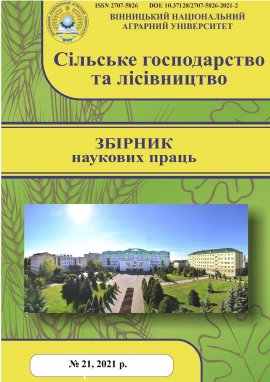
Issue №: 2 (21)
Випуск журнала присвячено вивченню оптимізації технологічних прийомів вирощування сільськогосподарських культур. Розглянуто важливість впливу бобових культур на покращення родючості грунту, екології та охорони навколишнього середовища, методам боротьби із шкодочинними об'єктами, озеленення територій, селекції та насінництва.
PROSPECTS OF GROWING CORN FOR GRAIN FOR BIOETHANOL PRODUCTION
Palamarchuk Vitalii – Doctor of Agricultural Sciences, Associate Professor of the Department of Plant Production, Selection and Bioenergetic cultures (21008, Vinnytsia, Soniachna Str. 3, е-mail: vd-palamarchuk@ukr.net).
Telekalo Nataliу – Candidate of Agricultural Sciences, Associate Professor of the Department of Plant Production, Selection and Bioenergetic cultures (21008, Vinnytsia, Soniachna Str. 3, е-mail: nataliiatelekalo@gmail.com).
The article presents the results of studying the production of bioethanol from corn grain. The research was supposed to study the influence of elements of cultivation technology and vegetation factors on the yield of bioethanol from grain. Field researches were carried out during 2011-2017. on the experimental field of the Department of Plant Growing, Breeding and Bioenergetic Crops of the State Enterprise "Kordelivka" of the Institute of Potato Growing of the NAANU VNAU. The soils of the experimental plot are deep, medium-loamy black soil on loess, the humus content in the arable layer was 4.60%. Field experiments were laid in accordance with the recommendations set out in the "Methodology for field experiments with corn." The climatic conditions of 2011-2017 were favorable for the growth and development of corn, and in 2012 and 2015 were characterized by the limiting factor - humidity, which ultimately affected the productivity of the corn hybrids. The yield of bioethanol from raw materials was calculated as the yield of ethanol - its amount obtained from a ton of fermented carbohydrates in terms of starch. Research has established that the use of such hybrids of the early maturing group as DKS 2971, DKS 2960, DKS 2787, the mid-early group DKS 3472, DKS 3420, DKS 3476 and the mid-ripening group DKS 4964, DK 315, DKS 4626 and DK 440 will significantly increase the yield of bioethanol per unit area. A delay in sowing corn hybrids leads to a decrease in the yield of bioethanol by 0.640-0.847 thousand. l / ha. Foliage fertilizing provided an increase in bioethanol yield, which averaged 0.1-1.04 thousand l / ha relative to control (water feeding), the growth of bioethanol yield with a single foliar top dressing was 0.10-0.65 thousand l / ha , and with double foliar feeding - 0.30-1.04 thousand l / ha in comparison with the control. The highest bioethanol yield was obtained for a double application of Ecolist Mono Zinc microfertilizer in combination with the bacterial preparation Biomag, the growth of which averaged 0.72-0.90 thousand l / ha relative to the control. In 2015, which turned out to be quite arid, the yield of bioethanol, on average, in the studied corn hybrids was 3.622 thousand l / ha, in 2016 - 4.494 thousand l / ha, and in 2017 - 4.230 thousand l / ha. The yield of bioethanol in the group of early-maturing hybrids was 3.365 thousand l / ha, medium-early - 4.096 thousand l / ha and mid-season - 4.885 thousand l / ha. The yield of bioethanol when sowing with seeds of a fine fraction, on average, fluctuated within 2.94-3.78 thousand l / ha, or on average for a fraction of 3.41 thousand l / ha, when sowing with seeds of an average fraction - 3.28- 4.36 thousand l / ha, or on average for a fraction of 3.81, and when sowing with seeds of a coarse fraction - 3.33-4.31 thousand l / ha, or on average for a fraction of 3.84 thousand l / ha. The seeding depth of corn seeds had an ambiguous effect on the yield of bioethanol from the grain, that is, an increase in the seeding depth leads to a decrease in the yield of bioethanol from the sowing unit. So, a significant influence of the studied elements of technology and vegetation factors on the yield of bioethanol in corn hybrids of different ripeness groups has been established.
1.Kaletnik G.M. (2010). Biofuels. Food, energy and ecological security of Ukraine: monograph. [Food, energy and ecological security of Ukraine: monograph]. 516 p. [in Ukrainian].
2.Nagy Janos. (2012). Corn. [Corn]. Vinnytsia. [in Ukrainian].
3.Palamarchuk V.D. (2018). Vplyv hlybyny zahortannia ta fraktsii nasinnia na vmist krokhmaliu u zerni kukurudzy ta vykhid bioetanolu. [Influence of wrapping depth and seed fraction on starch content in corn grain and bioethanol yield]. Visnyk Poltavskoi derzhavnoi ahrarnoi akademii −Bulletin of the Poltava State Agrarian Academy]. 2. 55-65. [in Ukrainian].
4.Prutska O. O. (2010). Derzhavne rehuliuvannia rozvytku rynku biopalyva v Ukraini. [State regulation of biofuel market development in Ukraine]. Visnyk Zaporizhskoho ahrarnoho universytetu −Bulletin of Zaporizhia Agrarian University. 1. 179-182. [in Ukrainian].
5.Kamenshchuk B.D. (2013). Otsinka hibrydiv kukurudzy na prydatnist do vyrobnytstva bioetanolu. [Evaluation of maize hybrids for suitability for bioethanol production]. Ahronom −Agronomist. 3. 162-163. [in Ukrainian].
6.Palamarchuk, V., Honcharuk, I. & Honcharuk, T. et al. (2018). Effect of the elements of corn cultivation technology on bioethanol production under conditions of the right-bank forest-steppe of Ukraine. Ukrainian Journal of Ecology, 8(3), 47-53 [In English].
7.Dudka T.V. (2012). Dotsilnist otrymannia bioetanolu iz zerna kukurudzy. [Expediency of obtaining bioethanol from corn grain]. Sortovyvchennia ta okhorona prav na sorty roslyn − Variety research and protection of plant variety rights. 1. 44-47. [in Ukrainian].
8.Facts on health and the environment. Biofuel yields for different feedstocks. URL: http://www.greenfacts.org/en/biofuels/figtableboxes/biofuel-yields-countries. htm. [In English].
9.Perspektyvy rozvytku rynku bioetanolu v Ukraini. [Prospects for the development of the bioethanol market in Ukraine]. URL: http://saee.gov.ua/sites/ default /files/Schulmeister_bioethanol_1.pdf. [in Ukrainian].
10.Rybalka O.I., Chervonis M.V., Morhun B.V., Pochynok V.M., Polishchuk S.S. (2013). Henetychni ta selektsiini kryterii stvorennia sortiv zernovykh kultur spyrto-dystyliatnoho napriamu tekhnolohichnoho vykorystannia zerna. [Genetic and selection criteria for the creation of varieties of grain crops of alcohol-distillate direction of technological use of grain]. Fyzyolohyia y byokhymyia kult. Rastenyi − Physiology and biochemistry of cultivated plants]. 45. 1. 3-20. [in Ukrainian].
11.Kernasiuk Yu. (2018). Rynok kukurudzy: osnovni trendy. [Corn market: main trends]. Ahrobiznes sohodni −Agribusiness today. 19. 12-14. [in Ukrainian].
12.Palamarchuk, V.D., Polishchuk, I.S. & Yermakova, L.M. et al. (2013). Biolohiia ta ekolohiia silskohospodarskykh Roslyn [Biology and ecology of agricultural plants]. Vinnytsia: FOP Danyliuk [in Ukrainian].
13.Lebid, Ye. M., Tsykov, V. S. & Pashchenko, Yu. M. (et al.) (2008). Metodyka provedennia polovykh doslidiv z kukurudzoiu [Method of conducting field experiments with corn]. Dnipropetrovsk [in Ukrainian].
14.Palamarchuk V.D., Didur I.M., Kolisnyk O.M., Alieksieiev O.O. (2020). Aspekty suchasnoi tekhnolohii vyroshchuvannia vysokokrokhmalnoi kukurudzy v umovakh Lisostepu pravoberezhnoho. [Aspects of modern technology of growing high-starch corn in the right-bank Forest-steppe]. Vinnytsia: Vydavnytstvo «Druk». [in Ukrainian].
15.Blium Ya.B., Heletukha H.H., Hryhoriuk I.P., Dubrovin V.O., Yemets A.I., Zabarnyi H.M., Kaletnik H.M., Melnychuk M.D., Myronenko V.H., Rakhmetov D.B., Tsyhankov S.P. (2010). Novitni tekhnolohii bioenerhokonversii: Monohrafiia. [The latest technologies of bioenergy conversion: Monograph]. K.: «Ahrar Media Hrup». [in Ukrainian].
About the journal
Cluster Agricultural and veterinary sciences (H1 Agronomy, H4 Forestry)
Name of the publication «AGRICULTURE AND FORESTRY»
The aim of the journal "Agriculture and Forestry" is to highlight the results of fundamental and applied research in the fields of agriculture and forestry, aimed at improving the efficiency of agricultural production and introducing modern technologies into farming practice.
This goal defines the main objectives:
– to ensure the creation of open information access regarding the dissemination of relevant scientific research results to: lecturers of agricultural higher education institutions, postgraduate students, doctoral candidates, research staff, and agricultural production specialists;
– to promote the development of young scientists in agricultural sciences;
– to enhance communication between experienced researchers and young scientists in agronomy and forestry;
– to facilitate the expansion of ties between Vinnytsia National Agrarian University and domestic and foreign educational institutions, scientific establishments, and their academic communities.
The scientific, production, and educational journal "Agriculture and Forestry" is a peer-reviewed open-access publication that publishes original experimental research, theoretical and practice-oriented articles within the cluster of "Agricultural and Veterinary Sciences".
The journal's subject matter covers such areas as agronomy and forestry. Publications of scientific and practical significance address the experimental foundations of agricultural and forestry sector development, innovative production technologies, and the results of fundamental and applied research aimed at increasing productivity, product quality, and the sustainable development of natural and production systems.
Publisher: Vinnytsia National Agrarian University
EDRPOU code: 00497236
Publisher's ROR:05m3ysc06
Prefix DOI: 10.37128/
Frequency is quarterly
Publication languages: (Ukrainian, English)
Media ID R30-05174.
Editor in Chief Ihor Didur
According to the order of the Ministry of Education and Science of Ukraine dated 17.03.2020 № 409. The journal Agriculture and Forestry is included in the List of scientific professional publications of Ukraine Category "B" in agricultural sciences (specialties) - 101, 201, 202, 203, 205, 206.
State registration: Decision of the National Council of Ukraine on Television and Radio Broadcasting No. 1337 and No. 1181. Media identifier – R30-05174.
Scientific journal "AGRICULTURE AND FORESTRY" was founded in 1995; it was entitled as Bulletin of Vinnytsya State Agricultural Institute.
In 2010-2014 was enritled as Collection of scientific works of Vinnytsia National Agrarian University.
It has been named as Agriculture and Forestry since 2015.
Listed in the updated list of scientific professional editions of Ukraine on agricultural sciences under the name Agriculture and Forestry (Order of the Ministry of Education and Science of Ukraine of May 16, 2016; No. 515).
Since 2015, "Agriculture and Forestry". (archive of previous issues for 2015-2019) at http://forestry.vsau.edu.ua/.
The journal “Agriculture and Forestry (ISSN: 2707-5826)” passed the evaluation process of Index Copernicus positively and is indexed in the database of ICI Journals Master List ICV for 2018, 2019, 2020, 2021, 2022, 2023, 2024 is presented in the full list of indexed journals in the Master List International List
ICI Journals Master List Value
