

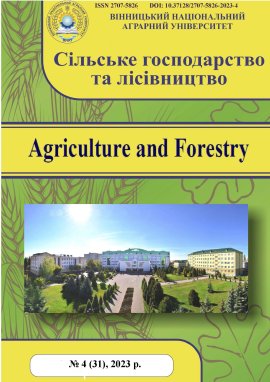
Issue №: 4 (31)
This issue of the "Agriculture and Forestry" magazine highlights the results of research on soybean varieties based on the genetic determination of traits in cross-breeding, optimization of technological techniques for growing agricultural crops, rational nature management, preservation of soil fertility, reproduction of forest resources.
PROSPECTS FOR GROWING PLANTS OF THE GENUS EUSTOMA L. IN PROTECTED GROUND
Vdovenko Serhiy Anatoliyovych – Doctor of Agricultural Sciences, Professor of the Department of Forestry, Horticulture and Viticulture of Vinnytsia National Agrarian University (21008, Vinnytsia, 3 Sonyachna Street. e-mail: sloi@i.ua).
Mykhailo Vasyliovych Matusiak – head of the department, associate professor of forestry, horticulture, horticulture and viticulture at Vinnytsia National Agrarian University (21008, Vinnytsia, 3 Sonyachna Street. email: mikhailo1988@gmail.com)
Danyliuk Boris Mykolayovych – regional sales manager, LLC «NPC Ukraine».
The article presents the results of studies on the cultivation of Eustoma L. plants in closed ground conditions on different substrates. As a result of the cultivation, the influence of the substrate on the passage of the main phenological phases of plant growth and development was determined, as well as data on the effect on plant height and flower diameter of different varieties. Four substrates were used in the study, namely: Domoflor; Compo; Peatfield; Generous soil and seven varieties of the genus Eustoma were studied: Aurora, Echo, Heidi, Flamenco, Mermaid, LittleBell, Florida Pink. It was found that growing plants of Eystoma L. varieties on substrates increases the duration of flowering from 3.39 % to 8.96 %, and accelerates flowering by several days. The size of the flower is a characteristic feature of the Eustoma species. The larger the flower size, the better the growing conditions. Most Eustoma varieties are characterized by the formation of flowers with a relatively large diameter. As a result of growing Echo and Florida Pink varieties, the flower diameter was the smallest and amounted to only 5 cm and was 3 cm or 37% less than the flower diameter of Aurora. A slight increase in flower diameter, relative to Echo and Florida Pink, but less than Aurora, was found for Echo, Heidi, Mermaid and LittleBell. In these variants, the flower diameter was at the level of 6-7 cm. The large size of the flower and similar diameter relative to the control was characterized by the variety Flamenco. The flower diameter of this variety was 8 cm. The use of the Compo substrate for growing tall flowers gave the highest plant height of 98 cm (+18.8 %), and in the case of short flowers 15.3 cm (+15 %) relative to the substrates: Domoflor – 89.5 cm (+8.5 %) for tall varieties and 14.3 cm (+7.5 %) for short varieties, Peatfield – 91.2 cm (+10.6 %) for tall varieties and 14.3 cm (+7.5 %) for short varieties, and on the substrate Generous Earth the plant height was 88 cm (+6.6 %) for tall flowers and 14.3 cm (+7.5 %) for short varieties. Experiments have shown that the substrate does not have a significant effect on flower diameter, with the exception of the Compo. In this variant, an increase of +2.1 % was found in the overall study, while in other substrates the indicator increased only by +0.76 %. Despite the different plant heights, the number of peduncles and buds on the experimental plants was almost the same. Their total number was in the range of 25-34 pcs. The largest number of buds was characterized by the varieties Eustoma, Echo and Heidi. In these variants, the total number of buds was 33 pcs. The same number of buds was characterized by the varieties Flamenco, Mermaid and Little Bell. As a result of growing the Florida Pink variety, the number of buds was the smallest and amounted to only 25 pcs. In terms of substrate use, the best performance was characterized by the Compo substrate, which on average had 1 more bud than the control (+3.5 %), while other substrates had slightly lower rates of increase in the number of buds, where their value ranged from (1-2 %).
1. Bilorusets Ye.Sh., Hyl L.S. (1994). Kvitnykarstvo zakhyshchenoho gruntu [Floriculture of protected soil]. Urozhai – Harvest. [in Ukrainian].
2. Matusiak M.V. (2019) Doslidzhennia ta analiz skladu travianoho pokryvu fitotsenoziv m. Vinnytsia na prykladi okremykh dilianok lisoparku ta botanichnoho sadu VNAU [Research and analysis of the composition of the herbaceous cover of phytocenoses in the city of Vinnytsia on the example of individual sections of the forest park and the botanical garden of VNAU]. Molodyi vchenyi – A young scientist. №3 (67). 224-228. [in Ukrainian].
3. Mykhalska O.M., Beldii N.M., Demianiuk O.S. (2013). Ahroekolohichna otsinka zastosuvannia rehuliatoriv rostu roslyn dlia vyroshchuvannia ovochevykh kultur [Agroecological assessment of the use of plant growth regulators for growing vegetable crops]. Ahroekolohichnyi zhurnal – Agroecological journal. № 2. 71-79. [in Ukrainian].
4. Prylipka O.V. (2008). Innovatsiinyi rozvytok efektyvnoho funktsionuvannia pidpryiemstv zakrytoho gruntu: teoriia, metodolohiia, praktyka [Innovative development of effective functioning of closed-ground enterprises: theory, methodology, practice]. PP R.K.Maister-prynt – PP R.K. Master print. [in Ukrainian].
5. Prylipka O.V. (2002). Teplychne ovochivnytstvo [Greenhouse vegetable growing]. Urozhai – Harvest. [in Ukrainian].
6. Rudska N.O., Pinchuk N.V., Vatamaniuk O.V. (2020). Lisova entomolohiia [Forest entomology]. TOV «Tvory» – Tvori LLC. [in Ukrainian].
7. Slieptsov Yu.V., Yakubenko V.D. (2014). Kvitnykarstvo zakrytoho hruntu [Indoor floriculture]. TOV «NilanLTD» – LLC "NilanLTD". [in Ukrainian].
8. Slieptsov Yu.V., Yakubenko B.E., Bohdanova V.D., Pozdniakov I.O., Andrusyk R.V. (2014). Kvitnykarstvo zakrytoho gruntu [Indoor floriculture]. Navchalnyi posibnyk – Tutorial. [in Ukrainian].
9. Chaika V.O. (2015). Stratehiia rozvytku ovochivnytstva zakhyshchenoho gruntu v umovakh asotsiatsii z YeS [Strategy for the development of vegetable growing in protected soil under the conditions of association with the EU]. Ekonomichnyi visnyk PereiaslavKhmelnytskoho derzhavnoho pedahohichnoho universytetu im. Hryhoriia Skovorody – Economic Bulletin of Pereyaslav Khmelnytskyi State Pedagogical University named after Grigory Skovorody. № 27 (1). 72-77. [in Ukrainian].
10.Cherevchenko T.M. (1997). Vyhonka kvitkovykh roslyn v zakrytomu grunti [Distillation of flowering plants in closed soil]. Наукова думка – Scientific thought. [in Ukrainian].
11.Shapoval O.A. Vakulenko V.V. (2009). Rehuliatory rostu roslyn dlia ovochevykh kultur [Plant growth regulators for vegetable crops]. Naukovo - doslidnyi instytut im. D.I. Prianishnikova – Scie tific Research Institute named after D.I. Pryanishnikova. № 3. 14-15. [in Ukrainian].
12.Yakovenko K. I. (2001) Suchasni tekhnolohii v ovochivnytstvi [Modern technologies in vegetable growing]. IOB UAAN – IOB of the Ukrainian Academy of Sciences. [in Ukrainian].
About the journal
Cluster Agricultural and veterinary sciences (H1 Agronomy, H4 Forestry)
Name of the publication «AGRICULTURE AND FORESTRY»
The aim of the journal "Agriculture and Forestry" is to highlight the results of fundamental and applied research in the fields of agriculture and forestry, aimed at improving the efficiency of agricultural production and introducing modern technologies into farming practice.
This goal defines the main objectives:
– to ensure the creation of open information access regarding the dissemination of relevant scientific research results to: lecturers of agricultural higher education institutions, postgraduate students, doctoral candidates, research staff, and agricultural production specialists;
– to promote the development of young scientists in agricultural sciences;
– to enhance communication between experienced researchers and young scientists in agronomy and forestry;
– to facilitate the expansion of ties between Vinnytsia National Agrarian University and domestic and foreign educational institutions, scientific establishments, and their academic communities.
The scientific, production, and educational journal "Agriculture and Forestry" is a peer-reviewed open-access publication that publishes original experimental research, theoretical and practice-oriented articles within the cluster of "Agricultural and Veterinary Sciences".
The journal's subject matter covers such areas as agronomy and forestry. Publications of scientific and practical significance address the experimental foundations of agricultural and forestry sector development, innovative production technologies, and the results of fundamental and applied research aimed at increasing productivity, product quality, and the sustainable development of natural and production systems.
Publisher: Vinnytsia National Agrarian University
EDRPOU code: 00497236
Publisher's ROR:05m3ysc06
Prefix DOI: 10.37128/
Frequency is quarterly
Publication languages: (Ukrainian, English)
Media ID R30-05174.
Editor in Chief Ihor Didur
According to the order of the Ministry of Education and Science of Ukraine dated 17.03.2020 № 409. The journal Agriculture and Forestry is included in the List of scientific professional publications of Ukraine Category "B" in agricultural sciences (specialties) - 101, 201, 202, 203, 205, 206.
State registration: Decision of the National Council of Ukraine on Television and Radio Broadcasting No. 1337 and No. 1181. Media identifier – R30-05174.
Scientific journal "AGRICULTURE AND FORESTRY" was founded in 1995; it was entitled as Bulletin of Vinnytsya State Agricultural Institute.
In 2010-2014 was enritled as Collection of scientific works of Vinnytsia National Agrarian University.
It has been named as Agriculture and Forestry since 2015.
Listed in the updated list of scientific professional editions of Ukraine on agricultural sciences under the name Agriculture and Forestry (Order of the Ministry of Education and Science of Ukraine of May 16, 2016; No. 515).
Since 2015, "Agriculture and Forestry". (archive of previous issues for 2015-2019) at http://forestry.vsau.edu.ua/.
The journal “Agriculture and Forestry (ISSN: 2707-5826)” passed the evaluation process of Index Copernicus positively and is indexed in the database of ICI Journals Master List ICV for 2018, 2019, 2020, 2021, 2022, 2023, 2024 is presented in the full list of indexed journals in the Master List International List
ICI Journals Master List Value
