

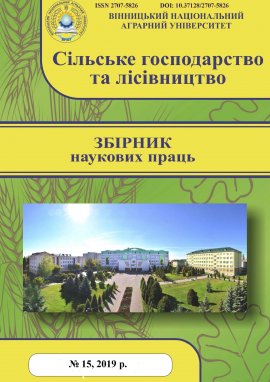
Issue №: 4 (15)
Publications are devoted to the reserch of technological methods of cultivation of crops, preservation of soil fertility, through the cultivation of perennial grasses and legumes, alternatives to the marginal lands utilization, greening agricultural production, the use of selection indices for the identification of source material, reproduction.
PLASTICITY AND STABILITY OF LEGUMINOUS CROPS ACCORDING TO ECONOMICALLY VALUABLE TRAITS AND SELECTION INDICES
Mazur Oleksandr – Candidate of Agricultural Sciences, Associate Professor of the Department of Plant Production, Selection and Bioenergetic Cultures, Vinnytsia National Agrarian University (21008, Vinnytsia, Soniachna Str. 3, e-mail: selection@vsau.vin.ua).
Mazur Olena – Candidate of Agricultural Sciences, Аssistant of the Department of Plant Growing, Breeding and Bioenergetic Cultures, Vinnytsia National Agrarian University (21008, Vinnytsia, Soniachna Str. 3).
Creating modern competitive varieties of crops requires a breeder combination in one genotype of high genetic potential with a favorable response rate to environmental conditions. The high variability of traits, due to the diversity of genotypes, indicates the possibility of their change in the desired direction at different stages of the breeding process.
The varieties of common beans were distinguished by the number of productive nodes,i.e. UD0302642 – 5.2 pcs., UD0302683 – 4.8 pcs., UD0303533 – 4.75 pcs. These regression coefficients were classified as highly plastic – (bi> 1). The highest indexes of the selection index (seed weight / number of beans per plant) were obtained from the common bean varieties, i.e. UD0300658 – 0.8, UD0302746 – 0.69, UD0302256 and UD0300565 – 0.62. These varieties belong to different genotypes in response to hydrothermal regime change. The highest indexes of selection index (seed weight / number of seeds per plant) provided varieties of common beans, which were characterized by high response to the improvement of hydrothermal regime, UD0300658 – 0.27, UD0300232 – 0.21 and UD0302256 – 0.2.
The number of productive nodes is an important feature that determines the grain productivity of soybean varieties, the number of productive units determines the number of beans and seeds per plant. According to the number of productive nodes on the plant, soybean variety samples were distinguished, i.e. UD0202563 – 14.0 pcs., UD0200983 – 13.6 pcs., UD0202201 – 13.6 pcs., UD0202529 – 13.6 pcs. The high number of seeds on the plant, as well as the number of beans, provided varieties of soybeans, which were highly plastic in response to the improvement of the hydrothermal regime and conservative to change agrophone cultivation. The high-plastic varieties included UD0202201, UD0202563, UD0202566. Conservative agrophone replacement cultivation included UD0200983 and UD0202529. Higher grain productivity was provided by soybean varieties: UD0202566 – 5.6 g, UD0202201 – 5.5 g, UD0202557 – 5.4 g, UD0202529 – 5.4 g. These varieties according to the parameters of adaptability and stability were treated as highly plastic UD0202566, UD0202201, UD0202557, so with a conservative reaction to the change in cultivation agrophone – UD0202529.
Key words: varieties of beans, soybeans, adaptability parameters, plasticity coefficient, agronomic stability, stability variant.
1.Kuzmina S.P., Kazyidub N.G., Demyanenko K.A., Burlakov A.A. (2016) Ekologicheskaya plastichnost kollektsionnyih obraztsov nuta v yuzhnoy Lesostepi Omskoy oblasti. [Ecological plasticity of chickpea collection samples in the southern forest-steppe of Omsk region]. Mezhdunarodnyiy nauchno-issledovatelskiy zhurnal – International research journal. 3 (45). Ch. 3. S. 102–105 URL: DOI: 10.18454/IRJ.2016.45.143. [in Russian].
2.Dyakov A.B., Vasyleva T. A. (2007). Byometrycheskye ocenky adaptyvnosty sortov soy [Biometric evaluation of adaptability of soybean varieties]. Maslychnye kultury : nauchno-texnycheskyj byul – Oilseeds: scientific and technical bulletin. VNYYMK. Issue. 1 (136). 31-41. [in Russian].
3.Lytun P. P., Shevchenko M. V., Subota G. M. (1982). Plastichnost genotipov v ekologicheskih opyitah prostoy struktury [Plasticity of genotypes in ecological experiments simple structure]. Selekcyya y semenovodstvo – Breeding and seed production. Kyiv : Urozhaj Issue. 50. 11-15. [in Russian].
4.Vavylov N. Y. (1965). Problema y sxodnogo materyala : y zbrannыe trudы v 5-ty t. Problema ishodnogo materiala [The problem is the source material]: M–L., 1965. Vol. 5. [in Russian].
5.Petrenkova V.P., Sokol T.V., Luchna I.S. (2013). Teoretychni osnovy selekciyi zernobobovyx kultur na stijkist do shkidlyvyx organizmiv [Theoretical foundations of breeding legumes for resistance to pests]. NAAN, In-t roslynnycztva im. V.Ya. Yuryeva. Kharkiv: Kolegium [in Ukrainian].
6.Monarx V.V., Gorodyska I.M., Lishhuk A.M., Chub A.O. (2018). Osoblyvosti organichnogo nasinnycztva soyi v konteksti yevrointegraciyi Ukrayiny [Features of the organic seed production of soybean in the context of European integration of Ukraine]. Zbirnyk naukovyx pracz. Silske gospodarstvo ta lisivnycztvo – Collection of scientific works. Agriculture and forestry. 2018. 9. 89-101 [in Ukrainian].
7.Kobyzyeva L.N. (2016). Metodychni rekomendaciyi z vyvchennya genetychnyx resursiv zernobobovyx kultur [Methodical recommendations for studying genetic resources of leguminous plants]. NAAN, Instytut roslynnycztva im. V.Ya. Yuryeva. Kharkiv: Stil-Izdat. [in Ukrainian].
8.Eberhart S. A., Russel W. A. (1966). Stability parameters for comparing varieties. Crop Sci. Vol. 6, 1, 34-40. [in English].
9.Xangyldyn V. V., Lytvynenko N. A. (1981). Gomeostatychnost y adaptyvnost sortov ozymoj pshenyczy [Homeostasis and adaptability of winter wheat varieties]. scientific and technical. bullet VSGI]. Nauchn.-texn. byul. VSGY. – Scientific and technical. bullet VSGI. Issue 39, 8-14. [in Russian].
10.Sichkar V.I., Lavrova G.D., Ganzhelo O.I. (2014). Urozhajnist i yakist nasinnya shyrokoadaptovanyx sortiv soyi [Seed yield and quality of widely adapted soybean varieties]. Zb. nauk. pr. Selekcijno-genetychnogo instytutu – Collection ofscientific works of the Breeding and Genetic Institute. Issue. 23. 72-87. [in Ukrainian].
About the journal
Cluster Agricultural and veterinary sciences (H1 Agronomy, H4 Forestry)
Name of the publication «AGRICULTURE AND FORESTRY»
The aim of the journal "Agriculture and Forestry" is to highlight the results of fundamental and applied research in the fields of agriculture and forestry, aimed at improving the efficiency of agricultural production and introducing modern technologies into farming practice.
This goal defines the main objectives:
– to ensure the creation of open information access regarding the dissemination of relevant scientific research results to: lecturers of agricultural higher education institutions, postgraduate students, doctoral candidates, research staff, and agricultural production specialists;
– to promote the development of young scientists in agricultural sciences;
– to enhance communication between experienced researchers and young scientists in agronomy and forestry;
– to facilitate the expansion of ties between Vinnytsia National Agrarian University and domestic and foreign educational institutions, scientific establishments, and their academic communities.
The scientific, production, and educational journal "Agriculture and Forestry" is a peer-reviewed open-access publication that publishes original experimental research, theoretical and practice-oriented articles within the cluster of "Agricultural and Veterinary Sciences".
The journal's subject matter covers such areas as agronomy and forestry. Publications of scientific and practical significance address the experimental foundations of agricultural and forestry sector development, innovative production technologies, and the results of fundamental and applied research aimed at increasing productivity, product quality, and the sustainable development of natural and production systems.
Publisher: Vinnytsia National Agrarian University
EDRPOU code: 00497236
Publisher's ROR:05m3ysc06
Prefix DOI: 10.37128/
Frequency is quarterly
Publication languages: (Ukrainian, English)
Media ID R30-05174.
Editor in Chief Ihor Didur
According to the order of the Ministry of Education and Science of Ukraine dated 17.03.2020 № 409. The journal Agriculture and Forestry is included in the List of scientific professional publications of Ukraine Category "B" in agricultural sciences (specialties) - 101, 201, 202, 203, 205, 206.
State registration: Decision of the National Council of Ukraine on Television and Radio Broadcasting No. 1337 and No. 1181. Media identifier – R30-05174.
Scientific journal "AGRICULTURE AND FORESTRY" was founded in 1995; it was entitled as Bulletin of Vinnytsya State Agricultural Institute.
In 2010-2014 was enritled as Collection of scientific works of Vinnytsia National Agrarian University.
It has been named as Agriculture and Forestry since 2015.
Listed in the updated list of scientific professional editions of Ukraine on agricultural sciences under the name Agriculture and Forestry (Order of the Ministry of Education and Science of Ukraine of May 16, 2016; No. 515).
Since 2015, "Agriculture and Forestry". (archive of previous issues for 2015-2019) at http://forestry.vsau.edu.ua/.
The journal “Agriculture and Forestry (ISSN: 2707-5826)” passed the evaluation process of Index Copernicus positively and is indexed in the database of ICI Journals Master List ICV for 2018, 2019, 2020, 2021, 2022, 2023, 2024 is presented in the full list of indexed journals in the Master List International List
ICI Journals Master List Value
