

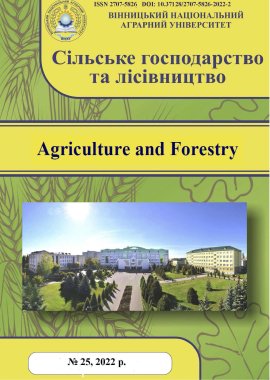
Issue №: 2 (25)
The issue of the magazine is devoted to the study of the optimization of the elements of the technology of growing agricultural crops. An important role is given to the influence of leguminous crops on improving soil fertility, adaptive breeding, mineral and foliar fertilization of agricultural crops, ecology and environmental protection, in particular, the impact of chemical treatment on the contamination of soil and grain products with pesticides, methods of combating harmful objects.
PHYTOSANITARY STATE OF THE AGROECOSYSTEM OF WINTER WHEAT DEPENDING ON THE PREDECESSORS OF PERENNIAL LEGUMINOUS GRASSES
Tkachuk Оleksander Petrovich - Doctor of Agricultural Sciences, Associate Professor of the Department of Ecology and Environmental Protection of Vinnitsa National Agrarian University (Str. Sunny, 3, Vinnitsa city, 21008. tel. 0679546095. e-mail: tkachukop@ukr.net).
Kravets Ruslan Andriyovych - Doctor of Pedagogical Sciences, Associate Professor, Head of the Department of Ukrainian and Foreign Languages, Vinnytsia National Agrarian University (Street Pirogov, 3, Vinnytsia, 21018. tel. 0686608638. e-mail: krawezj@ukr.net).
The article deals with the issues of increasing the resistance of winter wheat crops to the effects of the most common diseases, weeds and pests for growing after the predecessors of six types of perennial leguminous grasses without using pesticides. The damage caused to the leaf surface of winter wheat by septoria and powdery mildew diseases has been shown. The number of cockchafer larvae has been analysed. Determining the predominant types of weeds in the context of predecessors the level of weed infestation of winter wheat crops has been researched. The level of winter wheat yield depending on its predecessors has been assessed and correlation-regression dependences between it and the spread of pests, diseases and weeds in their crops have been identified. A close correlation between winter wheat yield and the damage caused to the leaf surface by powdery mildew has been proved. It has been shown that the highest level of winter wheat yield is observed after meadow clover. The slightest damage to the leaf surface of winter wheat caused by powdery mildew has been found after the predecessor of meadow clover. After the predecessor of white sweet clover the damage caused to the winter wheat’s leaf surface by the septoria disease was minimal. During the sowing season of winter wheat, no cockchafer larvae were found in the arable layer of soil after the predecessors of alfalfa, white sweet clover and fodder galega. The smallest number of weeds during the spring growth of winter wheat was found after the predecessor of white sweet clover. Meadow clover provides the highest productivity level of the winter wheat yield in case of cultivation after six types of perennial leguminous grasses without additional use of mineral fertilisers – 5,8 t/ha. The minimal damage to the leaf surface of winter wheat plants caused by powdery mildew Erysiphe graminis DC has been found after the meadow clover predecessor – 6%, without using fungicides. The damage to the leaf surface of winter wheat from Septoria tritici Mg disease without fungicides was the smallest after white sweet clover – 5%. During the sowing season of winter wheat no cockchafer larvae Melolontha melolontha L. has been disclosed in the arable layer of the soil after alfalfa, white sweet clover and fodder galega predecessors. The smallest number of weeds in the period of spring growth of winter wheat has been observed after white sweet clover predecessor – 12 pcs/m2.
1.Melnik P.P., Chaika V.M. (2002). Evaluation of economic efficiency of plantprotection measures (on the example of winter wheat). Plant protection and quarantine. № 48. 224. [in Ukrainian].
2.Zelenets O.A., Meshko V.A., Maliuchenko A.G., Kovalenko N.P., PospelovaG.D. (2019). Problems of phytosanitary condition of wheat crops and ways to solve them. Proceedings of the III International Scientific and Practical Internet Conference «Effective functioning of ecologically stable areas in the context of sustainable development strategy: agro-environmental, social and economic aspects». December 12, 2019 Poltava. Poltava. 44 – 48. [in Ukrainian].
3.Retman S.V. (2008). Phytopathogenic complex of winter wheat in the Forest-Steppe of Ukraine. Quarantine and plant protection. № 4. P. 5. [in Ukrainian].
4.Kosilovich G.E., Vashchishin R.P. (2013). The effectiveness of the use of newpesticides to protect winter wheat from diseases and pests. Bulletin of Lviv National Agrarian University: agronomy. № 17 (2). P. 344–350. [in Ukrainian].
5.Retman S.V., Storchous I.M., Babich S.M. (2006). Winter wheat. Crop protection technology taking into account the specific phytosanitary situation. Quarantine and plant protection. № 9. 7–12. [in Ukrainian].
6.Fedorenko V.P., Retman S.V. (2009). Current issues of crop protection. Quarantine and plant protection. № 3. P. 1 – 5. [in Ukrainian].
7.Moiseychenko V.F., Yeshchenko V.O. (1994). Fundamentals of scientific research in agronomy. K.: Higher school. [in Ukrainian].
8.Plonsak V.A. (2007). Phytopharmacology. Part 3. Workshop on phytopharmacology. Vinnytsia: RVV VSAU, 196 p. [in Ukrainian].
9.Ushkarenko V.A., Polyakov N.N. (1997). Mathematical analysis of fieldexperience data. Kherson: SHI, 82 p. [in Ukrainian].
10.Vergunova I.M. (2000). Fundamentals of mathematical modelling foranalysis and forecasting of agronomic processes. K.:Nora-print, 146 s. [in Ukrainian].
About the journal
Cluster Agricultural and veterinary sciences (H1 Agronomy, H4 Forestry)
Name of the publication «AGRICULTURE AND FORESTRY»
The aim of the journal "Agriculture and Forestry" is to highlight the results of fundamental and applied research in the fields of agriculture and forestry, aimed at improving the efficiency of agricultural production and introducing modern technologies into farming practice.
This goal defines the main objectives:
– to ensure the creation of open information access regarding the dissemination of relevant scientific research results to: lecturers of agricultural higher education institutions, postgraduate students, doctoral candidates, research staff, and agricultural production specialists;
– to promote the development of young scientists in agricultural sciences;
– to enhance communication between experienced researchers and young scientists in agronomy and forestry;
– to facilitate the expansion of ties between Vinnytsia National Agrarian University and domestic and foreign educational institutions, scientific establishments, and their academic communities.
The scientific, production, and educational journal "Agriculture and Forestry" is a peer-reviewed open-access publication that publishes original experimental research, theoretical and practice-oriented articles within the cluster of "Agricultural and Veterinary Sciences".
The journal's subject matter covers such areas as agronomy and forestry. Publications of scientific and practical significance address the experimental foundations of agricultural and forestry sector development, innovative production technologies, and the results of fundamental and applied research aimed at increasing productivity, product quality, and the sustainable development of natural and production systems.
Publisher: Vinnytsia National Agrarian University
EDRPOU code: 00497236
Publisher's ROR:05m3ysc06
Prefix DOI: 10.37128/
Frequency is quarterly
Publication languages: (Ukrainian, English)
Media ID R30-05174.
Editor in Chief Ihor Didur
According to the order of the Ministry of Education and Science of Ukraine dated 17.03.2020 № 409. The journal Agriculture and Forestry is included in the List of scientific professional publications of Ukraine Category "B" in agricultural sciences (specialties) - 101, 201, 202, 203, 205, 206.
State registration: Decision of the National Council of Ukraine on Television and Radio Broadcasting No. 1337 and No. 1181. Media identifier – R30-05174.
Scientific journal "AGRICULTURE AND FORESTRY" was founded in 1995; it was entitled as Bulletin of Vinnytsya State Agricultural Institute.
In 2010-2014 was enritled as Collection of scientific works of Vinnytsia National Agrarian University.
It has been named as Agriculture and Forestry since 2015.
Listed in the updated list of scientific professional editions of Ukraine on agricultural sciences under the name Agriculture and Forestry (Order of the Ministry of Education and Science of Ukraine of May 16, 2016; No. 515).
Since 2015, "Agriculture and Forestry". (archive of previous issues for 2015-2019) at http://forestry.vsau.edu.ua/.
The journal “Agriculture and Forestry (ISSN: 2707-5826)” passed the evaluation process of Index Copernicus positively and is indexed in the database of ICI Journals Master List ICV for 2018, 2019, 2020, 2021, 2022, 2023, 2024 is presented in the full list of indexed journals in the Master List International List
ICI Journals Master List Value
