

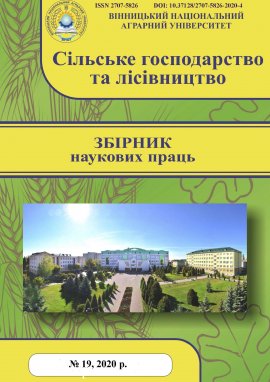
Issue №: 4 (19)
The issue of the journal deals with the study of optimization of technological methods of growing crops using of drugs of biological origin. A special role is given to the influence of perennial grasses on the improvement of soil fertility, ecological-adaptive selection, peculiarities of vegetable growing, ecology and environmental protection, introduction of ornamental plants.
INFLUENCE OF THE LEVEL OF WATER MINERALIZATION ON THE CONCENTRATION OF HEAVY METALS IN MUSHROOMS
Vradiy Oksana Ihorivna – assistant of the Department of Ecology and Environmental Protection, Vinnytsia National Agrarian University (21008, Vinnytsia, 3, Soniachna St., e-mail: oksanavradii@gmail.com).
The current ecological condition of forest plantations has been characterized by high anthropogenic load as a result of population activity. The consequences of the human impact have been manifested in the disturbance of natural landscapes, air pollution, hydrosphere, destruction of the lithosphere, uncontrolled depletion of forest resources, resulting in a decrease and extinction of a huge number of species of animals and plants. In the result of various industries’ work chemical compounds have been formed, which have been transformed into the biosphere and enter all living organisms. Therefore, there are serious problems in the relationship between nature and man. The human impact on the environment is extremely powerful and it is obvious that the biosphere as a result of this impact loses the ability to self-regulate and it does not allow it to function properly. One of the current environmental problems that threatens plants, animals and human health and the quality of the environment is heavy metal pollution. These substances gradually enter plants, animals and humans through the air, water and food chain over a period of time [4]. Toxicity of metals has a direct effect on flora, which is an integral part of ecosystems. These effects lead to changes in the biochemical, physiological and metabolic processes that take place in plants that grow directly in areas with high levels of heavy metals. Samples of edible forest mushrooms were taken on the territory of forests of Tyvriv, Vinnytsia and Kalyniv districts in the Forest-Steppe of the Right Bank of Ukraine. Studies of the concentration of heavy metals were performed in the research and measurement agrochemical laboratory of the Department of Ecology and Environmental Protection, Faculty of Agronomy and Forestry on the basis of Vinnytsia National Agrarian University. The concentrations of Cu, Zn, Pb and Cd of the studied fungi were determined by atomic absorption spectrometry after dry mineralization. Studies of the effect of cooking on the concentration of heavy metals in mushrooms were carried out according to the following scheme: 1. control option: mushrooms, cleaned and washed with tap water; 2. option 1: mushrooms soaked for 3 hours in water without mineral residue; 3. mushrooms soaked for 3 hours in water without mineral residue with the addition of salt (1 kg of mushrooms – 1 liter of water and 10 g of salt). The effect of soaking mushrooms in water without mineral residue with the addition of salt was studied. It was found that when soaking mushrooms for 3 hours in water without mineral residue, the concentration of zinc in them decreased: from 1.02 to 1.37 times; copper - from 1.14 to 1.5 times; lead - from 1.09 to 1.13 times; cadmium - from 1.3 to 1.5 times. When soaking mushrooms for 3 hours in water without mineral residue with the addition of salt, the concentration of zinc in them decreased: from 1.23 to 1.28 times; copper - from 1.2 to 1.36 times; lead - from 1.31 to 1.38 times; cadmium - from 1.41 to 1.6 times.
1.Minienko H.M., Shevyrova H.H. (2017). Stan lisovykh ekosystem v umovakhantyterorystychnoi operatsii na skhodi Ukrainy [State of forest ecosystems in the conditions of anti-terrorist operation in the east of Ukraine]. Vseukrainska naukovo-praktychna konferentsiia «Vidtvorymo lisy razom» – «Let's recreate the forests together». Zbirnyk tez / za zah. red. d. p. n., profesora V. V. Verbytskoho. Kyiv: «NENTs», 35–38 [in Ukrainian].
2.Derzhavne ahentstvo lisovykh resursiv Ukrainy (2018). [State Agency of ForestResources of Ukraine]. URL: http://dklg.kmu.gov.ua/forest/control/uk/publish / article?art_id=62921 (data zvernennia: 12.03.2018) [in Ukrainian].
3.Zamula Kh.P. (2013). Suchasnyi stan vedennia lisovoho hospodarstva v Ukraini [Thecurrent state of forestry in Ukraine]. Ahrosvit – Agrosvit, Issue. 19. 54-59 [in Ukrainian].
4.Publichnyi zvit za 2016 rik (2016). [Public report for 2016]. Derzhavne ahentstvolisovykh resursiv. Kyiv. [in Ukrainian].
5.Myhal A.V., Bokoch V.V. Nederevni resursy (2017). [Non-timber resources]:navch. Posib. Vyd-vo UzhNU «Hoverla». Uzhhorod. [in Ukrainian].
6.Tkachuk O.P., Yakovets L.A. (2016). Osoblyvosti zabrudnennia zernovoi produktsiivazhkymy metalamy v umovakh Vinnytskoi oblasti [Features of contamination of grain products with heavy metals in the Vinnytsia region]. Zbirny`k naukovy`x pracz` VNAU. Sil`s`ke gospodarstvo ta lisivny`cztvo − Collection of scientific works of VNAU. Agriculture and forestry. № 4. 179-186 [in Ukrainian].
7.Storozhuk T.M., Druzhynska N.S. (2015). Udoskonalennia klasyfikatsii lisovykhresursiv. [Improving the classification of forest resources]. Biznes Inform – Business Inform. Issue 7. [in Ukrainian].
8.Poriadok zahotivli druhoriadnykh lisovykh materialiv i zdiisnennia pobichnykhlisovykh korystuvan v lisakh Ukrainy vid 23 kvit. (1996). [Procedure for harvesting secondary forest materials and carrying out secondary forest uses in the forests of Ukraine 23 apr. (1996)]. № 449. [in Ukrainian].
9.Shcherbachenko O.I. (2014). Vazhki metaly yak toksychnyi faktor zabrudnenniapryrodnoho seredovyshcha. Stiikist i adaptatsiia roslyn do yikh vplyvu. [Heavy metals as a toxic factor in environmental pollution. Resistance and adaptation of plants to their influence]. Naukovi zapysky derzhavnoho pryrodoznavchoho muzeiu – Scientific notes of the State Natural History Museum. Issue. 30. 157-182 [in Ukrainian].
10.Kupchyk O.Iu. (2016). Vyznachennia koreliatsii mizh vmistom vazhkykh metaliv uproduktakh roslynnytstva ta hrunti pry ekolohichnomu monitorynhu. [Determination of the correlation between the content of heavy metals in crop products and soil in environmental monitoring]. Ekolohichna bezpeka ta zbalansovane resursovykorystannia – Environmental safety and balanced resource use. №1 (13). 85-91 [in Ukrainian].
11.Matchuk S.F. (2014). Klasyfikatsiia lisovykh resursiv. [Classification of forestresources]. Naukovyi visnyk Khersonskoho derzhavnoho universytetu. Seriia: Yurydychni nauky – Scientific Bulletin of Kherson State University. Series: Legal Sciences, Issue 2. Vols 2. 140-143 [in Ukrainian].
12.Krasnov V.P. (2016). Radioekolohichni doslidzhennia u lisovykh ekosystemakhUkrainy [Radioecological research in forest ecosystems of Ukraine]. Zbirnyk naukovykh prats: Ekolohiia ta pryrodno-zapovidna sprava – Collection of scientific works: Ecology and nature reserve business. Issue. 14. 210-216 [in Ukrainian].
13.Buialska N., Denysova N., Kupchyk O. (2017). Doslidzhennia vmistu vazhkykhmetaliv u molotsi yak element realizatsii systemy NASSR [Research of heavy metals content in milk as an element of HACCP system implementation]. Tekhnichni nauky ta tekhnolohii – Technical sciences and technologies. Issue. 2 (8). 179-187 [in Ukrainian].
14.Razanov S.F., Vradii O.I. (2019). Otsinka vplyvu vody za kulinarnoi obrobky hrybivna kontsentratsiiu v nykh tsynku i midi [Estimation of influence of water at culinary processing of mushrooms on concentration in them of zinc and copper]. Zbalansovane pryrodokorystuvannia – Balanced nature management. №4. 63-68 [in Ukrainian].
About the journal
Cluster Agricultural and veterinary sciences (H1 Agronomy, H4 Forestry)
Name of the publication «AGRICULTURE AND FORESTRY»
The aim of the journal "Agriculture and Forestry" is to highlight the results of fundamental and applied research in the fields of agriculture and forestry, aimed at improving the efficiency of agricultural production and introducing modern technologies into farming practice.
This goal defines the main objectives:
– to ensure the creation of open information access regarding the dissemination of relevant scientific research results to: lecturers of agricultural higher education institutions, postgraduate students, doctoral candidates, research staff, and agricultural production specialists;
– to promote the development of young scientists in agricultural sciences;
– to enhance communication between experienced researchers and young scientists in agronomy and forestry;
– to facilitate the expansion of ties between Vinnytsia National Agrarian University and domestic and foreign educational institutions, scientific establishments, and their academic communities.
The scientific, production, and educational journal "Agriculture and Forestry" is a peer-reviewed open-access publication that publishes original experimental research, theoretical and practice-oriented articles within the cluster of "Agricultural and Veterinary Sciences".
The journal's subject matter covers such areas as agronomy and forestry. Publications of scientific and practical significance address the experimental foundations of agricultural and forestry sector development, innovative production technologies, and the results of fundamental and applied research aimed at increasing productivity, product quality, and the sustainable development of natural and production systems.
Publisher: Vinnytsia National Agrarian University
EDRPOU code: 00497236
Publisher's ROR:05m3ysc06
Prefix DOI: 10.37128/
Frequency is quarterly
Publication languages: (Ukrainian, English)
Media ID R30-05174.
Editor in Chief Ihor Didur
According to the order of the Ministry of Education and Science of Ukraine dated 17.03.2020 № 409. The journal Agriculture and Forestry is included in the List of scientific professional publications of Ukraine Category "B" in agricultural sciences (specialties) - 101, 201, 202, 203, 205, 206.
State registration: Decision of the National Council of Ukraine on Television and Radio Broadcasting No. 1337 and No. 1181. Media identifier – R30-05174.
Scientific journal "AGRICULTURE AND FORESTRY" was founded in 1995; it was entitled as Bulletin of Vinnytsya State Agricultural Institute.
In 2010-2014 was enritled as Collection of scientific works of Vinnytsia National Agrarian University.
It has been named as Agriculture and Forestry since 2015.
Listed in the updated list of scientific professional editions of Ukraine on agricultural sciences under the name Agriculture and Forestry (Order of the Ministry of Education and Science of Ukraine of May 16, 2016; No. 515).
Since 2015, "Agriculture and Forestry". (archive of previous issues for 2015-2019) at http://forestry.vsau.edu.ua/.
The journal “Agriculture and Forestry (ISSN: 2707-5826)” passed the evaluation process of Index Copernicus positively and is indexed in the database of ICI Journals Master List ICV for 2018, 2019, 2020, 2021, 2022, 2023, 2024 is presented in the full list of indexed journals in the Master List International List
ICI Journals Master List Value
