

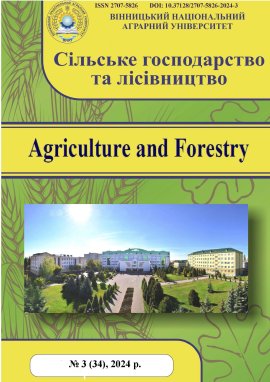
Issue №: 3 (34)
The issue of the journal is dedicated to the study of optimization of elements of crop cultivation technology. An important role is given to the influence of legumes on improving soil fertility, adaptive selection, mineral and foliar fertilization of crops, ecology and environmental protection, in particular, the influence of chemicalization on soil and grain pollution by pesticides, and methods of combating harmful objects.
FORMATION OF ELEMENTS OF THE YIELD STRUCTURE AND YIELD OF CORN HYBRIDS DEPENDING ON PLANT DENSITY AND FERTILIZER
Bogomaz Serhii Oleksandrovych is a graduate student of the Department of Agriculture, Soil Science and Agrochemistry of VNAU (21008, Vinnytsia, 3 Sonyachna St.; e-mail).
The article presents the results of experimental studies of the features of the formation of elements of grain productivity of corn hybrids of different maturity groups depending on the density of plants and fertilization, taking into account new forms, clarification of application rates and terms of their application according to the stages of organogenesis. The share of influence on corn productivity of plant density was the highest and amounted to 72.7%. The share of the influence of hybrid characteristics was smaller - 10.84%, the share of the influence of fertilizer - 10.16% was noted almost at the same level. A high index was noted for the share of the influence of the interaction of plant density and fertilizer - 5.98%, respectively. The maximum indicators of the elements of the crop structure (the number of grains from the cob and the mass of grain from the cob) were noted on the variant with the simultaneous application of zinc sulfate, Ecoline Zinc and Ecoline Boron on the background of N100P31 at a density of 60 thousand plants/ha in hybrids of corn DKS 3795 - 501.7 pcs. and 164.9 g; DKS 3972 –569.8 pcs.; 187 g; and DKS 4351 – 580.3; 182.8 g. This is higher compared to the control variantby 130.9 pcs., 66.5 g; 154.5 pcs., 77.1 g; 190.9 pcs., 75.3 g, respectively. For increasing the density to 70,000 plants/ha, there is a decrease in the elements of the crop structure, both the number of grains from the cob and the weight of the grain from the cob: DKS 3795 – 465.5 pcs., and 149.8 g; DKS 3972 – 517.4 pcs. and 165.1 g; DKS 4351 – 549.3; 156.7 g; The maximum decrease in the elements of the crop structure was noted in this variant at a density of 80,000 plants/ha: DKS 3795 –427.8 pcs., 131 g; DKS 3972 – 502.0; 145.2 g; DKS 4351 – 513.5; 128.6 g, respectively.Themaximum indicators of the elements of the crop structure (the number of ears per plant and the yield of grain from the ear) were noted on the variant with the simultaneous application of zinc sulfate, Ecoline Zinc and Ecoline Boron on the background of N100P31 at a density of 60 thousand plants/ha in corn hybrids: DKS 3795 – 1, 2; 85.5%; DKS 3972 – 1.3; 86.4%; and DKS 4351 – 1.3 units, 86.2%, respectively.
1. Dudka M.I., Yakunin O.P. (2023). Formuvannia vrozhainosti zerna kukurudzy zalezhno vid sposobu sivby ta hustoty stoiannia roslyn v Pivnichnomu Stepu Ukrainy [The formation of corn grain yield depending on the method of sowing and plant density in the Northern Steppe of Ukraine]. Zernovi kultury − Cereal crops. Vol. 7, № 1. 76–84. [in Ukrainian].
2. Kravets S.S. (2013). Formuvannia produktyvnosti kukurudzy zalezhno vid shyryny mizhriad i herbitsydiv v piv nichnomu Stepu Ukrainy [The formation of corn productivity depending on the width of the row spacing and herbicides in the Northern Steppe of Ukraine]: avtoref. dys. … kand. s.-h. nauk: spets. 06.01.09. Dnipropetrovsk. [in Ukrainian].
3. Pashchenko Yu.M., Borysov V.M., Shyshkyna O.Yu. (2009). Adaptyvni i resursozberezhni tekhnolohii vyroshchu vannia hibrydiv kukurudzy [Adaptive and resource-saving technologies for growing corn hybrids]: monohrafiia. Dnipropetrovsk: ART-PRES. [in Ukrainian].
4. Zubets M.V. (2010). Naukovi osnovy ahropromyslovoho vyrobnytstva v zoni Lisostepu Ukrainy [Scientific basis of agro-industrial production in the forest-steppe zone of Ukraine]. Kyiv: Ahrarna nauka. [in Ukrainian].
5. Marchenko T.Yu., Lavrynenko Yu.O., Mykhalenko I.V., Khomenko T.M. (2019). Biometrychni pokaznyky hibrydiv kukurudzy riznykh hrup FAO zalezhno vid obrobky mikrodobryvamy za umov zroshennia [Biometric indicators of corn hybrids of different FAO groups depending on treatment with microfertilizers under irrigation conditions]. Plant Varieties Studying and Protection. Vol. 15. № 1. 71–79. URL:https://doi.org/10.21498/2518-1017.15.1.2019.162486. [in Ukrainian].
6. Palamarchuk V.D., Demchuk B.S. (2021). Rol pozakorenevykh pidzhyvlen u suchasnykh tekhnolohiiakh vyroshchuvannia zernovoi kukurudzy [The role of foliar fertilization in modern grain corn cultivation technologies]. Silske hospodarstvo ta lisivnytstvo − Agriculture and forestry. № 20. 60–76. doi.org/10.37128. [in Ukrainian].
7. Hospodarenko H.M. (2015). Systema zastosuvannia dobryv [Fertilizer application system]: navch. posibnyk. Kyiv: TOV «SIK HRUP UKRAINA». [in Ukrainian].
8. Didenko N.O., Ranskyi A.P. (2018). Vplyv kompleksnykh spoluk kuprumu (II), kobaltu (II) ta tsynku z aromatychnymy i heterotsyklichnymy tioamidamy na posivni vlastyvosti deiakykh silskohospodarskykh kultur [The influence of complex compounds of copper (II), cobalt (II) and zinc with aromatic and heterocyclic thioamides on the sowing properties of some agricultural crops]. Visnyk Poltavskoi derzhavnoi silskohospodarskoi akademii − Bulletin of the Poltava State Agricultural Academy. № 2. 17–23. URL:https://doi.org/ 10.31210/ visnyk2018.02.02. [in Ukrainian].
9. Vovkodav V.V. [2001]. Metodyka derzhavnoho sortovyprobuvannia silskohospodarskykh kultur (zernovi, krupiani ta zernobobovi) [Methodology of state variety testing of agricultural crops (cereals, cereals and legumes)]. [in Ukrainian].
10. Bohomaz S.O. (2024). Vyvchennia vplyvu hustoty roslyn i udobrennia na urozhainist hibrydiv kukurudzy [Study of the effect of plant density and fertilization on the yield of corn hybrids]. Silske hospodarstvo ta lisivnytstvo − Agriculture and forestry. № 23. 209–220. DOI: 10.37128/2707-5826-2024-2-17. [Ukrainian].
11.Moldovan V.H., Moldovan Zh.A. (2023). Efektyvnist vykorystannia tsynkuu pozakorenevomu pidzhyvlenni kukurudzy u Zakhidnomu Lisostepu Ukrainy [Effectiveness of zinc use in foliar feeding of corn in the Western Forest Steppe of Ukraine]. Zernovi kultury − Cereal crops. Vol. 7, № 1. 146–152. [Ukrainian].
About the journal
Cluster Agricultural and veterinary sciences (H1 Agronomy, H4 Forestry)
Name of the publication «AGRICULTURE AND FORESTRY»
The aim of the journal "Agriculture and Forestry" is to highlight the results of fundamental and applied research in the fields of agriculture and forestry, aimed at improving the efficiency of agricultural production and introducing modern technologies into farming practice.
This goal defines the main objectives:
– to ensure the creation of open information access regarding the dissemination of relevant scientific research results to: lecturers of agricultural higher education institutions, postgraduate students, doctoral candidates, research staff, and agricultural production specialists;
– to promote the development of young scientists in agricultural sciences;
– to enhance communication between experienced researchers and young scientists in agronomy and forestry;
– to facilitate the expansion of ties between Vinnytsia National Agrarian University and domestic and foreign educational institutions, scientific establishments, and their academic communities.
The scientific, production, and educational journal "Agriculture and Forestry" is a peer-reviewed open-access publication that publishes original experimental research, theoretical and practice-oriented articles within the cluster of "Agricultural and Veterinary Sciences".
The journal's subject matter covers such areas as agronomy and forestry. Publications of scientific and practical significance address the experimental foundations of agricultural and forestry sector development, innovative production technologies, and the results of fundamental and applied research aimed at increasing productivity, product quality, and the sustainable development of natural and production systems.
Publisher: Vinnytsia National Agrarian University
EDRPOU code: 00497236
Publisher's ROR:05m3ysc06
Prefix DOI: 10.37128/
Frequency is quarterly
Publication languages: (Ukrainian, English)
Media ID R30-05174.
Editor in Chief Ihor Didur
According to the order of the Ministry of Education and Science of Ukraine dated 17.03.2020 № 409. The journal Agriculture and Forestry is included in the List of scientific professional publications of Ukraine Category "B" in agricultural sciences (specialties) - 101, 201, 202, 203, 205, 206.
State registration: Decision of the National Council of Ukraine on Television and Radio Broadcasting No. 1337 and No. 1181. Media identifier – R30-05174.
Scientific journal "AGRICULTURE AND FORESTRY" was founded in 1995; it was entitled as Bulletin of Vinnytsya State Agricultural Institute.
In 2010-2014 was enritled as Collection of scientific works of Vinnytsia National Agrarian University.
It has been named as Agriculture and Forestry since 2015.
Listed in the updated list of scientific professional editions of Ukraine on agricultural sciences under the name Agriculture and Forestry (Order of the Ministry of Education and Science of Ukraine of May 16, 2016; No. 515).
Since 2015, "Agriculture and Forestry". (archive of previous issues for 2015-2019) at http://forestry.vsau.edu.ua/.
The journal “Agriculture and Forestry (ISSN: 2707-5826)” passed the evaluation process of Index Copernicus positively and is indexed in the database of ICI Journals Master List ICV for 2018, 2019, 2020, 2021, 2022, 2023, 2024 is presented in the full list of indexed journals in the Master List International List
ICI Journals Master List Value
