

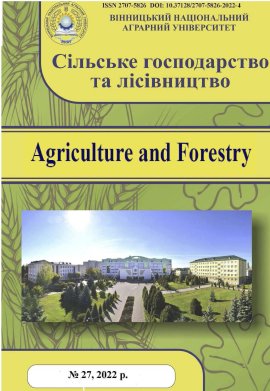
Issue №: 4 (27)
The issue of the magazine is dedicated to the study of the optimization of technological methods of growing agricultural crops. The impact of leguminous crops on improving soil fertility, methods of combating pests, greening territories, and adaptive selection of leguminous crops are considered.
FORMATION OF CORN PRODUCTIVITY DEPENDING ON THE USE OF MODERN BIOLOGICAL FERTILIZERS IN THE FOREST-STEPPE RIGHT BANK
Tsyhanskyi Viacheslav – Candidate of Agricultural Sciences, docent of the Department of of Plant Production, Selection and Bioenergetic Cultures of Vinnytsia National Agrarian University (21008, Vinnytsia, Soniachna Str. 3).
Corn is one of the oldest agricultural crops. It is one of the most productive cereals of universal purpose, which is grown for food, feed and technical purposes. In the countries of the world about 20% of corn grain is used for food needs, 15-20% for technical needs, 60 - 65% for fodder for farm animals. In our country, corn is the most important fodder crop. At its expense, livestock is provided with concentrated feed, silage and green mass. The most valuable feed is corn grain, which contains 9-12% protein, 65-70% carbohydrates, 4-8% oil, 1.5% minerals. 100 kg of it contains 134 feeds, units, up to 8 kg of digestible protein. In the current conditions of agricultural production, biological fertilizers and drugs with different mechanisms of action on plants are in increasing demand among agricultural producers. Particular attention is paid to biological products that promote the active settlement of root and root zone mycorrhizal fungi and saprophytic rhizosphere bacteria, one of which is Melanoriz and complex fertilizers based on potassium humate type Gumifrend, which are created with additional content of beneficial microorganisms and their products. These biological preparations ensure the development of soil biota, increase soil fertility, while activating its suppression against phytopathogens, increase crop yields, including corn. The research was conducted with the use of modern promising biological products, manufactured by BTU Center, which were used for pre-sowing seed treatment and application to foliar fertilization. Based on the obtained results, it was found that the treatment of seeds before sowing with Melanoriz with a rate of 3 l / t and the application of humic fertilizer Gumifrend (0.5 l / ha) and its combination with plant growth regulator Stimpo (25 ml / ha) provided the best plant productivity parameters. Under these growing conditions, the maximum plant height in the experiment was 236.1 cm, leaf surface area 44.6 thousand m 2 / ha, grain weight from the beginning of 152.6 g, weight of 1000 grains 286.6 g and grain yield 11, 75 t ha-1.
1.Azurkin V.О., Polishchuk I.S., Mazur V.A. (2011). Productivity of maizehybrids depending on standing density for bioethanol production. Bulletin of Vinnytsia National Agrarian University. Agricultural sciences. Issue. 8 (48). PP. 27-30.[in Ukrainian].
2.Barvinchenko V.I., Zabolotny G.M. (2004). Soils of Vinnytsia region.Tutorial. Vinnitsa. 46 p. [in Ukrainian].
3.Didur I.M. Tsyhanskyi V.I., Rybachok V.V. (2018). Productivity of corndepending on the influence of modern biological products and microbiological fertilizers in the right-bank forest-steppe. Collection of scientific works of Vinnytsia National Agrarian University. Agriculture and forestry. №11. PP. 26-36. [in Ukrainian].
4.Didur I.M. Tsyhanskyi V.I. (2017). Formation of grain productivity of corndepending on application of microbiological fertilizer Graunfix in the conditions of the Forest-steppe of the right bank. Collection of scientific works of Vinnytsia National Agrarian University. Agriculture and forestry . №7 (Vol. 1). PP. 70–77. [in Ukrainian].
5.Demyanchuk O.P. (2015). Influence of foliar feeding on maize productivity.The latest technologies for the production of competitive crop products. Proceedings of the scientific-practical conference of young scientists and specialists November 29-30. PP. 49-51. [in Ukrainian].
6.Palamarchuk V.D., Klimchuk O.V., Polishchuk I.S. and others (2010). Ecological, biological and technological principles of growing field crops: textbook. way. Vinnitsa. Danilyuk V.G. 633 p. [in Ukrainian].
7.Zubreychuk M.S., Gazinska T.V., Tkachenko I.S. (2015). Productivity ofmaize hybrids depending on hydrothermal conditions of vegetation. Seed production. №3. PP. 7–12. [in Ukrainian].
8.Corn. Grain. (2016). № 7. PP. 80–87. [in Ukrainian].
9.Lavrinenko Y.O., Gozh O.A. (2016). Growth and development of plants ofhybrids of corn FAO 180-430 under the influence of growth regulators and microfertilizers under irrigation in the South of Ukraine. Irrigated agriculture: coll. Science. ave . № 65. S. 128–131. [in Ukrainian].
10.Likhochvor V.V., Petrichenko V.F., Ivashchuk P.V. (2008). Grainproduction. Lviv. SPF "Ukrainian Technologies". 624 p. [in Ukrainian].
11.Mazur V.A., Tsyganskaya O.I., Shevchenko N.V. (2018). Height of cornplants depending on technological methods of cultivation. Agriculture and forestry. Vinnytsia. № 8. P. 5–13. [in Ukrainian].
12.Mazur V.A., Shevchenko N.V. (2017). Influence of technological methodsof cultivation on the formation of quality indicators of corn grain. Agriculture and forestry . Vinnytsia. № 6, Vol. 1. P. 7–14. [in Ukrainian].
13.Methods of state variety testing of crops. (2000). Kyiv. Issue. 1. 100 s. [in Ukrainian].
14.Palamarchuk V.D., Polishchuk I.S., Venediktov O.M. (2011). Systems ofmodern intensive technologies in crop production: textbook. way. Vinnytsia: Danyliuk V.G. 431 p. [in Ukrainian].
15.Tsyhanskyi V.I. (2017). Biofertilizers and productivity of corn. Accessmode: http://btu-center.com/upload/publication/2017/Groundfix_2017.pdf [in Ukrainian].
16.Melnychuk D., Hoffman J., Gorodny M. (2016). Soil quality and modernfertilization strategies. For the order. K. Aristei. 488 p. [in Ukrainian].
About the journal
Cluster Agricultural and veterinary sciences (H1 Agronomy, H4 Forestry)
Name of the publication «AGRICULTURE AND FORESTRY»
The aim of the journal "Agriculture and Forestry" is to highlight the results of fundamental and applied research in the fields of agriculture and forestry, aimed at improving the efficiency of agricultural production and introducing modern technologies into farming practice.
This goal defines the main objectives:
– to ensure the creation of open information access regarding the dissemination of relevant scientific research results to: lecturers of agricultural higher education institutions, postgraduate students, doctoral candidates, research staff, and agricultural production specialists;
– to promote the development of young scientists in agricultural sciences;
– to enhance communication between experienced researchers and young scientists in agronomy and forestry;
– to facilitate the expansion of ties between Vinnytsia National Agrarian University and domestic and foreign educational institutions, scientific establishments, and their academic communities.
The scientific, production, and educational journal "Agriculture and Forestry" is a peer-reviewed open-access publication that publishes original experimental research, theoretical and practice-oriented articles within the cluster of "Agricultural and Veterinary Sciences".
The journal's subject matter covers such areas as agronomy and forestry. Publications of scientific and practical significance address the experimental foundations of agricultural and forestry sector development, innovative production technologies, and the results of fundamental and applied research aimed at increasing productivity, product quality, and the sustainable development of natural and production systems.
Publisher: Vinnytsia National Agrarian University
EDRPOU code: 00497236
Publisher's ROR:05m3ysc06
Prefix DOI: 10.37128/
Frequency is quarterly
Publication languages: (Ukrainian, English)
Media ID R30-05174.
Editor in Chief Ihor Didur
According to the order of the Ministry of Education and Science of Ukraine dated 17.03.2020 № 409. The journal Agriculture and Forestry is included in the List of scientific professional publications of Ukraine Category "B" in agricultural sciences (specialties) - 101, 201, 202, 203, 205, 206.
State registration: Decision of the National Council of Ukraine on Television and Radio Broadcasting No. 1337 and No. 1181. Media identifier – R30-05174.
Scientific journal "AGRICULTURE AND FORESTRY" was founded in 1995; it was entitled as Bulletin of Vinnytsya State Agricultural Institute.
In 2010-2014 was enritled as Collection of scientific works of Vinnytsia National Agrarian University.
It has been named as Agriculture and Forestry since 2015.
Listed in the updated list of scientific professional editions of Ukraine on agricultural sciences under the name Agriculture and Forestry (Order of the Ministry of Education and Science of Ukraine of May 16, 2016; No. 515).
Since 2015, "Agriculture and Forestry". (archive of previous issues for 2015-2019) at http://forestry.vsau.edu.ua/.
The journal “Agriculture and Forestry (ISSN: 2707-5826)” passed the evaluation process of Index Copernicus positively and is indexed in the database of ICI Journals Master List ICV for 2018, 2019, 2020, 2021, 2022, 2023, 2024 is presented in the full list of indexed journals in the Master List International List
ICI Journals Master List Value
