

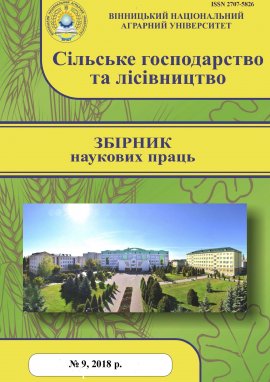
Issue №: 2 (9)
Випуск присвячений вивченню технологічних прийомів вирощування сільськогосподарських культур, особливостям органічного насінництва та виробництва органічної продукції, біологізації землеробства, застосування бактеріальних препаратів.
EVALUATION OF THE SOILS SUITABILITY OF SCIENTIFIC AND EXPERIMENTAL FARM «AGRONOMICHNE» FOR THE GROWING OF ORGANIC PRODUCTS BY THE CONTENT OF HEAVY METALS
Mazur Viktor Anatoliyovych – Candidate of Agricultural Sciences, Associate Professor of the department of plant production, selection and bioenergetic cultures, rector of the Vinnitsa National Agrarian University, vice-president of the All-Ukrainian scientific-training consortium, (21008, Vinnytsia, vul. Solar, 3).
Vergelis Victoria Ihorivna – assistant of the department of ecology and environmental protection, Vinnytsia National Agrarian University (21008, Vinnytsia, 3, Solnychna St., e-mail: viktoriya_iv47@ukr.net).
The soils suitability of scientific and experimental farm «Agronomichne» for the growing of organic products by the content of heavy metals is analyzed in the article.
It has been found that the content of lead, cadmium, zinc and copper in the soils of scientific and experimental farm «Agronomichne» was different. The concentration of lead varied from 0.65 to 1.25 mg/kg, of cadmium – from 0.11 to 0.16 mg/kg, of zinc – from 1.9 to 2.65 mg/kg and that one of copper – from 0.73 to 1.17 mg/kg. That is, the difference in the contents of lead was by 1.92 times, of cadmium – by 1.45 times,of zinc – by 1.39 times and of copper – by 1.60 times on the plots. It has been determined that the content of lead, cadmium, zinc and copper on the experimental plots was significantly lower than MAC, indicating a favorable state of soils for the growing of organic products. The concentration of lead, cadmium, zinc and copper in the soil on the plot 1 was lower than MAC by 4.8; 4.3; 8.6 and 2.5 times, respectively. The concentration of lead, cadmium, zinc and copper in the soil on the plot 2 was lower than MAC by 7.0; 5.8; 10.2 and 3.1 times, respectively. The concentration of lead, cadmium, zinc and copper in the soil on the plot 3 was lower than MAC by 5.4; 6.3; 12.1 and 4.1 times, respectively. The concentration of lead was by 9.2 times, of cadmium by 5.3 times, of zinc by 11.5 times and that one of copper by 3.5 times lower than MAC in the soil on the plot 4. The concentration of lead, cadmium, zinc and copper in the soil on the plot 5 was lower than MAC by 5.7; 6.3; 9.3 and 3.1 times, respectively.
It has been defined that the average concentration of lead is 1.25 mg/kg, of zinc – 2.65 mg/kg and of copper – 1.17 mg/kg on the plot 1. The average concentration of lead, zinc and copper on the plot 2 is 0.85 mg/kg, 2.25 mg/kg and 0.95 mg/kg, respectively. Analyzing the content of micronutrients and heavy metals in the soils on the plot 3, it has been found that the concentration of lead is 1.1 mg/kg, of zinc – 1.9 mg/kg and that one of copper – 0.73 mg/kg. The average concentration of lead, zinc and copper on the plot 4 is 0.65 mg/kg, 2.0 mg/kg and 0.84 mg/kg, respectively. Determining the content of micronutrients and heavy metals in the soils on the plot 5, it has been found that the concentration of lead is 1.05 mg/kg, of zinc – 2.45 mg/kg and that one of copper – 0.98 mg/kg. That is, the average concentration of lead is less than 6.0 mg/kg, of zinc is in the range of 1.0 – 23.0 mg/kg and that one of copper is in the range of 0.5 – 3.0 mg/kg on all experimental plots. It means that the concentration of heavy metals as microelements is favorable for the growth and development of plants. It has been determined that the soils of the scientific and experimental farm «Agronomichne» belong to the first class with the category «suitable» for organic production.
1.Antonets A. S., Pysarenko V. V., Lukianenko T. V., Pysarenko Yu. H. Formuvannia rynku ekolohichno bezpechnoi produktsii pry orhanichnomu zemlerobstvi [Formation of the market for environmentally safe products in organic farming]. Ekonomika APK – Economy of agroindustrial complex. 2010. №12. P. 75-79.
2. DSTU 4944:2008. Ahrokhimikaty. Vstanovlennia dopustymykh kontsentratsii shkidlyvykh rechovyn [Chynnyi vid 2009-01-01.] [Agrochemicals. Establishment of permissible concentrations of harmful substances]. Kyiv. 2009. 8 p. (Informatsiia ta dokumentatsiia).
3. DSTU 7244:2011. Yakist gruntu. Spetsialni syrovynni zony. Zahalni vymohy [Chynnyi vid 2012-01-01] [The quality of the soil. Special raw material zones. General requirements]. Kyiv. 2011. 16 p. (Informatsiia ta dokumentatsiia).
4. Kaletnik H. M., Pryshliak N. V. Vyrobnytstvo ta sertyfikatsiia orhanichnoi produktsii: dosvid SShA [Production and certification of organic products: experience of the USA]. Ekonomika. Finansy. Menedzhment: aktualni pytannia nauky i praktyky: vseukrainskyi naukovo-vyrobnychyi zhurnal – «Eсonomy. Finanсes. Management: Topical issues of science and practical activity». 2017. №9. P. 7-22.
5. Kapshtyk M. V., Demydenko O. V. Gruntozakhysni tekhnolohii yak peredumova orhanichnoho zemlerobstva [Soil protection technologies as a prerequisite for organic farming]. Ahroekolohichnyi zhurnal – Agroecological journal. 2011. №2. P. 52-57.
6. Kysil V. I. Biolohichne zemlerobstvo v Ukraini: problemy i perspektyvy [Biological agriculture in Ukraine: problems and perspectives]. Kharkiv: Shtrykh. 2000. 161 p.
7. Martyniuk M.P. Derzhavne rehuliuvannia orhanichnoho vyrobnytstva: stan ta perspektyvy rozvytku [State regulation of organic production: state and prospects of development]. Orhanichne vyrobnytstvo i prodovolcha bezpeka: zb. materialiv dop. uchasn. V Mizhnarodnoi nauk.-prakt. konf. Zhytomyr: ZhNAEU – Organic production and food safety: Sb. additional materials participant V international science. – Price conf Zhitomir: ZNAMEU. 2017. P. 5 - 10.
8. Naida I. S., Zapsha H. M. Orhanichne zemlerobstvo yak priorytetnyi napriam sotsioekonomichnoho rozvytku silskoho hospodarstva Ukrainy [Organic Farming as a Priority Direction of Socioeconomic Development of Agriculture in Ukraine]. Biznes Inform. Ekonomika silskoho hospodarstva i APK – Business Inform. Economy of agriculture and agroindustrial complex. 2015. №1. P. 200-204.
9. Podzerei R. V., Makarenko N. A. Naukovi osnovy otsiniuvannia stanu silskohospodarskykh terytorii ta uhid shchodo mozhlyvosti vedennia orhanichnoho vyrobnytstva [Scientific bases of estimation of the condition of agricultural territories and lands concerning the possibility of organic production]. Elektronnyi naukovyi fakhovyi zhurnal. Naukovi dopovidi Natsionalnoho universytetu bioresursiv i pryrodokorystuvannia Ukrain – Electronic Scientific Specialty Magazine. Scientific reports of the National University of Bioresources and Natural Resources of Ukraine. 2015. № 4 (53). URL: http://dspace.udpu.org.ua:8080/jspui/handle/6789/4329.
10. Pro vyrobnytstvo ta obih orhanichnoi silskohospodarskoi produktsii ta syrovyny: Zakon Ukrainy [On the production and circulation of organic agricultural products and raw materials: Law of Ukraine]. vid 03.09.2013 r. № 425. URL: http://zakon2.rada.gov.ua/laws/show/425-18 (data zvernennia 17.04.2018).
11. Prutska O. O., Khodakivska O. V. Orhanichne silske hospodarstvo v SShA: realii ta perspektyvy dlia Ukrainy [Organic agriculture in the USA: realities and prospects for Ukraine]. Ekonomika APK – Economy of agroindustrial complex. 2011. №12. P. 142-151.
12. Stetsyshyn P. O., Rekunenko V. V., Pyndus V. V. Osnovy orhanichnoho vyrobnytstva [Fundamentals of organic production]. Vinnytsia: Nova Knyha. 2008. 528 p.
13. Fatieiev A. I., Smirnova K. B., Semenov D. O. Otsinka prydatnosti gruntiv Ukrainy dlia orhanichnoho zemlerobstva za vmistom mikroelementiv [Assessment of the suitability of Ukrainian soils for organic farming based on the content of trace elements]. Visnyk ahrarnoi nauky – Bulletin of Agrarian Science. 2014. №4. P. 5-9.
About the journal
Cluster Agricultural and veterinary sciences (H1 Agronomy, H4 Forestry)
Name of the publication «AGRICULTURE AND FORESTRY»
The aim of the journal "Agriculture and Forestry" is to highlight the results of fundamental and applied research in the fields of agriculture and forestry, aimed at improving the efficiency of agricultural production and introducing modern technologies into farming practice.
This goal defines the main objectives:
– to ensure the creation of open information access regarding the dissemination of relevant scientific research results to: lecturers of agricultural higher education institutions, postgraduate students, doctoral candidates, research staff, and agricultural production specialists;
– to promote the development of young scientists in agricultural sciences;
– to enhance communication between experienced researchers and young scientists in agronomy and forestry;
– to facilitate the expansion of ties between Vinnytsia National Agrarian University and domestic and foreign educational institutions, scientific establishments, and their academic communities.
The scientific, production, and educational journal "Agriculture and Forestry" is a peer-reviewed open-access publication that publishes original experimental research, theoretical and practice-oriented articles within the cluster of "Agricultural and Veterinary Sciences".
The journal's subject matter covers such areas as agronomy and forestry. Publications of scientific and practical significance address the experimental foundations of agricultural and forestry sector development, innovative production technologies, and the results of fundamental and applied research aimed at increasing productivity, product quality, and the sustainable development of natural and production systems.
Publisher: Vinnytsia National Agrarian University
EDRPOU code: 00497236
Publisher's ROR:05m3ysc06
Prefix DOI: 10.37128/
Frequency is quarterly
Publication languages: (Ukrainian, English)
Media ID R30-05174.
Editor in Chief Ihor Didur
According to the order of the Ministry of Education and Science of Ukraine dated 17.03.2020 № 409. The journal Agriculture and Forestry is included in the List of scientific professional publications of Ukraine Category "B" in agricultural sciences (specialties) - 101, 201, 202, 203, 205, 206.
State registration: Decision of the National Council of Ukraine on Television and Radio Broadcasting No. 1337 and No. 1181. Media identifier – R30-05174.
Scientific journal "AGRICULTURE AND FORESTRY" was founded in 1995; it was entitled as Bulletin of Vinnytsya State Agricultural Institute.
In 2010-2014 was enritled as Collection of scientific works of Vinnytsia National Agrarian University.
It has been named as Agriculture and Forestry since 2015.
Listed in the updated list of scientific professional editions of Ukraine on agricultural sciences under the name Agriculture and Forestry (Order of the Ministry of Education and Science of Ukraine of May 16, 2016; No. 515).
Since 2015, "Agriculture and Forestry". (archive of previous issues for 2015-2019) at http://forestry.vsau.edu.ua/.
The journal “Agriculture and Forestry (ISSN: 2707-5826)” passed the evaluation process of Index Copernicus positively and is indexed in the database of ICI Journals Master List ICV for 2018, 2019, 2020, 2021, 2022, 2023, 2024 is presented in the full list of indexed journals in the Master List International List
ICI Journals Master List Value
