

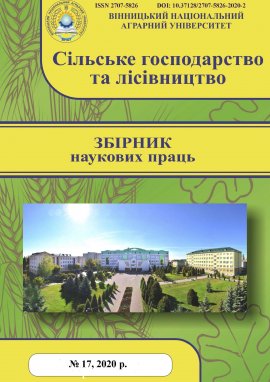
Issue №: 2 (17)
The issue of the journal deals with the study of optimization of technological methods of growing crops, assessment of selection material. A special role is played by the influence of legumes on improving soil fertility, plant protection systems against pests, ecology and environmental protection.
EVALUATION OF MAIZE SOURCE MATERIAL BY QUALITATIVE GRAIN INDICATORS
Zhemoida Vitali – candidate of Agricultural Sciences, Associate Professor of Genetics, Breeding and Seed Production. prof. M.O. Zelensky department, National University of Life and Environmental Sciences of Ukraine (03041, Kiev, Silskohospodarskyy l, f. 29, e-mail: wisena.seeds@gmail.com).
Makarchuk Oleksandr – candidate of Agricultural Sciences, acting manager of Genetics, Breeding and Seed Production. prof. M.O. Zelensky department, National University of Life and Environmental Sciences of Ukraine (03041, Kiev, Generala Rodimtceva str. 1a, e-mail: mcar2010@ukr.net).
Spriazhka Roman – postgraduate student of Genetics, Breeding and Seed Production. prof. M.O. Zelensky department, National University of Life and Environmental Sciences of Ukraine (02160, Kiev, Kharkivske Shose str. 18/1, f. 67, e-mail: spriaga96@gmail.com).
The basis of a complex and long process of creating new maize hybrids is the selection of parent components that can serve as sources of improved biochemical and economically valuable traits. Thus, depending on the peculiarities of the directions of maize grain processing, the production requires hybrids with a high starch content, and in the starch itself – amylose or amylopectin. When used for fodder purposes, high protein content is a must. This distribution of hybrids by areas of use will increase the profitability of production and reduce the cost of final products. The article presents the evaluation results of self-pollinating maize lines collection, which has 38 samples. The collection includes selection samples of the National University of Life and Environmental Sciences of Ukraine, Institute of Plant Breeding. V.Ya. Yuriev NAAS and lines of Canadian and Russian origin which are obtained from the National Center for Plant Genetic Resources of Ukraine. Field research was conducted according to generally accepted methods in the research fields of the Department of genetics, breeding and seed production. prof. M.O. Zelensky National University of Life and Environmental Sciences of Ukraine of the production unit "Agronomic Research Station", which is located in Vasylkiv district of Kyiv region laboratory. The soil of the experimental area is typical, low-humus, coarse-grained-medium-loam chernozem in terms of granulometric composition. Weather conditions were favorable for maize growing. Determination of quality indicators of maize grain was carried out on the «Infratec 1241 Grain Analyzer». The samples were divided into groups according to the content of quality indicators in the grain. In terms of protein content, two groups with high and medium content were formed, and the total variation of the indicator ranged from 10.0 to 13.8%. According to the starch content, the samples were also divided into two groups with very high and high content, and the percentage varied in the range of 66.5-71.8%. The range of oil content in the grain was in the range of 3.0-5.9% and, accordingly, three groups with high, medium and low content were formed. Selected inbred lines according to a set of indicators that serve as analyzers in the scheme of tester crosses to determine the degree of inheritance of specific biochemical traits.
1.Zhemojda V.L., Spriazhka R.O., Alokhin V.I. (2019). Czinnist vikhidnogo materialu kukurudzi pri selekcziyi na yakist zerna. «Roslinnicztvo XXI stolittya: vikliki ta innovacziyi. Do 120-ti richchya kafedri roslinnicztva NUBiP Ukarayini» III mizhnarodna naukovo-praktichna konferencziya [The value of the source material of corn in the selection for grain quality. "Crop production of the XXI century: challenges and innovations. To the 120th anniversary of the Department of Plant Breeding NULES of Ukraine "], m. Kiyiv, 25-26 veresnya 2019 r.: tezi dopovidi. Kiyiv. [in Ukrainian].
2.Miller J.Be, Whistler R. Eds. (2009). Starch chemistry and technology, 3rd ed. / - Amsterdam – Boston – Heidelberg – London - New York – Oxford – Paris – San –Diego – San Francisco – Singapore : Acad. Press, Elsevier Publ. [in English].
3.Ryabchun V.K., Gur'yeva I.A. (2007). Genetychni resursy kukurudzy na Ukrayini (Monografiya) [Genetic resources of corn in Ukraine (Monograph)] Kharkiv. – IR im. V.Ya. Yuryeva. [in Ukrainian].
4.Didenko S.Iu. (2008). Rozshyrennia henetychnoho riznomanittia za fraktsiinym skladom krokhmaliu [Expansion of genetic diversity by fractional composition of starch]. Henetychni resursy roslyn – Genetic resources of plants. №5. 77-85 [in Ukrainian].
5.Shmaraev H.E. (1999). Henofond y selektsyia kukuruzы [Gene pool and selection of corn]. Pod red. V.A. Drahavtseva. SPb.: VYR. [in Russian]
6.Dumanovic J., Pajic Z. (1998). Specificni tipovi kukuruza.- Beograd- Zemun: Institut za kukuruz "Zemun Polje". [in English].
7.Dospekhov B. A. (1985). Metodyka polevoho opыta [Field Experience Methodology]. M. : Ahropromyzdat. [in Russian].
8.Metodyka provedennia kvalifikatsiinoi ekspertyzy sortiv roslyn na prydatnist do poshyrennia v Ukraini (2017). Metody vyznachennia pokaznykiv yakosti produktsii roslynnytstva [Methods of qualification examination of plant varieties for suitability for distribution in Ukraine. Methods for determining the quality of crop products]. Za red. Tkachyk S. O. 3-tie vyd., vypr. i dop. Vinnytsia: FOP Korzun D. Yu. [in Ukrainian].
9.Kyrychenko B. B., Hurieva I. A., Riabchun V. K. ta in. (2009). Klasyfikator-dovidnyk vydu Zea mays L. [Classifier-reference species Zea mays L.]. Kharkiv. [in Ukrainian].
10.Tymchuk S.M., Martyniuk M.M., Pozdniakov V.V. ta in. (2012). Henetychnyi analiz osnovnykh oznak yakosti hranuliarnoho krokhmaliu u zubovydnoi ta voskovydnoi kukurudzy [Genetic analysis of the main characteristics of the quality of granular starch in toothed and waxy corn]. Selektsiia i nasinnytstvo – Breeding and seed production. Issue 101. 198-206 [in Ukrainian].
About the journal
Cluster Agricultural and veterinary sciences (H1 Agronomy, H4 Forestry)
Name of the publication «AGRICULTURE AND FORESTRY»
The aim of the journal "Agriculture and Forestry" is to highlight the results of fundamental and applied research in the fields of agriculture and forestry, aimed at improving the efficiency of agricultural production and introducing modern technologies into farming practice.
This goal defines the main objectives:
– to ensure the creation of open information access regarding the dissemination of relevant scientific research results to: lecturers of agricultural higher education institutions, postgraduate students, doctoral candidates, research staff, and agricultural production specialists;
– to promote the development of young scientists in agricultural sciences;
– to enhance communication between experienced researchers and young scientists in agronomy and forestry;
– to facilitate the expansion of ties between Vinnytsia National Agrarian University and domestic and foreign educational institutions, scientific establishments, and their academic communities.
The scientific, production, and educational journal "Agriculture and Forestry" is a peer-reviewed open-access publication that publishes original experimental research, theoretical and practice-oriented articles within the cluster of "Agricultural and Veterinary Sciences".
The journal's subject matter covers such areas as agronomy and forestry. Publications of scientific and practical significance address the experimental foundations of agricultural and forestry sector development, innovative production technologies, and the results of fundamental and applied research aimed at increasing productivity, product quality, and the sustainable development of natural and production systems.
Publisher: Vinnytsia National Agrarian University
EDRPOU code: 00497236
Publisher's ROR:05m3ysc06
Prefix DOI: 10.37128/
Frequency is quarterly
Publication languages: (Ukrainian, English)
Media ID R30-05174.
Editor in Chief Ihor Didur
According to the order of the Ministry of Education and Science of Ukraine dated 17.03.2020 № 409. The journal Agriculture and Forestry is included in the List of scientific professional publications of Ukraine Category "B" in agricultural sciences (specialties) - 101, 201, 202, 203, 205, 206.
State registration: Decision of the National Council of Ukraine on Television and Radio Broadcasting No. 1337 and No. 1181. Media identifier – R30-05174.
Scientific journal "AGRICULTURE AND FORESTRY" was founded in 1995; it was entitled as Bulletin of Vinnytsya State Agricultural Institute.
In 2010-2014 was enritled as Collection of scientific works of Vinnytsia National Agrarian University.
It has been named as Agriculture and Forestry since 2015.
Listed in the updated list of scientific professional editions of Ukraine on agricultural sciences under the name Agriculture and Forestry (Order of the Ministry of Education and Science of Ukraine of May 16, 2016; No. 515).
Since 2015, "Agriculture and Forestry". (archive of previous issues for 2015-2019) at http://forestry.vsau.edu.ua/.
The journal “Agriculture and Forestry (ISSN: 2707-5826)” passed the evaluation process of Index Copernicus positively and is indexed in the database of ICI Journals Master List ICV for 2018, 2019, 2020, 2021, 2022, 2023, 2024 is presented in the full list of indexed journals in the Master List International List
ICI Journals Master List Value
