

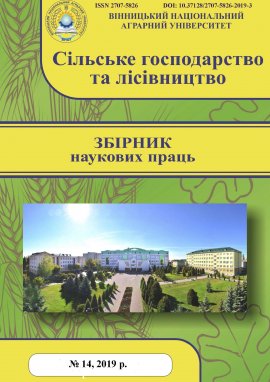
Issue №: 3 (14)
This issue of the journal "Agriculture and Forestry" contains the results of studies of ecological plasticity and stability of soybean and bean varieties, optimization of technological methods of growing crops, rational use of nature, preservation of soil fertility, reproduction of forest resources.
ESTIMATION OF EFFICIENCY OF CONSTRUCTION OF AGRO-PHYTOCENOSES AND FERTILIZER OF THE OIL RADISH ON THE BASIS OF THE MODULAR-VITALITY METHOD
Tsytsiura Yaroslav Hrigorovych – Candidate of Agricultural Sciences (PhD), Associate Professor of the Department of Soil Management, Soil Science and Agrochemistry, Vinnytsia National Agrarian University (21008, Vinnytsia, Soniachna Str., build 5/42, е-mail: yaroslavtsytsyura@ukr.net).
The article presents the results of a long-term study of the features of the phytocenology of agrophytocenoses of oil radish using different methods for assessing their condition and studying the tactics of the plant vitality strategy. A comprehensive assessment was made of the effect of changes in row spacing, seeding rates and fertilizer rates on the formation of various plant morphotypes, the variability of morphological characters and the general characteristics of plant viability.
Three idiotypes of the plant oil radish were identified in a vertical study of agrophytocenosis, on the basis of which a detailed analysis of the variability of each group and a statistical assessment of the reliability of its existence were carried out.
The features of the morphological integration of each tier are analyzed and its impact on the formation of the overall field productivity is evaluated.
Based on the modular and vitality grouping, the effectiveness and feasibility of combining various options for plant density and fertilizer in the range of 30-90 kg of active substance per 1 ha were evaluated.
Conclusions are drawn about the desired model of agrophytocenosis of oil radish based on the characteristics of its vital tactics and the goals of its growing.
Grouping was carried out according to a variety of morphological traits of plants in the population and the possibilities of applying the basic patterns of phytocenology in their application to radish oilseed plants were evaluated.
Through the use of regression analysis, the influence of climatic conditions on the formation of various morphological types of plants and the nature of the relationship of plants of oil radish in cenoses of various densities against the background of various fertilizer options has been evaluated.
The main promising areas for further research on the peculiarities of creating highly productive and highly adaptable agrophytocenoses of oil radish have been outlined.
1.Rabotnov T.A. (1960). Metody yzuchenyia semennoho razmnozhenyia travianystykh rastenyi v soobshchestvakh [Methods for studying seed propagation of grassy plants in communities]. Polevaia heobotanyka – Field geobotany. M.; L.: Yzd-vo AN SSSR. 20-39 [in Russian].
2.Tsenopopuliatsyy rastenyi: osnovnye poniatyia y struktura (1976). [Plant Cenopopulations: Basic Concepts and Structure]. Pod red. A. A. Uranov, T. Y. Serebriakova M.: Nauka. [in Russian].
3. Karmanova Y.V. (1976). Matematycheskye metody yzuchenyia rosta y produktyvnosty rastenyi [Mathematical methods for studying plant growth and productivity]. AN SSSR, Lab. lesovedenyia. Moskva : Nauka. [in Russian].
4. Rostova N.S. (2002). Korreliatsyy: struktura y yzmenchyvost [Correlations: structure and variability]. SPb. [in Russian].
5. Zhyliaev H. H. (2005). Zhyznesposobnost populiatsyi rastenyi [Viability of plant populations]. Lvov: NAN Ukraynы. [in Russian].
6.Tkachuk O. P. (2016). Ekolohichna konkurentozdatnist bobovykh bahatorichnykh trav z burianamy v rik sivby pry bezpokryvnomu vyroshchuvanni [Ecological competitiveness of legumes of perennial grasses with weeds in year of sowing with non-perishable cultivation]. Kormy i kormovyrobnytstvo – Forage and feed production. Issue 82. 87-91 [in Ukrainian].
7. Zlobyn Yu.A. (2009). Populiatsyonnaia эkolohyia rastenyi: sovremennoe sostoianye, tochky rosta [Population ecology of plants: current state, points of growth]. Sumy: Unyversytet. Knyha. [in Russian].
8. Yshbrydyn A.R., Yshmuratova M.M. (2004). Adaptyvnyi morfohenez y эkoloho-tsenotycheskye stratehyy vyzhyvanyia travianystykh rastenyi [Adaptive
morphogenesis and ecological-cenotic strategies for the survival of herbaceous plants]. Metody populiatsyonnoi byolohyy – Methods of population biology. Syktyvkar. Ch. II. 113-120 [in Russian].
9. Hlukhov O. Z., Safonov A. I., Khyzhniak N. A. (2006). Fitoindykatsiia metalopresynhu v antropohenno transformovanomu seredovyshchi: Monohrafiia [Phytindication of metal pressing in anthropogenically transformed environment: Monograph]. Donets. botan. sad NAN Ukrainy. Donetsk: Nord-Press. [in Ukrainian].
10.Rasevych V.V. (2008). Ekoloho-tsenotychni osoblyvosti populiatsii u pryrodnii flori Ukrainy. Ukr. botan. Zhurn – Ukrainian Botanical Journal. Vols. 65. 1. 92-102 [in Ukrainian].
11. Osoblyvosti provedennia doslidzhen z khrestotsvitymy oliinymy kulturamy / Za red. V. F. Saika [ta in.] (2011). [Features of conducting studies on cruciferous oilseed crops]. K.: “Instytut zemlerobstva NAAN”. [in Ukrainian].
12.Zaitsev H.N. (1984). Metodyka byometrycheskykh raschetov [Method of biometric calculations]. M.: Nauka, 1984. [in Russian].
13. Sukachev V. N. (1956). O sovremennyih problemah izucheniya rastitelnogo pokrova [On modern problems of the study of the vegetation cover]. Botanical Journal of the USSR Botanycheskyi zhurnal SSSR, Vols. 41 (4), 476-486 [in Russian].
14. Laman N. A., Vlasova N. N., Poplavskaya R. S., Prohorov V. N. (1999). Biologo-ekologicheskie osobennosti formirovaniya vyisokoproduktivnyih posevov hlebnyih zlakov: selektsionnyie aspektyi. Minsk. [Biological and ecological features of formation of highly productive sowings of cereal crops: breeding aspects]. Proceedings of the Academy of Agrarian Sciences of the Republic of Belarus, 3, 52-58 [in Russian].
15. Khmelianchyshyn Yu.V. (2005). Optymalne poiednannia sortu, sposobu sivby i udobrennia v enerhozaoshchadzhuvanii tekhnolohii vyroshchuvannia nasinnia ripaku yaroho v pivdenno-zakhidnii chastyni Lisostepu Ukrainy [The optimal combination of the variety, method of sowing and fertilization in the energy-saving technology of growing rape seeds in the southwestern part of the Forest-Steppe of Ukraine]. Kam’ianets:Podilskyi. [in Ukrainian].
About the journal
Cluster Agricultural and veterinary sciences (H1 Agronomy, H4 Forestry)
Name of the publication «AGRICULTURE AND FORESTRY»
The aim of the journal "Agriculture and Forestry" is to highlight the results of fundamental and applied research in the fields of agriculture and forestry, aimed at improving the efficiency of agricultural production and introducing modern technologies into farming practice.
This goal defines the main objectives:
– to ensure the creation of open information access regarding the dissemination of relevant scientific research results to: lecturers of agricultural higher education institutions, postgraduate students, doctoral candidates, research staff, and agricultural production specialists;
– to promote the development of young scientists in agricultural sciences;
– to enhance communication between experienced researchers and young scientists in agronomy and forestry;
– to facilitate the expansion of ties between Vinnytsia National Agrarian University and domestic and foreign educational institutions, scientific establishments, and their academic communities.
The scientific, production, and educational journal "Agriculture and Forestry" is a peer-reviewed open-access publication that publishes original experimental research, theoretical and practice-oriented articles within the cluster of "Agricultural and Veterinary Sciences".
The journal's subject matter covers such areas as agronomy and forestry. Publications of scientific and practical significance address the experimental foundations of agricultural and forestry sector development, innovative production technologies, and the results of fundamental and applied research aimed at increasing productivity, product quality, and the sustainable development of natural and production systems.
Publisher: Vinnytsia National Agrarian University
EDRPOU code: 00497236
Publisher's ROR:05m3ysc06
Prefix DOI: 10.37128/
Frequency is quarterly
Publication languages: (Ukrainian, English)
Media ID R30-05174.
Editor in Chief Ihor Didur
According to the order of the Ministry of Education and Science of Ukraine dated 17.03.2020 № 409. The journal Agriculture and Forestry is included in the List of scientific professional publications of Ukraine Category "B" in agricultural sciences (specialties) - 101, 201, 202, 203, 205, 206.
State registration: Decision of the National Council of Ukraine on Television and Radio Broadcasting No. 1337 and No. 1181. Media identifier – R30-05174.
Scientific journal "AGRICULTURE AND FORESTRY" was founded in 1995; it was entitled as Bulletin of Vinnytsya State Agricultural Institute.
In 2010-2014 was enritled as Collection of scientific works of Vinnytsia National Agrarian University.
It has been named as Agriculture and Forestry since 2015.
Listed in the updated list of scientific professional editions of Ukraine on agricultural sciences under the name Agriculture and Forestry (Order of the Ministry of Education and Science of Ukraine of May 16, 2016; No. 515).
Since 2015, "Agriculture and Forestry". (archive of previous issues for 2015-2019) at http://forestry.vsau.edu.ua/.
The journal “Agriculture and Forestry (ISSN: 2707-5826)” passed the evaluation process of Index Copernicus positively and is indexed in the database of ICI Journals Master List ICV for 2018, 2019, 2020, 2021, 2022, 2023, 2024 is presented in the full list of indexed journals in the Master List International List
ICI Journals Master List Value
