

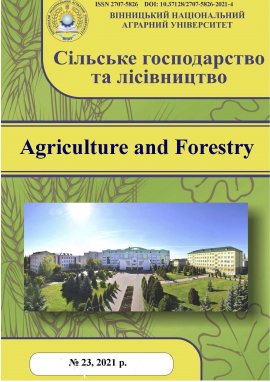
Issue №: 4 (23)
Випуск журнала присвячено вивченню оптимізації технологічних прийомів вирощування сільськогосподарських культур. Особливу роль відведено впливу бобових культур на покращення родючості грунту, а також удосконалення технології вирощування соняшника, як високорентабельної культури, особливостей вирощування овочевих культур, екології та охорони навколишнього середовища, методам боротьби із шкодочинними об'єктами, інтродукції декоративних рослин.
EFFICACY OF HERBICIDES APPLICATION IN GROWING SORGHUM IN THE FOREST STEPPE OF UKRAINE
Kolisnyk Oleh − Сandidate of Agricultural Sciences, Associate Professor of the Department of Botany, Genetics and Plant Protection, Vinnytsia National Agrarian University (21008, Vinnytsia, Soniachna St. 3, e-mail: ooov@i.ua).
Mazur Kateryna − Candidate of economic sciences, Associate Professor, Head of the Department Agrarian Management and Marketing, Vinnytsia National Agrarian University (21008, Vinnytsia, Soniachna St, 3 e-mail: mazurk@vsau.vin.ua).
In recent years, due to the increasing aridity of the climate in the forest-steppe zone of Ukraine, the need to expand crops of drought- and heat-resistant crops has increased significantly. One of the crops suitable for such conditions is sorghum. However, in the technology of its cultivation there are some periods that require the greatest attention of farmers to ensure the formation of high and sustainable yields. And before that it concerns plant protection. Field experiments were conducted in the conditions of the research farm "Agronomichesky" of Vinnytsia National Agrarian University in 2021. The research sites are located in the zone of the right-bank Forest-Steppe of Ukraine. Studies have shown that in areas with chemical weed control, the highest yield of sorghum grain (4.04 t / ha) was provided by the application of the herbicide Peak at a dose of 20 g/ha, which is only 0.22 t/ha less than options with manual removal weeds. This indicates the creation of favorable conditions and weak phytotoxic effect of this drug on sorghum plants. When using the herbicide Prima, the best grain yield (3.56 t/ha) was when it was applied at a dose of 0.4 l/ha. Further increase in dose led to plant suppression and reduced sorghum grain productivity. When using Grantox, the optimal dose was 0.7 l/ha, which ensured the formation of grain yield of 3.61 t/ha. Increasing the dose of the herbicide led to the suppression of sorghum plants and a decrease in its grain productivity. According to the research results, new and improved optimized agrotechnical measures for grain sorghum cultivation have been developed, which in the research zone contribute to the fuller realization of plant genetic potential, thus increasing yields while reducing production costs.
1.Alyeksyeyev YA.V., Semenov S.S., Lyubchych O.H., Hryshchenko R.YE.,Hliyeva O.V. (2021). Produktyvnistʹ sorho zernovoho pry zastosuvanni pislyaskhodovykh herbitsydiv [Productivity of grain sorghum when using post-emergence herbicides]. Zernovi kulʹtury - Cereals. Vol. 5. № 1. 59-64 [In Ukrainian].
2.Boyko M.O. (2016). Obgruntuvannya ahrotekhnichnykh pryyomivvyroshchuvannya sorho zernovoho v umovakh Pivdnya Ukrayiny [Substantiation of agrotechnical methods of grain sorghum cultivation in the conditions of the South of Ukraine]. Scientific Bulletin of the National University of Life and Environmental Sciences of Ukraine. Ser .: Agronomy - Naukovyy visnyk NUBIP Ukrayiny.− Scientific bulletin of NUBIP of Ukraine. № 235. 33–39 [In Ukrainian]
3.Hyrka A.D., Alyeksyeyev YA. V.(2020). Sortova reaktsiya roslyn sorhozernovoho sortu Vinetsʹ na ploshchu zhyvlennya v umovakh Pivnichnoho Stepu Ukrayiny [Varietal reaction of sorghum plants of grain variety Vinets on the feeding area in the Northern Steppe of Ukraine]. Ahrarni innovatsiyi - Agrarian innovations. № 3. 21-25 [In Ukrainian].
4.Ohinova I.O. (2006). Adaptyvni reaktsiyi reproduktyvnoyi sfery sorho do diyiherbitsydiv [Adaptive reactions of the reproductive sphere of sorghum to the action of herbicides]. Visnyk Dnipropetrovsʹkoho universytetu. Biolohiya, ekolohiya - Bulletin of Dnipropetrovsk University. Biology, ecology. 14(1). 135-140 [In Ukrainian].
5.Alyeksyeyev YA.V., Semenov S.S., Lyubchych O.H., Hryshchenko R.YE.,Hliyeva O.V. (2021). Produktyvnistʹ sorho zernovoho pry zastosuvanni pislyaskhodovykh herbitsydiv [Productivity of grain sorghum when using post-emergence herbicides]. Zernovi kulʹtury - Cereals .Vol. 5. (1). 122-129 [In Ukrainian].
6.Ivanov M.I., Rutkevych V.S., Kolisnyk O.M., Lisovoy I.O. (2019). Research ofthe influence of the parameters of the block-portion separator on the adjustment range of speed of operating elements [Research of the influence of the parameters of the block-portion separator on the adjustment range of speed of operating elements] Inmateh. Agricultural Engineering. Vol. 57/1. P. 37-44. [in English].
7.Kolisnyk O.M, Kolisnyk O.O, Vatamaniuk O.V, Butenko A.O. (2020).Analysis of strategies for combining productivity with disease and pest resistance in the genotype of base breeding lines of maize in the system of diallele crosses. Modern Phytomorphology 14: 49-55. [in English].
8.Palamarchuk V.D., Didur I.M., Kolisnyk O.M., Alekseev O.O. (2020). Aspectsof modern technology of growing high-starch corn in the right-bank forest-steppe [Aspekty suchasnoi tekhnolohii vyroshchuvannia vysokokrokhmalnoi kukurudzy v umovakh Lisostepu pravoberezhnoho]. Monografiya. Vinnytsia [in Ukrainian].
9.Kolisnyk O.M., Khodanitska O.O., Butenko A.O., Lebedieva N.A., YakovetsL.A., Tkachenko O.M., Ihnatieva O.L., Kurinnyi O.V. (2020). Influence of foliar feeding on the grain productivity of corn hybrids in the conditions of the right-bank forest-steppe of Ukraine. Ukrainian Journalof Ecology. 10 (2). С. 40-44, doi: 10.15421/2020_61 [in English].
10.Kolisnyk O. M., Onopriienko V. P., Onopriienko I.M., Kandyba N. M.,Khomenko L. M., Kyrychenko T. O., Tymchuk D. S., Tymchuk N. F. (2020). Study of correlations between yield inheritance and resistance of corn self-pollinating lines and hybrids to pathogens. Ukrainian Journal of Ecology. Vol. 10, No 1. C. 220-225. [in English].
11.Mazur V., Kolisnyk O., Yakovets L. (2021). [Dialial analysis of thecombination capacity of resistance to diseases and pests of the source selection corn material]. Silʹsʹke hospodarstvo ta lisivnytstvo - Agriculture and forestry. № 21. 233-244.
12.Kolisnyk O.M. (2019). Stiykistʹ samozapylenykh liniy ta hibrydiv kukurudzydo osnovnykh khvorob ta shkidnykiv v umovakh Pravoberezhnoho Lisostepu Ukrayiny [Resistance of self-pollinated lines and hybrids of corn to major diseases and pests in the conditions of the Right Bank Forest-Steppe of Ukraine]. Visnyk Poltavsʹkoyi Derzhavnoyi Ahrarnoyi Akademiyi - Bulletin of the Poltava State Agrarian Academy. 9. 53-61[In Ukrainian].
13.Kolisnyk O.M. (2016). Zalezhnistʹ stiykosti do khvorob ta shkidnykivsamozapylenykh liniy kukurudzy vid vehetatsiynoho periodu [Dependence of resistance to diseases and pests of self-pollinated corn lines on the growing season]. «Selektsiyno-henetychna nauka i osvita» Materialy mizhnarodnoyi naukovoyi konferentsiyi 16-18 bereznya 2016 roku - "Breeding and Genetic Science and Education" Proceedings of the International Scientific Conference March 16-18. "Sochinsky M.M.".16. 130-13 [In Ukrainian].
14.Kolisnyk O.M. (2016). Vykhidnyy material dlya selektsiyi kukurudzy nastiykistʹ do pukhyrchatoyi sazhky [The starting material for the selection of corn for resistance to corn worm]. Vestnyk Umanskoho natsyonalʹnoho unyversyteta sadovodstva - Bulletin of Uman National University of Horticulture. 63-65 [In Ukrainian].
15.Palamarchuk V.D., Klymchuk O.V., Polishchuk I.S., Kolisnyk O.M. (2010).Ekoloho-biolohichni ta tekhnolohichni pryntsypy vyroshchuvannya polovykh kultur [Ecological-biological and technological principles of growing of field crops]: Navch. posibnyk Vinnytsya. [in Ukrainian].
About the journal
Cluster Agricultural and veterinary sciences (H1 Agronomy, H4 Forestry)
Name of the publication «AGRICULTURE AND FORESTRY»
The aim of the journal "Agriculture and Forestry" is to highlight the results of fundamental and applied research in the fields of agriculture and forestry, aimed at improving the efficiency of agricultural production and introducing modern technologies into farming practice.
This goal defines the main objectives:
– to ensure the creation of open information access regarding the dissemination of relevant scientific research results to: lecturers of agricultural higher education institutions, postgraduate students, doctoral candidates, research staff, and agricultural production specialists;
– to promote the development of young scientists in agricultural sciences;
– to enhance communication between experienced researchers and young scientists in agronomy and forestry;
– to facilitate the expansion of ties between Vinnytsia National Agrarian University and domestic and foreign educational institutions, scientific establishments, and their academic communities.
The scientific, production, and educational journal "Agriculture and Forestry" is a peer-reviewed open-access publication that publishes original experimental research, theoretical and practice-oriented articles within the cluster of "Agricultural and Veterinary Sciences".
The journal's subject matter covers such areas as agronomy and forestry. Publications of scientific and practical significance address the experimental foundations of agricultural and forestry sector development, innovative production technologies, and the results of fundamental and applied research aimed at increasing productivity, product quality, and the sustainable development of natural and production systems.
Publisher: Vinnytsia National Agrarian University
EDRPOU code: 00497236
Publisher's ROR:05m3ysc06
Prefix DOI: 10.37128/
Frequency is quarterly
Publication languages: (Ukrainian, English)
Media ID R30-05174.
Editor in Chief Ihor Didur
According to the order of the Ministry of Education and Science of Ukraine dated 17.03.2020 № 409. The journal Agriculture and Forestry is included in the List of scientific professional publications of Ukraine Category "B" in agricultural sciences (specialties) - 101, 201, 202, 203, 205, 206.
State registration: Decision of the National Council of Ukraine on Television and Radio Broadcasting No. 1337 and No. 1181. Media identifier – R30-05174.
Scientific journal "AGRICULTURE AND FORESTRY" was founded in 1995; it was entitled as Bulletin of Vinnytsya State Agricultural Institute.
In 2010-2014 was enritled as Collection of scientific works of Vinnytsia National Agrarian University.
It has been named as Agriculture and Forestry since 2015.
Listed in the updated list of scientific professional editions of Ukraine on agricultural sciences under the name Agriculture and Forestry (Order of the Ministry of Education and Science of Ukraine of May 16, 2016; No. 515).
Since 2015, "Agriculture and Forestry". (archive of previous issues for 2015-2019) at http://forestry.vsau.edu.ua/.
The journal “Agriculture and Forestry (ISSN: 2707-5826)” passed the evaluation process of Index Copernicus positively and is indexed in the database of ICI Journals Master List ICV for 2018, 2019, 2020, 2021, 2022, 2023, 2024 is presented in the full list of indexed journals in the Master List International List
ICI Journals Master List Value
