

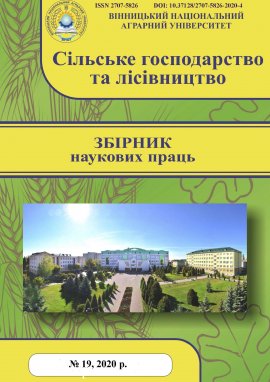
Issue №: 4 (19)
The issue of the journal deals with the study of optimization of technological methods of growing crops using of drugs of biological origin. A special role is given to the influence of perennial grasses on the improvement of soil fertility, ecological-adaptive selection, peculiarities of vegetable growing, ecology and environmental protection, introduction of ornamental plants.
EFFECT OF SOWING METHOD AND N APPLICATION ON SEED YIELD AND N USE EFFICIENCY OFWINTER OILSEED RAPE
Matsera Olha Olegivna – assistant at the chair of agriculture, soil science and agrochemistry at Vinnytsia National Agrarian University (21008, Vinnytsia, Soniachna St., 3. e-mail: matsera.olga.vnau@gmail.com).
In the conditions of the Right-Bank Forest-Steppe, the cultivation of winter rapeseed crops after winter wheat usually leads to a delay in sowing the latter and deterioration of autumn plant development. Based on data from a field experiment conducted in 2016/2017, 2017/2018 and 2018/2019, the aim of this study was to investigate how sowing delay affects seed yield, nitrogen uptake by seeds and significant efficiency of nitrogen use by winter rape plants; to check the ability of autumn and spring application of nitrogen fertilizers to compensate for the negative impact of delays in sowing crops; and estimate the minimum autumn development for optimal seed yield. To solve the set tasks, a combination of four sowing dates (from the first week of August to the third week of September) and four autumn nitrogen applications (0, 30, 60 and 90 kg / ha per year) was fixed. In each of these 16 variants, nitrogen application was performed 5 times in the spring (0/0, 40/40, 80/80, 120/120, 140/140 kg / ha, etc.) in order to estimate the individual nitrogen reaction curves. Nitrogen accumulation by aboveground mass of plants in autumn, seed yield and nitrogen uptake by seeds were determined. It was found that sowing the crop after mid-September significantly reduced yields. Application of nitrogen fertilizers in autumn in the amount of at least 30 kg / ha per year increased the yield and absorption of nitrogen seeds without any significant interaction with the sowing period and spring application of nitrogen fertilizers. Increasing the dose of spring fertilizer application to 130 kg / ha increased seed yield. Nitrogen utilization efficiency decreased with increasing application rate when winter oilseed rape plants used nitrogen applied in the fall to a lesser extent than in the spring. In order to achieve high yields, it was necessary for the above-ground mass of plants to absorb nitrogen at the level of at least 10-15 kg / ha at the end of the autumn vegetation. From an ecological point of view, the optimal autumn development of plants should be achieved by choosing an adequate sowing date, rather than using additional nitrogen in autumn.
1.Luteman, P.J.W.; Dixon, F.L. The effect of drilling date on the growth and yield of oil-seed rape (Brassica napus L.). J. Agric. Sci. 1987, 108, 195–200. [in English].
2.Sieling, K.; Böttcher, U.; Kage, H. Sowing date and N application effects on tape root and above-ground dry matter of winter oilseed rape in autumn. Eur. J. Agric. 2017, 83, 40–46. [in English].
3.Lääniste, P.; Jõudu, J.; Eremeev, V.; Mäeorg, E. Sowing date influence on winter oilseed rape overwintering in Estonia. Acta Agric. Scand. 2007, B 57, 342–348. [in English].
4.Balodis, O.; Gaile, Z.Winter oilseed rape (Brassica napus L.) autumn growth. In Proceedings of the Annual 17th International Scientific Conference Research for Rural Development, Jelgava, Latvia, 18–20 May 2011; Latvia University of Agriculture: Jelgava, Latvia; Volume 1, pp. 6–12. [in English].
5.Waalen,W.; Overgaard, S.I.; Åssveen, M.; Gusta, L.V. Winter survival of winter rapeseed and winter turnip rapeseed in field trials as explained by PPLS regression. Eur. J. Agron. 2013, 51, 81–90. [in English].
6.Uzun, B.; Zengin, Ü.; Furat, S.; Akdesir, Ö. Sowing date effects on growth, flowering, oil content and seed yield of canola cultivars. Asian J. Chem. 2009, 21, 1957–1965. [in English].
7.Scott, R.K.; Ogunremi, E.A.; Ivins, J.U.D.; Mendham, N.J. The effect of sowing date and season on growth abd yield of oilseed rape (Brassica napus). J. Agric. Sci. 1973, 81, 277–285. [in English].
8.Dejoux, J.-F.; Meynard, J.-M.; Reau, R.; Roche, R.; Saulas, P. Evaluation of environmentally-friendly crop management systems based on very early sowing dates for winter oilseed rape in France. Agronomie 2003, 23, 725–736. [in English].
9.Matsera O. Comparative evaluation of quality properties of winter rapeseed depending on the level of fertilizers and sowing date. Collection of scientific works of VNAU. Series: Agriculture and Forestry, 2020. № 16. Pp. 108-119 [in English].
10.Dospehov B. A. Methods of field experience (with basics of statistical processing of research results) 3rd ed., Revised. and ext. Moscow: Colossus, 1985. 336 p. [in Russian].
11.Ulas, A.; Behrens, T.;Wiesler, F.; Horst,W.J.; Schulte auf’m Erley, G. Does genotypic variation in nitrogen remobilisation efficiency contribute to nitrogen efficiency of winter oilseed-rape cultivars (Brassica napus L.)? Plant Soil 2013, 371, 463–471. [in English].
12.Girondé, A.; Poret, M.; Etienne, P.; Trouverie, J.; Bouchereau, A.; Le Cahérec, F.; Leport, L.; Orsel, M.; Niogret, M.-F.; Deleu, C.; et al. A profiling approach of the natural variability of foliar N remobilization at the rosette stage gives clues to understand the limiting processes involved in the low N use efficiency of winter oilseed rape. J. Exp. Bot. 2015, 66, 2461–2473. [in English].
About the journal
Cluster Agricultural and veterinary sciences (H1 Agronomy, H4 Forestry)
Name of the publication «AGRICULTURE AND FORESTRY»
The aim of the journal "Agriculture and Forestry" is to highlight the results of fundamental and applied research in the fields of agriculture and forestry, aimed at improving the efficiency of agricultural production and introducing modern technologies into farming practice.
This goal defines the main objectives:
– to ensure the creation of open information access regarding the dissemination of relevant scientific research results to: lecturers of agricultural higher education institutions, postgraduate students, doctoral candidates, research staff, and agricultural production specialists;
– to promote the development of young scientists in agricultural sciences;
– to enhance communication between experienced researchers and young scientists in agronomy and forestry;
– to facilitate the expansion of ties between Vinnytsia National Agrarian University and domestic and foreign educational institutions, scientific establishments, and their academic communities.
The scientific, production, and educational journal "Agriculture and Forestry" is a peer-reviewed open-access publication that publishes original experimental research, theoretical and practice-oriented articles within the cluster of "Agricultural and Veterinary Sciences".
The journal's subject matter covers such areas as agronomy and forestry. Publications of scientific and practical significance address the experimental foundations of agricultural and forestry sector development, innovative production technologies, and the results of fundamental and applied research aimed at increasing productivity, product quality, and the sustainable development of natural and production systems.
Publisher: Vinnytsia National Agrarian University
EDRPOU code: 00497236
Publisher's ROR:05m3ysc06
Prefix DOI: 10.37128/
Frequency is quarterly
Publication languages: (Ukrainian, English)
Media ID R30-05174.
Editor in Chief Ihor Didur
According to the order of the Ministry of Education and Science of Ukraine dated 17.03.2020 № 409. The journal Agriculture and Forestry is included in the List of scientific professional publications of Ukraine Category "B" in agricultural sciences (specialties) - 101, 201, 202, 203, 205, 206.
State registration: Decision of the National Council of Ukraine on Television and Radio Broadcasting No. 1337 and No. 1181. Media identifier – R30-05174.
Scientific journal "AGRICULTURE AND FORESTRY" was founded in 1995; it was entitled as Bulletin of Vinnytsya State Agricultural Institute.
In 2010-2014 was enritled as Collection of scientific works of Vinnytsia National Agrarian University.
It has been named as Agriculture and Forestry since 2015.
Listed in the updated list of scientific professional editions of Ukraine on agricultural sciences under the name Agriculture and Forestry (Order of the Ministry of Education and Science of Ukraine of May 16, 2016; No. 515).
Since 2015, "Agriculture and Forestry". (archive of previous issues for 2015-2019) at http://forestry.vsau.edu.ua/.
The journal “Agriculture and Forestry (ISSN: 2707-5826)” passed the evaluation process of Index Copernicus positively and is indexed in the database of ICI Journals Master List ICV for 2018, 2019, 2020, 2021, 2022, 2023, 2024 is presented in the full list of indexed journals in the Master List International List
ICI Journals Master List Value
