

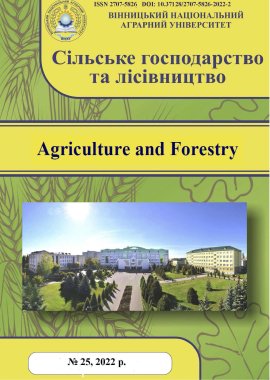
Issue №: 2 (25)
The issue of the magazine is devoted to the study of the optimization of the elements of the technology of growing agricultural crops. An important role is given to the influence of leguminous crops on improving soil fertility, adaptive breeding, mineral and foliar fertilization of agricultural crops, ecology and environmental protection, in particular, the impact of chemical treatment on the contamination of soil and grain products with pesticides, methods of combating harmful objects.
CONTENT AND RATIO OF PHOTOSYNTHETIC PIGMENTS IN STIPULES OF WINTER PEA WITH USING DIFFERENT GROWING TECHNOLOGIES
Didur Igor Nikolayevich – PhD of Agricultural Sciences, Associate Professor, Dean of the Faculty of Agronomy and Forestry of Vinnytsia National Agrarian University (21008, Vinnytsia, Soniachna Str. 3 е-mail: Didurihor@gmail.com).
Shevchuk Victoria Viсtorovna – postgraduate student of the Department of Agriculture, Soil Science and Agrochemistry of the Vinnytsia National Agrarian University (21008, Vinnytsia, Soniachna Str. 3 е-mail: Vvictoriya07@gmail.com).
The article describes the results of research on the content and ratio of photosynthetic pigments in the stipules of winter peas using different cultivation technologies. The objects of the study were winter pea plants (Pisum sativum L.) of variety NS Moroz, plant growth regulator (PGR) Endofit L1 RK, bacterial preparation Bioinoculant BTU-r, microfertilizers «LF-Bobovi» and Biobor 140. The purpose of our research was to study the formation of photosynthetic pigments of winter pea plants under the action of growth regulator Endophyte L1 RK, bacterial preparation Bioinoculant BTU-r, their complex applying and foliar treatment systems with microfertilizers «LF- Bobovi» and Biobor 140. Analysis of chlorophyll and carotenoid content in alcohol extract (96.0%) was performed using a spectrophotometer Ulab − 102UV (China) at different values of wavelength: λ = 441; λ = 649; λ = 665. The volume of the working solution was 25 ml. Calculations of these indexes were performed according to the formulas of H. K. Lichtenthaler. During the study period, the influence of plant growth regulator, bacterial preparation, and foliar fertilization on the content of chlorophyll a and b, their sum, and concentration of carotenoids in the stipules of winter pea plants were evaluated. The research results indicate the dependence of these indicators on the use of the growth regulator and the bacterial drug, as well as on foliar fertilization. It was found that the implementation of foliar treatment in the phase of 3-5 stipules and complex use (in phases 3-5 of stipules and buttons) phase with tank mixtures of micro fertilizers «LF- Bobovi» (1.5 l / ha and 2.5 l / ha) and Biobor 140 (1.0 l / ha) led to an increase of the content of chlorophyll a and b, their total amount and carotenoid content. The highest content of chlorophylls a and b, their sum, and carotenoids in the stipules of winter pea plants were in the variant with the combined use of pre-sowing seed treatment with growth regulator Endophyte L1 RK (0.01 l / t), bacterial preparation Bioinoculant BTU-r (2 l / t) and at foliar treatment with microfertilizers «LF- Bobovi» (1.5 l / ha and 2.5 l / ha) and Biobor 140 (1.0 l / ha).The search for ways and opportunities to increase the grain yield of winter pea varieties Moroz due to the introduction of new technological methods of its cultivation remains relevant. A possible solution to the problem of improving the productivity of winter peas is the use of different mechanisms of action of plant growth regulators, inoculation with symbiotic microorganisms, and foliar feeding with tank mixtures of chelated microfertilizers.
1.Chorna V.M. (2018). Osoblyvosti formuvannia produktyvnosti horokhu posivnoho za dii retardantu khlormekvatkhloryd [Peculiarities of pea productivity productivity under the action of retardant chlormequatchloride]. «Novitni tekhnolohii vyroshchuvannia silskohospodarskykh kultur»: VI Mizhnarodnoi naukovo-praktychnoi konferentsii molodykh vchenykh (29 bereznia 2018 r., m. Kyiv) – "The latest technologies for growing crops": VI International Scientific and Practical Conference of Young Scientists (March 29, 2018, Kyiv). Vinnytsia: Nilan-LTD. 159–160. [in Ukrainian].
2.França S.C., Tigre R.C., Oliveira M.T., Sacilot M., Pereira E.C. (2013). Spectrophotometric determination of chloroplastidic pigments in aceton, ethanol and dimethylsulphoxide. R. Bras. Bioci. (Brazilian Journal of Biosciences). Vol. 11 (1). P. 52–58. [in English].
3.Huliaiev B.I. (2001). Ekofiziolohiia fotosyntezu: dosiahnennia, stan ta perspektyvy doslidzhen [Ecophysiology of photosynthesis: achievements, status and prospects of research]. Fiziolohiia roslyn v Ukraini na mezhi tysiacholit – Plant physiology in Ukraine at the turn of the millennium. 1. Р. 60–74. [in Ukrainian].
4.Kots S.Ia., Kirizii D.A., Pavlyshche A.V. (2018). Vzaiemodiia protsesiv asymiliatsii azotu i vuhletsiu u roslyn soi, obroblenykh rechovynamy iz funhitsydnoiu aktyvnistiu ta bulbochkovymy bakteriiamy, inkubovanymy z lektynom [Interaction of nitrogen and carbon assimilation processes in soybean plants treated with substances with fungicidal activity and nodule bacteria incubated with lectin]. Dopov. Nats. akad. nauk Ukr. – Reports of the Nat. acad. Science Ukr. 7. 88–95. [in Ukrainian].
5.Mostoviak I.I., Kravchenko O.V. (2018). Formuvannia fotosyntetychnoi produktyvnosti posiviv soi za vykorystannia riznykh vydiv funhitsydiv ta inokulianta u Pravoberezhnomu Lisostepu Ukrainy [Formation of photosynthetic productivity of soybean crops using different types of fungicides and inoculants in the Right Bank Forest-Steppe of Ukraine]. Visnyk Umanskoho natsionalnoho universytetu sadivnytstva – Bulletin of Uman National University of Horticulture. 2. 21–24. [in Ukrainian].
6.Karpenko V.P., Ivasiuk Yu.I., Prytuliak R.M., Cherneha A.O. (2018). Formuvannia lystkovoi poverkhni roslyn soi i sumy khlorofiliv za intehrovanoi dii herbitsydu ta biolohichnykh preparativ [Formation of the leaf surface of soybean plants and the amount of chlorophyll by the integrated action of herbicides and biological products]. Ahrobiolohiia – Agrobiology. 1. 43–50. [in Ukrainian].
7.Ren B., Zhang J., Dong S., Liu P., Zhea B. (2017). Begulations of 6-benzyladenine (6-BA) on leaf ultrastructure and photosynthetic characteristics of waterlogged summer maize. J. of Plant Grownh Regul. 36 (3). P. 734–754. [in English].
8.Perelik pestytsydiv ta ahrokhimikativ, dozvolenykh do vykorystannia v Ukraini (2020). [List of pesticides and agrochemicals approved for use in Ukraine]. K.: Yunivest media. [in Ukrainian].
9.Didora V.H., Smahlii O.F., Ermantraut E.R. ta in. (2013). Metodyka naukovykh doslidzhen v ahronomii: navch. posib. [Methods of scientific research in agronomy: a textbook]. K.: «Tsentr uchbovoi literatury». [in Ukrainian].
10.Lichtenthaler H.K. (1987). Chlorophylls and Carotenoids: Pigments of Photosynthetic Biomembranes. Methods in Enzymology. 148. 350–382. [in English].
11.Tomashevskyi O.V., Rysikov V.P. (2015). Kompiuterni tekhnolohii statystychnoi obrobky danykh: navchalnyi posibnyk [Computer technologies of statistical data processing: a textbook]. Zaporizhzhia: Zaporizkyi natsionalnyi tekhnichnyi universytet. [in Ukrainian].
About the journal
Cluster Agricultural and veterinary sciences (H1 Agronomy, H4 Forestry)
Name of the publication «AGRICULTURE AND FORESTRY»
The aim of the journal "Agriculture and Forestry" is to highlight the results of fundamental and applied research in the fields of agriculture and forestry, aimed at improving the efficiency of agricultural production and introducing modern technologies into farming practice.
This goal defines the main objectives:
– to ensure the creation of open information access regarding the dissemination of relevant scientific research results to: lecturers of agricultural higher education institutions, postgraduate students, doctoral candidates, research staff, and agricultural production specialists;
– to promote the development of young scientists in agricultural sciences;
– to enhance communication between experienced researchers and young scientists in agronomy and forestry;
– to facilitate the expansion of ties between Vinnytsia National Agrarian University and domestic and foreign educational institutions, scientific establishments, and their academic communities.
The scientific, production, and educational journal "Agriculture and Forestry" is a peer-reviewed open-access publication that publishes original experimental research, theoretical and practice-oriented articles within the cluster of "Agricultural and Veterinary Sciences".
The journal's subject matter covers such areas as agronomy and forestry. Publications of scientific and practical significance address the experimental foundations of agricultural and forestry sector development, innovative production technologies, and the results of fundamental and applied research aimed at increasing productivity, product quality, and the sustainable development of natural and production systems.
Publisher: Vinnytsia National Agrarian University
EDRPOU code: 00497236
Publisher's ROR:05m3ysc06
Prefix DOI: 10.37128/
Frequency is quarterly
Publication languages: (Ukrainian, English)
Media ID R30-05174.
Editor in Chief Ihor Didur
According to the order of the Ministry of Education and Science of Ukraine dated 17.03.2020 № 409. The journal Agriculture and Forestry is included in the List of scientific professional publications of Ukraine Category "B" in agricultural sciences (specialties) - 101, 201, 202, 203, 205, 206.
State registration: Decision of the National Council of Ukraine on Television and Radio Broadcasting No. 1337 and No. 1181. Media identifier – R30-05174.
Scientific journal "AGRICULTURE AND FORESTRY" was founded in 1995; it was entitled as Bulletin of Vinnytsya State Agricultural Institute.
In 2010-2014 was enritled as Collection of scientific works of Vinnytsia National Agrarian University.
It has been named as Agriculture and Forestry since 2015.
Listed in the updated list of scientific professional editions of Ukraine on agricultural sciences under the name Agriculture and Forestry (Order of the Ministry of Education and Science of Ukraine of May 16, 2016; No. 515).
Since 2015, "Agriculture and Forestry". (archive of previous issues for 2015-2019) at http://forestry.vsau.edu.ua/.
The journal “Agriculture and Forestry (ISSN: 2707-5826)” passed the evaluation process of Index Copernicus positively and is indexed in the database of ICI Journals Master List ICV for 2018, 2019, 2020, 2021, 2022, 2023, 2024 is presented in the full list of indexed journals in the Master List International List
ICI Journals Master List Value
