

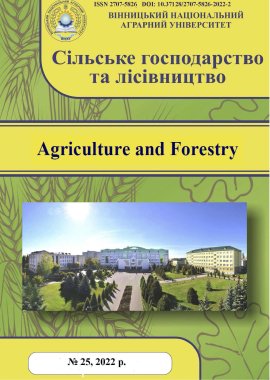
Issue №: 2 (25)
The issue of the magazine is devoted to the study of the optimization of the elements of the technology of growing agricultural crops. An important role is given to the influence of leguminous crops on improving soil fertility, adaptive breeding, mineral and foliar fertilization of agricultural crops, ecology and environmental protection, in particular, the impact of chemical treatment on the contamination of soil and grain products with pesticides, methods of combating harmful objects.
ASSESSMENT OF VARIETY SAMPLES OF COMMON BEANS ACCORDING TO THE VARIABILITY OF SIGNS
Mazur Olena Vasylivna – Candidate of Agricultural Sciences, Senior Lecturer of the Department of botany, genetics and plant protection, Vinnytsia National Agrarian University (21008, Vinnytsia, Soniachna Str. 3).
In the course of research, varieties of common bean were selected, which were distinguished by stable indicators of the duration of the growing season, which depended to a lesser extent on the hydrothermal regime of the conditions of the years of research. This will contribute to the formation of a stable growing season in dry and optimal years of research in terms of moisture supply. The highest coefficients of repeatability were noted in varieties of common bean: UD0301786 - 0.98, with a coefficient of variation (V) - 1%; UD0302656 – 0.97, coefficient of variation – 1%; UD0300495 – 0.95, coefficient of variation – 1.45%; UD0302223 – 0.95, and the coefficient of variation – 1.34%; UD0302398 – 0.95, coefficient of variation – 1.33%; UD0300019 is 0.95, and the coefficient of variation is 1.3%.
The weight of 1,000 grains affects the grain productivity, while, as already noted, varieties with low variability of the weight of 1,000 grains belong to drought-resistant ones. Higher values of the mass of 1000 grains compared to the standard and, at the same time, lower variability according to statistical indicators were identified in the variety samples: UD0300577 – 284.7 g, repeatability coefficient – 0.9, variation coefficient – 7%; UD0303753 – 274.5 g, repeatability coefficient – 0.9, coefficient of variation – 7.1%; UD0300004 – 265.4 g, repeatability coefficient – 0.86, coefficient of variation – 9%; UD0303398 – 243.4 g, repeatability coefficient – 0.91, coefficient of variation – 6.0%; UD0302256 – 234.6 g, repeatability coefficient – 0.9, coefficient of variation – 8.4%; Yield is a summary feature, the level and stability of which are affected by resistance to diseases and pests, drought resistance, heat resistance, cold resistance, and manufacturability.Higher yield and lower variability compared to the standard was noted only in variety samples: UD0300577 – 333.0 g/m², repeatability coefficient – 0.98, and variation coefficient – 4.5%; UD0303753 is 329.0 g/m², repeatability is 0.97, and coefficient of variation is 7.1%. The vast majority of variety samples were characterized by higher variability in the level of productivity, this is due to the influence of adverse growing conditions that cause stress.
1.Glyavy`n A.V. (2012). Osobly`vosti proyavu morfobiologichny`x oznak u kvasoli zvy`chajnoyi (Phaseolus Vulgaris L.) ta yix vy`kory`stannya v selekciyi ta derzhavnij eksperty`zi [Peculiarities of the manifestation of morphobiological traits in common bean (Phaseolus Vulgaris L.) and their use in breeding and state expertise]. avtoref. dy`s. … kand. s.-g. nauk : specz. 06.01.05. Dniprpetrovs`k. [in Ukrainian].
2.Ivanyuk S.V., Glyavy`n A.V. (2012). Vy`kory`stannya koeficiyenta povtoryuvanosti dlya xaraktery`sty`ky` kil`kisny`x oznak ta indeksiv genoty`piv kvasoli zvy`chajnoyi [Using the repeatability coefficient to characterize quantitative traits and genotype indices of common bean]. Kormy` i kormovy`robny`cztvo − Fodder and fodder production. Issue. 73. 97–101. [in Ukrainian].
3.Mazur O.V. (2020). Identyfikaciya oznak zernobobovy`x rosly`n za selekcijny`my` indeksamy` [Identification of features of leguminous plants by breeding indices]. Sil`s`ke gospodarstvo ta lisivny`cztvo −Agriculture and forestry. № 16. 119-133. [in Ukrainian].
4.Metody`ka derzhavnogo sortovy`probuvannya sil`s`kogospodars`ky`x kultur (2000). [Methodology of state variety testing of agricultural crops]. K. Issue. 1. [in Ukrainian].
5.Metody`ka derzhavnogo sortovy`probuvannya sil`s`kogospodars`ky`x kultur (2001) [Methodology of state variety testing of agricultural crops]. K. Issue. 2. [in Ukrainian].
6.Koby`zyeva L.N. (2016). Metody`chni rekomendaciyi z vy`vchennya genety`chny`x resursiv zernobobovy`x kul`tur [Methodological recommendations for the study of genetic resources of leguminous crops]. NAAN, Insty`tut rosly`nny`cztva im.V.Ya. Yur'yeva. Xarkiv : Stil`-Izdat. [in Ukrainian].
7.Korniyenko S.I., Gorova T.K., Sajko O.Yu. (2014). Staty`sty`chni pokazny`ky` formuvannya faz vegetacijnogo periodu kvasoli zvy`chajnoyi v adapty`vnij selekciyi [Statistical indicators of the formation of phases of the growing season of common beans in adaptive breeding]. Visn. CzNZ APV Xarkiv. obl− Visn. Kharkiv APV railway station. region. Issue. 17. 104–111. [in Ukrainian].
8.Sichkar V.I., Lavrova G.D., Ganzhelo O.I. (2014). Urozhajnist` i yakist` nasinnya shy`rokoadaptovany`x sortiv soyi [Yield and seed quality of widely adapted soybean varieties]. Zbirny`k naukovy`x pracz` Selekcijno-genety`chnogo insty`tutu – Collection of scientific works of the Breeding and Genetics Institute. Issue 23. 72-87. [in Ukrainian].
About the journal
Cluster Agricultural and veterinary sciences (H1 Agronomy, H4 Forestry)
Name of the publication «AGRICULTURE AND FORESTRY»
The aim of the journal "Agriculture and Forestry" is to highlight the results of fundamental and applied research in the fields of agriculture and forestry, aimed at improving the efficiency of agricultural production and introducing modern technologies into farming practice.
This goal defines the main objectives:
– to ensure the creation of open information access regarding the dissemination of relevant scientific research results to: lecturers of agricultural higher education institutions, postgraduate students, doctoral candidates, research staff, and agricultural production specialists;
– to promote the development of young scientists in agricultural sciences;
– to enhance communication between experienced researchers and young scientists in agronomy and forestry;
– to facilitate the expansion of ties between Vinnytsia National Agrarian University and domestic and foreign educational institutions, scientific establishments, and their academic communities.
The scientific, production, and educational journal "Agriculture and Forestry" is a peer-reviewed open-access publication that publishes original experimental research, theoretical and practice-oriented articles within the cluster of "Agricultural and Veterinary Sciences".
The journal's subject matter covers such areas as agronomy and forestry. Publications of scientific and practical significance address the experimental foundations of agricultural and forestry sector development, innovative production technologies, and the results of fundamental and applied research aimed at increasing productivity, product quality, and the sustainable development of natural and production systems.
Publisher: Vinnytsia National Agrarian University
EDRPOU code: 00497236
Publisher's ROR:05m3ysc06
Prefix DOI: 10.37128/
Frequency is quarterly
Publication languages: (Ukrainian, English)
Media ID R30-05174.
Editor in Chief Ihor Didur
According to the order of the Ministry of Education and Science of Ukraine dated 17.03.2020 № 409. The journal Agriculture and Forestry is included in the List of scientific professional publications of Ukraine Category "B" in agricultural sciences (specialties) - 101, 201, 202, 203, 205, 206.
State registration: Decision of the National Council of Ukraine on Television and Radio Broadcasting No. 1337 and No. 1181. Media identifier – R30-05174.
Scientific journal "AGRICULTURE AND FORESTRY" was founded in 1995; it was entitled as Bulletin of Vinnytsya State Agricultural Institute.
In 2010-2014 was enritled as Collection of scientific works of Vinnytsia National Agrarian University.
It has been named as Agriculture and Forestry since 2015.
Listed in the updated list of scientific professional editions of Ukraine on agricultural sciences under the name Agriculture and Forestry (Order of the Ministry of Education and Science of Ukraine of May 16, 2016; No. 515).
Since 2015, "Agriculture and Forestry". (archive of previous issues for 2015-2019) at http://forestry.vsau.edu.ua/.
The journal “Agriculture and Forestry (ISSN: 2707-5826)” passed the evaluation process of Index Copernicus positively and is indexed in the database of ICI Journals Master List ICV for 2018, 2019, 2020, 2021, 2022, 2023, 2024 is presented in the full list of indexed journals in the Master List International List
ICI Journals Master List Value
