

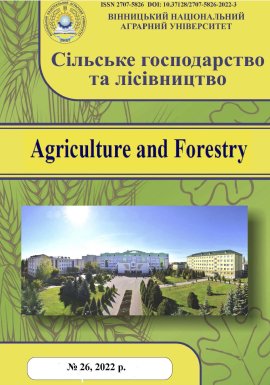
Issue №: 3 (26)
The issue of the magazine is devoted to the study of the optimization of the elements of the technology of growing agricultural crops. An important role is given to the influence of leguminous crops on improving soil fertility, adaptive breeding, mineral and foliar fertilization of agricultural crops, ecology and environmental protection, in particular, the impact of chemical treatment on the contamination of soil and grain products with pesticides, methods of combating harmful objects.
SCIENTIFIC FOUNDAMENTALS OF SYNANTHROPIC FLORISTICS IN FORESTRY
Kiselyov Yuriy Oleksandrovych - Doctor of Geographical Sciences, Professor, Professor of the Department of Geodesy, Cartography and Cadastre of the Uman National University of Horticulture (Uman, 1 Instytutska St., 20300, email: (kyseljov@ukr.net)
Chernysh Vitalii Ivanovych - graduate student of the Forestry Department of the Uman National University of Horticulture (20300, Uman, 1 Instytutska St., email: (vitaliy_chernish@ukr.net)
The publication characterizes basic principles of the scientific direction, which for the past hundred years has been shaped on the border of botany, ecology, forestry and constructive geography and study the flora that benefits from anthropogenic intervention in life of phytocenoses - synanthropic floristics. The object-subject sphere of synanthropic floristics as a separate scientific discipline is formulated. The interdisciplinary connections of synanthropic floristics with other branches of natural sciences, including geography, ecology, forestry, are highlighted. The importance of some concepts of modern natural science - sustainable development, noosphere, anthropogenic landscape - in the development of research on synanthropic flora is emphasized. The content of the most important studies during the formation of synanthropic floristics is outlined, which allowed to distinguish three stages in its development. It is noted that at the first stage, basically, the most important scientific principles of research of synanthropic flora were formed. The second stage is related to the improvement of theoretical foundations and the active development of regional research in the field of synanthropic floristics. The third stage is marked by in-depth regional studies of synanthropic floroelements of phytocenoses. Emphasis is placed on the significance of the works of the most prominent scientists in the field of synanthropic floristics - A. Tellung, J. Kornaś, V. Protopopova and others. Particular attention is paid to history of study of synanthropic flora of Ukraine since the 1920s. It is noted that synanthropic floristics uses a wide range of methods, including general science (dialectics, system, logic), interdisciplinary (historical and geographical) and special (Brown-Blanquet method, syntaxonomic analysis). The conceptual and terminological apparatus of the characterized discipline is given. Depending on the origin and content of the concept and terms are grouped into several groups that can develop into conceptual and terminological systems. In particular, such systems are formed around the basic concepts of "synanthropization", "flora", "phytocenosis", "landscape" and so on. It is noted that the synthetic nature of the discipline determines its significant prospects in the context of the development of modern natural science
1. Denysyk, H.I. (1998). Antropohenni landshafty Pravoberezhnoii Ukraiiny [The anthropogenic landscapes of the Right-Bank Ukraine]. Vinnytsia: Arbat [in Ukrainian].
2. Dziuba, T.P. & Dubyna, M. V. (2018). Klasyfikatsiia roslynnosti Ukraiiny: problemy ta perspektyvy [The classification of the vegetation of Ukraine: problems and perspectives]. Classification of the vegetation and biotopes of Ukraine: Proceedings of the 3-rd scientific and practical conference(Kyiv, April, 19-21, 2018). Under the redaction by Ya. P. Didukh, M. V. Dubyna. Kyiv. P. 116–123 [in Ukrainian].
3. Faliński, J.B. (ed.) (1968). Synantropizacja szaty roślinnej. I. Neofityzm i apofityzm w szacie roślinnej Polski [Synanthropization of plant cover. I. Neophytism and apophytism in the flora of Poland]. Mater. Zakladu Fitosocjol. Stosowanej Uniw. Warszawsk. 25: 1–229 [in Polish].
4. Holubets, M.A. (2004). Biotsenoz [Biocoenosis]. The encyclopedia of the modern Ukraine, vol. 1. P. 181–182 [in Ukrainian].
5. Honcharenko, I.V. & Didukh, Ya.P. (2003). Metod Braun-Blanquet: istoriia i suchasni tendentsii [The method of Braun-Blanquet; history and modern trends]. Scientific notes of the National university “Kyiv Mohyla academy”, Vol. 21. Biology and Ecology. P. 89–92 [in Ukrainian].
6. Kornaś J. (1968). A geographical-historical classification of synanthropic plants. Mater. Zakladu Fitosocjol. Stosowanej Uniw. Warszawsk. 25: 33–4122. [in English].
7. Kotov, M.I. (1929). Adventyvni roslyny USRR [Alien plants of the USRR]. Znannia, №2. P. 8–32 [in Ukrainian].
8. Kucher O.O. (2015). Transformer species in the flora of the Starobilsk grass-meadow steppe (Ukraine). Biodiv. Res. Conserv., 40. P. 49-59. [in English].
9. Kucheriavyi, V.P. (2010). Zahalna ekolohiia [General ecology]. Lviv: Svit [in Ukrainian].
10. Odum, E.P. (1953). Fundamentals of ecology. Philadelphia: Saunders.
11. Protopopova, V.V. (1973). Adventyvni roslyny lisostepu i stepu Ukraiiny [Adventitious plants of the forest-and-steppe and steppe zones of Ukraine]. Kyiv, Naukova dumka [in Ukrainian].
12. Protopopova, V.V. & Shevera, M.V. (2001). Adventyvni roslyny [Alien plants]. The encyclopedia of the modern Ukraine, vol. 1. P. 181–182 [in Ukrainian].
13. Lanovenko O.H., Ostapishyna O.O. Synanthropus (species) (2013). A dictionary-directory in ecology. Ed. P. 160 [in Ukrainian].
14. Shevchuk, L.T. (2007). Sotsialna heohrafiia [Social geography]. Kyiv: Znannia [in Ukrainian].
15. Thellung A. (1915). Pflanzenwanderungen unter dem Einfluss des Menschen [Plant travels under the influence of man]. Beibl. Englers Bot. Jahrb. 53, Beibl. Nr. 116: 37–66 [in German].
16. Yemelianov, I.H. (2004). Biotop [Biotope]. The encyclopedia of the modern Ukraine, vol. 1. P. 181–182 [in Ukrainian].
17. Yehorova, T.M. (2009). Landshaftna ekolohiia Ukraiiny [Landscape ecology of Ukraine]. Kamianets-Podilskyi: Zvoleiko D. H. [in Ukrainian].
About the journal
Cluster Agricultural and veterinary sciences (H1 Agronomy, H2 Animal Science, H3 Landscape Gardening, H4 Forestry, H6 Veterinary Medicine, and H7 Agricultural Engineering)
Name of the publication «AGRICULTURE AND FORESTRY»
The scientific-production and educational journal "Agriculture and Forestry" is an open-access, peer-reviewed publication that features original experimental research, as well as theoretical and practice-oriented articles within the "Agricultural and Veterinary Sciences" cluster.
The scope of the journal covers fields such as agronomy, forestry and horticulture, animal husbandry, veterinary medicine, and agricultural engineering. The publications, which hold both scientific and practical significance, highlight the experimental foundations for developing the agricultural and forestry sectors, innovative production technologies, and the results of fundamental and applied research aimed at increasing productivity, product quality, and the sustainable development of natural and production systems.
Purpose of the Scientific Journal. The purpose of the scientific journal "Agriculture and Forestry" is to present the results of fundamental and applied research in the fields of agricultural sciences and forestry aimed at improving the efficiency of agricultural production, and implementing modern technologies into practical management activities.
This purpose determines the main objectives:
– to ensure open informational access to the results of relevant scientific research for lecturers of agricultural higher education institutions, PhD students, doctoral candidates, researchers, and specialists in agricultural production;
– to promote the development of young scientists in the fields of agricultural and veterinary sciences;
– to intensify communication between experienced researchers and young scientists in agronomy, animal science, landscape gardening, forestry, veterinary medicine, and agricultural engineering;
– to promote the expansion of cooperation between Vinnytsia National Agrarian University and domestic and international educational institutions, research organizations, and their academic communities.
Publisher: Vinnytsia National Agrarian University
EDRPOU code: 00497236
Publisher's ROR:05m3ysc06
Prefix DOI: 10.37128/
Frequency is quarterly
Publication languages: (Ukrainian, English)
Media ID R30-05174.
Editor in Chief Ihor Didur
According to the order of the Ministry of Education and Science of Ukraine dated 17.03.2020 № 409. The journal Agriculture and Forestry is included in the List of scientific professional publications of Ukraine Category "B" in agricultural sciences (specialties) - 101, 201, 202, 203, 205, 206.
State registration: Decision of the National Council of Ukraine on Television and Radio Broadcasting No. 1337 and No. 1181. Media identifier – R30-05174.
Scientific journal "AGRICULTURE AND FORESTRY" was founded in 1995; it was entitled as Bulletin of Vinnytsya State Agricultural Institute.
In 2010-2014 was enritled as Collection of scientific works of Vinnytsia National Agrarian University.
It has been named as Agriculture and Forestry since 2015.
Listed in the updated list of scientific professional editions of Ukraine on agricultural sciences under the name Agriculture and Forestry (Order of the Ministry of Education and Science of Ukraine of May 16, 2016; No. 515).
Since 2015, "Agriculture and Forestry". (archive of previous issues for 2015-2019) at http://forestry.vsau.edu.ua/.
The journal “Agriculture and Forestry (ISSN: 2707-5826)” passed the evaluation process of Index Copernicus positively and is indexed in the database of ICI Journals Master List ICV for 2018, 2019, 2020, 2021, 2022, 2023, 2024 is presented in the full list of indexed journals in the Master List International List
ICI Journals Master List Value
