

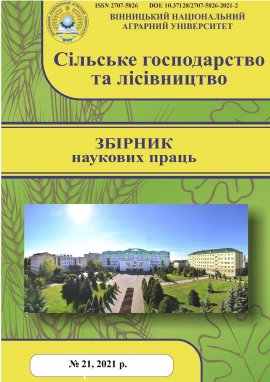
Issue №: 2 (21)
Випуск журнала присвячено вивченню оптимізації технологічних прийомів вирощування сільськогосподарських культур. Розглянуто важливість впливу бобових культур на покращення родючості грунту, екології та охорони навколишнього середовища, методам боротьби із шкодочинними об'єктами, озеленення територій, селекції та насінництва.
ECOLOGICAL EFFICIENCY OF SURFACE WATER PURIFICATION BY THE METHOD OF STRUCTURING CONTAMINATED BY THE ACTIVITIES OF THE AGROINDUSTRIAL COMPLEX
Tkachuk Olexander Petrovich, Doctor of Agricultural Sciences, Associate Professor of the Department of Ecology and Environmental Protection of Vinnitsa National Agrarian University. (Soniachna st. 3, Vinnitsa city, 21008. e-mail: tkachukop@ukr.net).
Demchuk Olga Andreevna, graduate student of Vinnytsia National Agrarian University. (Soniachna st. 3, Vinnytsia, 21008. e-mail: kush.o.a@ukr.net).
Biochemical oxygen consumption for five days in water without structuring is 5.0 mgO2/dm3, which is 1.7 MPC. With the structuring of water, the indicator of biochemical oxygen consumption decreased by 20%, to 4.0 mgO2/dm3, which was 1.3 MPC. The pH of water without structuring was 7.27, and in structured water it decreased by 0.7% or by 0.5 pH to 7.22 pH. The concentration of suspended solids in unstructured water was 180.0 mg/dm3, while the maximum permissible concentration (MPC) of suspended solids in surface waters was 15 mg/dm3. This indicates a strong pollution of the reservoir with suspended substances, 12 times higher than the permissible limits. With the structuring of water, the concentration of suspended solids decreased by 50.6%, to 89.0 mg/dm3, but this was 5.9 times higher than the MPC. The actual concentration of chlorides in water without structuring was 108.92 mg/dm3, and with structuring of water, the concentration of chlorides increased by 14.7%, to a level of 127.64 mg/dm3. In comparison with the maximum permissible concentration of chlorides in the reservoir, in both cases the actual chloride content was significantly less than the MPC and amounted to 0.3 and 0.4 MPC, respectively. The content of ammonium nitrogen in the reservoir without structuring was 6.63 mg/dm3, which was 4.4 times higher than the permissible limits. The structuring of water contributed to a decrease in the concentration of ammonium nitrogen in surface waters by 16%, to 5.57 mg/dm3. This concentration of ammoniacal nitrogen in water also exceeded the maximum permissible value by 3.7 times. The nitrate content in water without structuring was 5.18 mg/dm3. The structuring of water contributed to a decrease in the concentration of nitrates by 24.7%, to a level of 3.9 mg/dm3. This concentration of nitrates in the reservoir is significantly lower than the permissible limits and amounts to 0.52 and 0.39 MPC, respectively. The actual concentration of surfactants in the reservoir without structuring was 0.01 mg/dm3. After structuring, the concentration of surfactants in water was less than 0.01 mg/dm3, which is less than the technical sensitivity of the measuring device. Therefore, the ecological efficiency of structuring water to reduce the concentration of synthetic surfactants is more than 10%. Since the maximum permissible concentration of synthetic surfactants in water bodies is 0.2 mg/dm3, their actual concentration was much less than this indicator. Permanganate oxidizability of water without its structuring was 10.67 mgO2/dm3. With the structuring of water, permanganate oxidation decreased by 27.6% and amounted to 7.73 mgO2/dm3. Without structuring water, the permanganate oxidizability was 1.1 MPC, which was more than the permissible level, and when using a structurant, it was 0.8 MPC, which ensures acceptable limits. The transparency of the water without structuring was 2.5 cm. The structuring of the water led to an increase in the transparency of the reservoir by 44.4%, up to 4.5 cm. The minimum permissible transparency of surface waters should be 10 cm. This indicates that the water from both experimental variants is very contaminated with an excess of the permissible limits by 4 and 2.2 times, respectively.
1.Dobryansʹka T.I. (2016). Mekhanizmy zabezpechennya staloho rozvytku vodohospodarsʹkoho kompleksu Ukrayiny [Mechanisms for ensuring sustainable development of the water management complex of Ukraine]. dys. kand. ekon. nauk: 08.00.03. DU «Instytut ekonomiky pryrodokorystuvannya ta staloho rozvytku Natsionalʹnoyi akademiyi nauk Ukrayiny» – dis. сand. econ. science: 08.00.03. SI «Institute of Economics of Nature Management and Sustainable Development of the National Academy of Sciences of Ukraine». Kyiv. [in Ukrainian].
2.Nester A.A., Korchyk N.M., Baran B.A. (2008). Stichni vody pidpryyemstv ta yikh ochyshchennya [Wastewater from enterprises and their treatment]. мonohrafiya – a monograph. Khmelnytsky. [in Ukrainian].
3.Nadtochiy P.P., Myslyva T.M. (2007). Okhorona ta ratsionalʹne vykorystannya pryrodnykh resursiv i rekulʹtyvatsiya zemelʹ [Protection and rational use of natural resources and land reclamation]. navch. рosibnyk – textbook. manual. Zhytomyr: DAEU. [in Ukrainian].
4.Zapolʹsʹkyy A.K. (2005). Ekolohizatsiya kharchovykh vyrobnytstv [Greening of food production]. рidruchnyk – a textbook. K.: Higher school. [in Ukrainian].
5.Perle M., Kimchie S., Shelef G. (1995). Dynamic modeling of the pH influence of the anaerobic degradation of dairy waste-waste. Water Research. V. 29. № 6. P. 1549–1554. [in England].
6.Krivoshein D.A., Kukin P.P., Lapin V.L. (2003). Inzhenernaya zashchita poverkhnostnykh vod ot promyshlennykh stokov [Engineering protection of surface waters from industrial effluents]. ucheb. posobiye – textbook. allowance. M.: Higher school. [in Russian].
7.Karanov YU., Koshelʹ M., Dobrylovsʹkyy B., Bashmakova S. (2000). Ochyshchennya stichnykh vod drizhdzhovykh zavodiv [Wastewater treatment of yeast plants]. Kharchova i pererobna promyslovistʹ – Food and processing industry. № 7. 22–23. [in Ukrainian].
8.Krasinʹko V.O., Teterina S.M., Skokun T.M. (2012). Shlyakhy intensyfikatsiyi ochyshchennya stichnykh vod kharchovykh vyrobnytstv vid azotovmisnykh spoluk ta saponiniv [Ways to intensify wastewater treatment of food production from nitrogen-containing compounds and saponins]. Ekonomika. Ekolohiya. Upravlinnya – Economy. Ecology. Management. № 1. 157–162. [in Ukrainian].
9.Kuryk M.V., Nikitenko A.M. (2000). Bioenerhoinformatsiyni vlastyvosti vody [Bioenergy information properties of water]. Visnyk Bilotserkivsʹkoho derzhavnoho ahrarnoho universytetu – Bulletin of Bila Tserkva State Agrarian University. Vоl. 2. 156–159. [in Ukrainian].
10.Serebryakov R.A., Stepanov A.P. (2013). Polucheniye strukturirovannoy vody i yeyo ispol'zovaniye v tekhnologiyakh sel'skogo khozyaystva [Receiving structured water and its use in agricultural technologies]. Al'ternativnaya energetika i ekologiya – Alternative energy and ecology. № 7. P. 111–116. [in Russian].
11.Havrykov YU.S. (2018). Reyestr richok Vinnytsʹkoyi oblasti [Register of rivers of Vinnytsia region]. dovidkovyy posibnyk – reference guide. Vinnytsia: BUVR of the Southern Bug River. [in Ukrainian].
12.Voda pytna (2014). Vymohy ta metody kontrolyuvannya yakosti [Drinking water. Requirements and methods of quality control]. DSTU 7525:2014. Natsionalʹnyy standart Ukrayiny – National standard of Ukraine. Kyiv: Ministry of Economic Development of Ukraine. [in Ukrainian].
About the journal
Cluster Agricultural and veterinary sciences (H1 Agronomy, H2 Animal Science, H3 Landscape Gardening, H4 Forestry, H6 Veterinary Medicine, and H7 Agricultural Engineering)
Name of the publication «AGRICULTURE AND FORESTRY»
The scientific-production and educational journal "Agriculture and Forestry" is an open-access, peer-reviewed publication that features original experimental research, as well as theoretical and practice-oriented articles within the "Agricultural and Veterinary Sciences" cluster.
The scope of the journal covers fields such as agronomy, forestry and horticulture, animal husbandry, veterinary medicine, and agricultural engineering. The publications, which hold both scientific and practical significance, highlight the experimental foundations for developing the agricultural and forestry sectors, innovative production technologies, and the results of fundamental and applied research aimed at increasing productivity, product quality, and the sustainable development of natural and production systems.
Purpose of the Scientific Journal. The purpose of the scientific journal "Agriculture and Forestry" is to present the results of fundamental and applied research in the fields of agricultural sciences and forestry aimed at improving the efficiency of agricultural production, and implementing modern technologies into practical management activities.
This purpose determines the main objectives:
– to ensure open informational access to the results of relevant scientific research for lecturers of agricultural higher education institutions, PhD students, doctoral candidates, researchers, and specialists in agricultural production;
– to promote the development of young scientists in the fields of agricultural and veterinary sciences;
– to intensify communication between experienced researchers and young scientists in agronomy, animal science, landscape gardening, forestry, veterinary medicine, and agricultural engineering;
– to promote the expansion of cooperation between Vinnytsia National Agrarian University and domestic and international educational institutions, research organizations, and their academic communities.
Publisher: Vinnytsia National Agrarian University
EDRPOU code: 00497236
Publisher's ROR:05m3ysc06
Prefix DOI: 10.37128/
Frequency is quarterly
Publication languages: (Ukrainian, English)
Media ID R30-05174.
Editor in Chief Ihor Didur
According to the order of the Ministry of Education and Science of Ukraine dated 17.03.2020 № 409. The journal Agriculture and Forestry is included in the List of scientific professional publications of Ukraine Category "B" in agricultural sciences (specialties) - 101, 201, 202, 203, 205, 206.
State registration: Decision of the National Council of Ukraine on Television and Radio Broadcasting No. 1337 and No. 1181. Media identifier – R30-05174.
Scientific journal "AGRICULTURE AND FORESTRY" was founded in 1995; it was entitled as Bulletin of Vinnytsya State Agricultural Institute.
In 2010-2014 was enritled as Collection of scientific works of Vinnytsia National Agrarian University.
It has been named as Agriculture and Forestry since 2015.
Listed in the updated list of scientific professional editions of Ukraine on agricultural sciences under the name Agriculture and Forestry (Order of the Ministry of Education and Science of Ukraine of May 16, 2016; No. 515).
Since 2015, "Agriculture and Forestry". (archive of previous issues for 2015-2019) at http://forestry.vsau.edu.ua/.
The journal “Agriculture and Forestry (ISSN: 2707-5826)” passed the evaluation process of Index Copernicus positively and is indexed in the database of ICI Journals Master List ICV for 2018, 2019, 2020, 2021, 2022, 2023, 2024 is presented in the full list of indexed journals in the Master List International List
ICI Journals Master List Value
